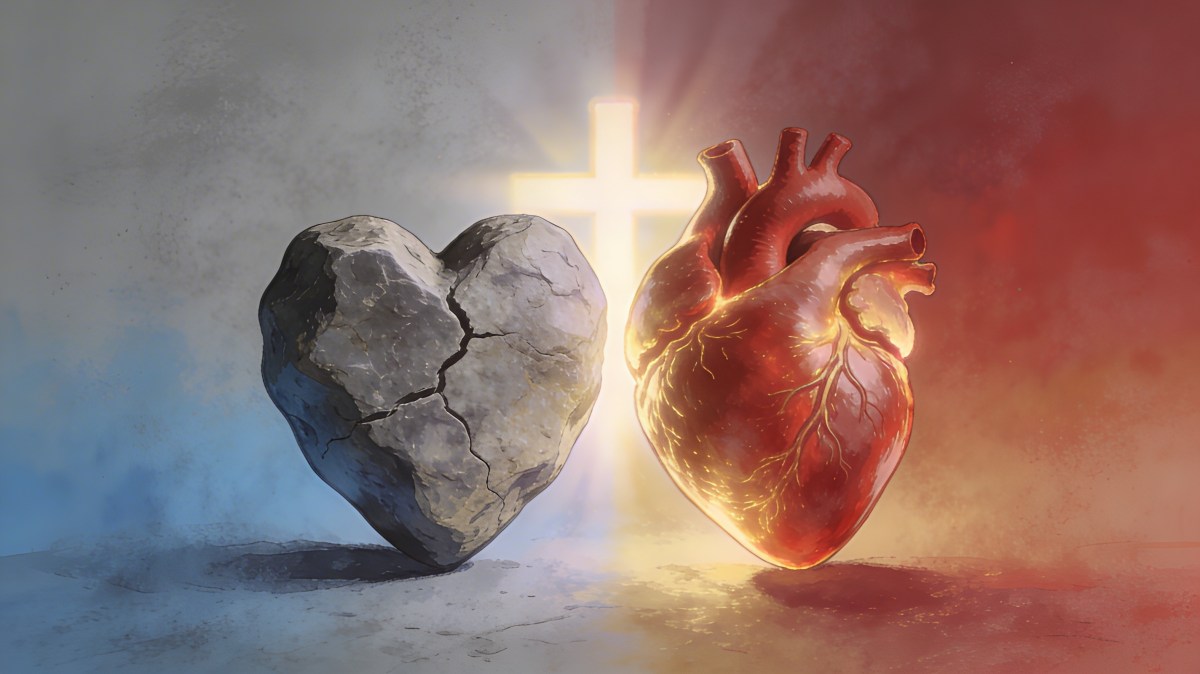
When Sin Runs Deep: Jesus’ Shocking Words and God’s Promise of a New Heart

Hardened Hearts

Jesus exposes how deep sin really runs—not to crush us, but to replace our hardened, petty hearts with a new, generous heart that looks like his.enduringword+2

When Jesus Sounds Extreme

In the Sermon on the Mount, Jesus uses some of the most jarring language in all of Scripture: “If your right eye causes you to sin, tear it out and throw it away… If your right hand causes you to sin, cut it off.” He repeats the same idea later: it is better to enter life “maimed or lame” than to be thrown into the fire with all your members intact. These are not literal surgical instructions, but spiritual shock therapy—Jesus is trying to wake us up to how lethal sin is when we treat it lightly or manage it politely.preceptaustin+5

If the problem were just our eye or our hand, we might imagine we could “fix” ourselves by removing a part. But you can pluck out the eye and still have a mind that replays the image; you can cut off the hand and still have a heart that broods over revenge or fantasizes about using others. Jesus’ hyperbole forces the question: if every part of me can become a channel for sin, maybe the real issue is deeper than body parts. Maybe the “surgery” we need is not on the limb, but on the center that drives them all.lifehopeandtruth+2

The Hidden Depth of Sin

Jesus doesn’t begin by talking about eyes and hands; he starts with the commandments themselves. “You have heard that it was said, ‘You shall not commit adultery’… But I say to you that everyone who looks at a woman with lustful intent has already committed adultery with her in his heart.” Earlier in the same chapter he goes even deeper with anger: “You have heard that it was said… ‘You shall not murder’… But I say to you that everyone who is angry with his brother will be liable to judgment.”harvestpca+2

In both cases, Jesus exposes the “road” that leads to the visible sin long before the final act:

  • Long before murder, there is unchecked anger, contempt, and the quiet decision to stop seeing the other person as a brother.bible.usccb+1
  • Long before adultery, there is the cultivated gaze, the entertained fantasy, the interior willingness to treat another person as an object.harvestpca+1

This is where pettiness shows itself. A petty heart asks, “How far can I go and still be technically innocent?” A generous heart asks, “What leads me toward love and away from anything that degrades God’s image in me or in others?” Jesus’ strong language about cutting off and plucking out is his way of saying: don’t negotiate with what kills your capacity to love; don’t bargain with what hardens your heart.

Hardened Hearts and Religious Pettiness

When Scripture talks about a “hardened heart,” it isn’t just describing emotional coldness; it’s naming a stubborn, resistant interior that refuses to be moved by God or by the needs of others. In the Gospels, Jesus repeatedly runs into this hardness—often among very religious people. In Mark, when he heals the man with the withered hand on the Sabbath, the religious leaders watch him, not with compassion, but with suspicion, and Jesus looks at them “with anger, grieved at their hardness of heart.” They are more concerned with guarding their system than with rejoicing that a broken man has been restored.openbible+2

When Jesus discusses divorce, he explains that Moses’ allowance was “because of your hardness of heart,” but that “from the beginning it was not so.” In other words, God had made a concession to human stubbornness, but it was far from his original, generous design for covenant love. Hardness of heart always shrinks love down to the smallest possible space: What am I allowed to do? How quickly can I write this person off and still feel righteous? How can I keep my image intact while my relationships crumble?dwightgingrich+2

Jesus is ruthless with this kind of religious minimalism because it blinds us to God’s generosity. A hardened, petty heart will quote Scripture while ignoring the suffering person in front of it; it will defend its rights while forgetting that every breath is a gift. The same Jesus who warns us to cut off hands and pluck out eyes is the Jesus who exposes our loopholes, our technicalities, and our carefully managed bitterness—and then offers us something entirely different.bible+1

God’s Promise: From Stone to Flesh

Centuries before Jesus, God had already diagnosed the problem: “I will remove the heart of stone from your flesh and give you a heart of flesh.” Ezekiel’s image is striking. A heart of stone is inflexible, unresponsive, and cold toward God’s voice; a heart of flesh is soft, living, and responsive, able to be impressed and moved by God’s will. In the ancient world, the heart was the center of decision, desire, and thought, so this is not cosmetic change—it is a promise of a new core.biblehub+3

God doesn’t stop there: “I will give you a new heart, and a new spirit I will put within you.” Jeremiah echoes the same hope: “I will put my law within them, and I will write it on their hearts.” Under the old covenant, God’s law was written on stone tablets outside of us; under the new covenant in Christ, that law of love is meant to be etched into our very desires and motivations. Jesus is not lowering the bar; he is raising it and then promising the grace to live what he commands.esv+3

Now the extreme sayings about eyes and hands come into focus. Jesus isn’t calling us to mutilate ourselves to earn God’s favor; he is revealing that the old, stone heart can’t be managed into holiness. It has to be replaced. It’s not that we remove one offending part and keep the rest intact; we bring the whole person to the surgeon who can actually give us a new heart.

From Pettiness to Generosity

What does a new, “flesh” heart look like in practice? The New Testament consistently links it with generosity. “We know love by this, that he laid down his life for us, and we ought to lay down our lives for the brethren.” “If anyone has the world’s goods and sees his brother in need, yet closes his heart against him, how does God’s love abide in him?” The contrast is sharp: a closed, stingy heart versus a heart opened by Christ’s own self-giving.lifepointbaptist+2

Jesus describes this generous posture in his own teaching: “If anyone forces you to go one mile, go with him two miles. Give to the one who begs from you, and do not refuse the one who would borrow from you.” This isn’t about becoming a doormat; it’s about becoming free from the internal bookkeeping that always asks, “Have I done enough yet?” Pettiness calculates; generosity rests in the Father’s abundance and asks, “How can I mirror the way God has treated me?”logos+2

In daily life, pettiness in my heart might show up as:

  • Doing the bare minimum in my marriage, parenting, or friendships, while resenting any extra demand.
  • Clinging to small offenses, replaying them, and refusing to let go until the other person “pays.”
  • Giving financially or serving others but constantly checking whether I am getting enough appreciation in return.globalchristianrelief+1

By contrast, a generous heart acts more like Christ: quick to forgive, willing to go beyond what is strictly required, eager to protect others from temptation rather than seeing how close to the line we can stand together. The same Jesus who warns about hell also says, “It is more blessed to give than to receive,” promising that there is joy on the other side of relinquished pettiness.lifepointbaptist+2

Letting Jesus Rewrite the Heart

So how do we move from a hardened, petty heart to a generous one? We don’t get there by gritting our teeth and cutting off figurative hands on our own; we get there by bringing our whole interior life under the gaze and grace of Jesus. First, we let him tell the truth about us. When he says that anger, contempt, and lust in the heart are already violations of the law of love, we resist the impulse to defend ourselves and instead allow his light to reach those hidden corners.bible.usccb+1

Second, we cooperate with his grace by taking his warnings seriously. That may mean literally “cutting off” certain habits, environments, or inputs that regularly pull us toward sin—changing what we watch, what we scroll, who we vent to, or how we let our imagination run. Not because we are terrified of God, but because we trust his diagnosis: whatever keeps feeding the hardness in me is not worth clinging to.gotquestions+2

Finally, we ask God for the miracle he has already promised: “Lord, take away my heart of stone and give me a heart of flesh; write your law of love on my heart.” Over time, as he answers that prayer, we find that obedience becomes less about rule-keeping and more about family resemblance. The goal is not simply to avoid sin but to become people whose very instincts are being reshaped—less petty, more generous; less defensive, more open; less stone, more flesh.dailyverse.knowing-jesus+2

That is the hope at the center of Jesus’ hard words: he exposes how deep sin really runs not to leave us in shame, but to invite us into a deeper healing than we imagined was possible—a new heart that looks a little more like his.

  1. https://enduringword.com/bible-commentary/ezekiel-36/   
  2. https://biblehub.com/ezekiel/36-26.htm    
  3. https://www.esv.org/Ezekiel+11:19;Ezekiel+36:26;Jeremiah+31:33;Hebrews+8:10/   
  4. https://www.preceptaustin.org/matthew_529-30   
  5. https://harvestpca.org/sermons/you-shall-not-commit-adultery-matthew-527-30/    
  6. https://www.biblegateway.com/passage/?search=Matthew+5%3A29-30&version=NRSVUE 
  7. https://biblehub.com/matthew/18-9.htm 
  8. https://lifehopeandtruth.com/change/christian-conversion/the-sermon-on-the-mount/if-eye-causes-you-to-sin/  
  9. https://www.gotquestions.org/pluck-out-eye-cut-off-hand.html   
  10. https://dwightgingrich.com/why-hardness-heart-cause-god-allow-divorce-jdr-9/  
  11. https://bible.usccb.org/bible/readings/021526.cfm    
  12. https://www.openbible.info/topics/hardness_of_heart    
  13. https://crosstheology.wordpress.com/the-hardening-of-the-heart-explained/ 
  14. https://www.awmaust.net.au/hardness-of-heart/ 
  15. https://billmuehlenberg.com/2017/01/02/hardened-hearts-judgment-god/ 
  16. https://bible.org/seriespage/lesson-57-why-jesus-hates-legalism-luke-1137-54 
  17. https://biblehub.com/commentaries/ezekiel/36-26.htm 
  18. https://dailyverse.knowing-jesus.com/ezekiel-36-26   
  19. https://www.lifepointbaptist.org/sermons/sermon/2024-01-14/the-law-of-love   
  20. https://www.logos.com/grow/10-bible-verses-about-generosity/    
  21. https://globalchristianrelief.org/stories/bible-verses-generosity/    
  22. https://versebyverseministry.org/bible-answers/pluck_it_out_cut_it_off 
  23. https://www.mljtrust.org/sermons/old-testament/a-new-heart/ 

Finding Your One True Priority in Life

Lately the word “priority” has been sticking with me. I learned that when it first entered English in the 1400s, it was singular—there was just one “priority,” the first and most important thing. Only in the 1900s did we start talking about “priorities,” as if we could have many “most important” things at the same time.

As a Catholic, that little language shift makes me pause. If everything is a priority, then nothing really is—and for me, it raises the question: who or what actually comes first in my life? In my faith, God is meant to be that one priority, the One everything else flows from and returns to.

Another word that has been on my heart is “consecrated,” which means something set apart, made holy, reserved for a special purpose. In Catholic theology, to be consecrated is to belong to God in a particular way, to be given over to Him in love. The ancient burnt offerings in the Old Testament were a symbol of this: something given completely, not partly, to God.

Christians believe that Jesus is the “Lamb of God,” offered not as a thing, but as a living person who gives Himself totally for us, for our forgiveness and healing. In Jesus, God is not distant or abstract; He draws close and offers His whole self so that we can live in friendship and union with Him. Even if you do not share that belief, there is something moving about the idea of a love that holds nothing back.

What encourages me is that God does not just give words, but also gives a language of actions, symbols, and even our everyday choices to communicate with us. The way we order our time, our energy, and our “one priority” becomes its own kind of prayer—a way of saying, “This is who I belong to, and this is what I’m living for.” That feels like good news in a scattered world: we are invited into a simpler, deeper center.

A Scripture that captures this for me is Romans 12:1: “Offer your bodies as a living sacrifice, holy and pleasing to God—this is your true and proper worship.” It speaks of life, not destruction: offering our ordinary selves—work, family, struggles, hopes—as something set apart for good, for love, for God. Whether or not you share my faith, it is an invitation to ask: what is my one true priority, and what am I willing to give myself to, wholeheartedly, in love?

As we close this reflection, please join me in prayer:

Lord Jesus Christ,
You are the one true priority and the Lamb of God, consecrated and given for our salvation.
Teach us to set our hearts on You above all things.
Gather our scattered desires into a single yes to Your will.
Consecrate our minds, our work, our relationships, and our rest,
so that all we are and all we do may be set apart for Your glory.
By Your Holy Spirit, make our lives a living sacrifice,
holy and pleasing to the Father, our true and spiritual worship.
Mary, Mother of God, and all the saints,
pray for us as we learn to live with one heart and one priority in Christ.
Amen.

Where Will You Be?

Eternity
How Will You Spend It?

Today’s reflection isn’t on designer perfume, but on the concept of “Eternity”. I just found that the ad campaign for this Calvin Klein product seemed fancy and eye-catching enough for the discussion.Ironically, this symbol of “high fashion” is an example of the material comforts that do not last the test of time and in fact, are a part of what we leave behind when we die.

As believers in Christ, we are reminded that life on earth is a mere temporary stop on our journey. Life here is intended only as a testing ground for what lies ahead: an eternal feast in the true presence of the Lord our God.

John 14:1-3
“Do not let your hearts be troubled. Trust in God; trust also in me. In my Father’s house are many rooms; if it were not so, I would have told you. I am going there to prepare a place for you. And if I go and prepare a place for you, I will come back and take you to be with me that you also may be where I am.”

There is a place for us that is prepared and not one of us spends a day more than God intends us to have on this earth.

Many of us grieve when we have lost a loved one also often ask the question “why“? Author Max Lucado said it best when he writes: “You and I both know I can’t answer that question. Only God knows the reasons behind his actions. But here is a key truth on which we can stand. Our God is a good God.” (Traveling Light, Max Lucado). As inspired in the Book of Psalms: “You are good, Lord. The Lord is good and right.” (Psalms 25:7-8) God’s plan may not be revealed completely to us, but the motivations are pure and loving; it truly is “for the good” that these things happen.

But how could death be good? Isaiah writes: “Good people are taken away, but no one understands. Those who do right are being taken away from evil and are given peace. Those who live as God wants find rest in death.” Death is God’s way of taking people away from evil.What is this evil that the Bible speaks of? It could be a number of things, but mostly they are the things that turn us away from God or the things that harm us or cause unnecessary suffering in ourselves and in others.

That’s where eternity comes into the picture. What length of time is our life here on earth compared to eternity? It’s almost nothing… “In God’s plan every life is long enough and every death is timely.” (Lucado) We all have our season of life and our time, though highly unpredictable is completely intentional and planned by the Lord.

Psalm 23:6
Surely goodness and love will follow me all the days of my life, and I will dwell in the house of the LORD forever.

These “days” are the eternity that believers long for – for those of us left behind to live, we should take comfort in the loss knowing that the sacrifice of Christ has ensured the continuation of the journey for the dead in the life of the world to come.

What is Prayer For?

[… eight years ago]  Read a great post that challenges readers to examine themselves and consider:

Do we pray to change God’s mind, or is it for some other reason?

We should indeed pray instead for what we need… and the wisdom to understand what was given before us instead. What God gives us in response to our prayers is not always what we expect. Nor should it ever be…

I used to think that I knew what I needed, and only had to ask.  IT’s different now.  It’s hard to trust, but that is more important for me.  Trust in God, that all needed is here as He knew it before I came to be. [RP 3/28/2017]


A simple example is once I prayed very hard to God for deliverance from a challenging emotional condition. Instead of directly granting me a cure, he sent me a response through my parish pastor. When on a visit, I confided my plea for help and instead of addressing the issue altogether, he simply suggested to pursue a parish ministry to quell the ache inside.

At the time I thought he was being callous and insensitive for not listening to my story or my complaints, but now I realize that it wasn’t my pastor’s response that needed correction… it was my attitude that needed broadening. God was calling me to a mission – to find healing in the ministry to other parishioners in the form of teaching. And that was what I did for a year after that initial meeting. I adopted the role as a catechism teacher for junior high students at our church.

Sharing my faith and answering the calling to witness Christ before an audience of teenagers brought me strength, resolve and healing that I could only recognize in hindsight several years later. I can say with confidence now that I have experienced the healing I had prayed so hard for – but only when I was finally able to open my eyes to what God had unfolded before my life’s journey.


The Prayer of Jabez

I recently picked up a Christian devotional entitled “The Prayer of Jabez” and I was overwhelmed with the sheer enthusiasm of its message. This devotional sparked a whole series of books, devotionals and publications all centered around a little-known man from the Bible. He wasn’t anyone as famous or well known as David or Noah; in fact, this man: Jabez is only mentioned once in the Bible and then only for two sentences. But what he has to say in prayer has phoenomenal impact and meaning on our life as God-fearing (revering) individuals. In fact, Jabez’s prayer has inspired me to write a series of articles on exactly what he has to say and how it can help you build your relationship with God.

From the first book of Chronicles:

Jabez was more honorable than his brothers. His mother had named him Jabez, saying, “I gave birth to him in pain.” Jabez cried out to the God of Israel, “Oh, that you would bless me and enlarge my territory! Let your hand be with me, and keep me from harm so that I will be free from pain.” And God granted his request. (1 Chronicles 4:9-10, NIV)

The prayer goes so quickly, you almost miss it. Truly, this is one gem that anyone can fit into their schedule in just 10 minutes. As a recap, Jabez did something remarkable in prayer that changed his life compared to the rest of the people referenced and mentioned in the same chapter. Jabez’s four requests:

  1. “Please bless me indeed!”
  2. “Please enlarge my territory!”
  3. “Please put Your hand on me!”
  4. “Please keep me from evil!”

And God granted his requests to him… The book, “The Prayer of Jabez” by Bruce Wilkinson tells of testimonials and anecdotes of answered prayers and requests just by changing one’s mindset to think and act along the lines of this four part prayer. Without giving away too much about the book itself, I’d like to share a series of blog articles just about Jabez’s prayer and ways to interpret its meaningfulness in our lives as Christians.

As a little background, back in the times of the ancient Hebrews (about 1200 B.C.) Jabez was born to the tribe of Judah… the same tribe that David and Jesus came from later… in Bible times, a person’s name defined his future. For example, Solomon means “peace,” and sure enough, he became the first king of Israel to reign without going to war. As history would have it, Jabez’s entry into the world was not the most auspicious one. Jabez bore a heavy burden with his name, meaning “pain” – what kind of future would be in store for him with an awful name like that?

Jabez was desperate. He was already predestined by his culture to have a miserable, poor, simple life… perhaps his family and tribe even treated him as such. In his desperation, instead of lamenting his situation or cursing his mother’s cruelty, he began to pray to God in earnest and he starts by asking for His blessing.

The devotional made a good point that the Biblical sense of “blessing” isn’t the watered down, every day expression we use when people sneeze… we ask God to bless everything: our parents, our day at work, the food we eat; however in the Biblical meaning, to request a “blessing” is to ask for a “supernatural” favor.

When we ask for God’s blessing, we’re not asking for more of what we could get for ourselves. We’re sincerely asking for the kind of good things only God has the power to know about or give. That’s why the Bible says, “The Lord’s blessing is our greatest wealth. All our work adds nothing to it!” (Proverbs 10:22, TLB)

The Lord has many blessings to bear upon each of us as well. But the catch is, we have to ask. If you’ve never prayed and asked God for His blessings, you’ve missed out on a gift that keeps giving, and giving, and gving. Don’t miss out on this opportunity of your lifetime! As the Bible says:

You do not have because you do not ask. The Bible also says (James 4:2) Ask, promised Jesus, and it will be given to you… What man is there among you who, if his son asks for bead, will give him a stone? If you then, being evil, know how to give good gifts to your children, how much more will your Father who is in heaven give good things to those who ask him!” (Matthew 7:7,9,11)

And that’s the catch. there is no limit to God’s blessings in our lives. They are only limited by us and our forgetfulness or ignorance to ask, not by His resources, his power or willingness to give.