What It Means to Let God’s Word Take Root

Woman touching the blue coat of a performer while a crowd watches on a cobblestone street

Start with the Word

Before you dive into this reflection, you might want to spend a few quiet minutes with these passages:

  • Parable of the Sower: Matthew 13:1–9, 18–23
  • The hemorrhaging woman: Mark 5:25–34 (also Matthew 9:20–22; Luke 8:43–48)
  • The centurion and his servant: Matthew 8:5–13 (also Luke 7:1–10)

Let them sink in. Notice what stirs, comforts, or challenges you. Then come back and we’ll walk through them together.


Good soil looks like real people

In the parable of the sower, Jesus tells this simple, earthy story about a farmer, some seed, and four kinds of ground—hard path, rocky soil, thorny soil, and good soil. Only one of them lets the seed really sink in and produce a harvest.

At Mass, Father Kwame put it plainly: “The soil is our hearts. The seed is Jesus, coming to us in the Word.” Every time the gospel is proclaimed, the Lord is sowing himself into our lives—into your life. And if that seed finds good soil, it doesn’t just sit there. It grows. It produces the fruits of the Holy Spirit that other people can actually see and taste.

What I love is that Jesus doesn’t leave this at the level of theory. In the hemorrhaging woman and the centurion, we get to see what “good soil” looks like with a face and a name (or in her case, a story, even if we never learn her name). Both of them have every reason to shut down. Both of them, in their own way, open their hearts and give Jesus permission to take root.


The hemorrhaging woman: when love, joy, and peace break through

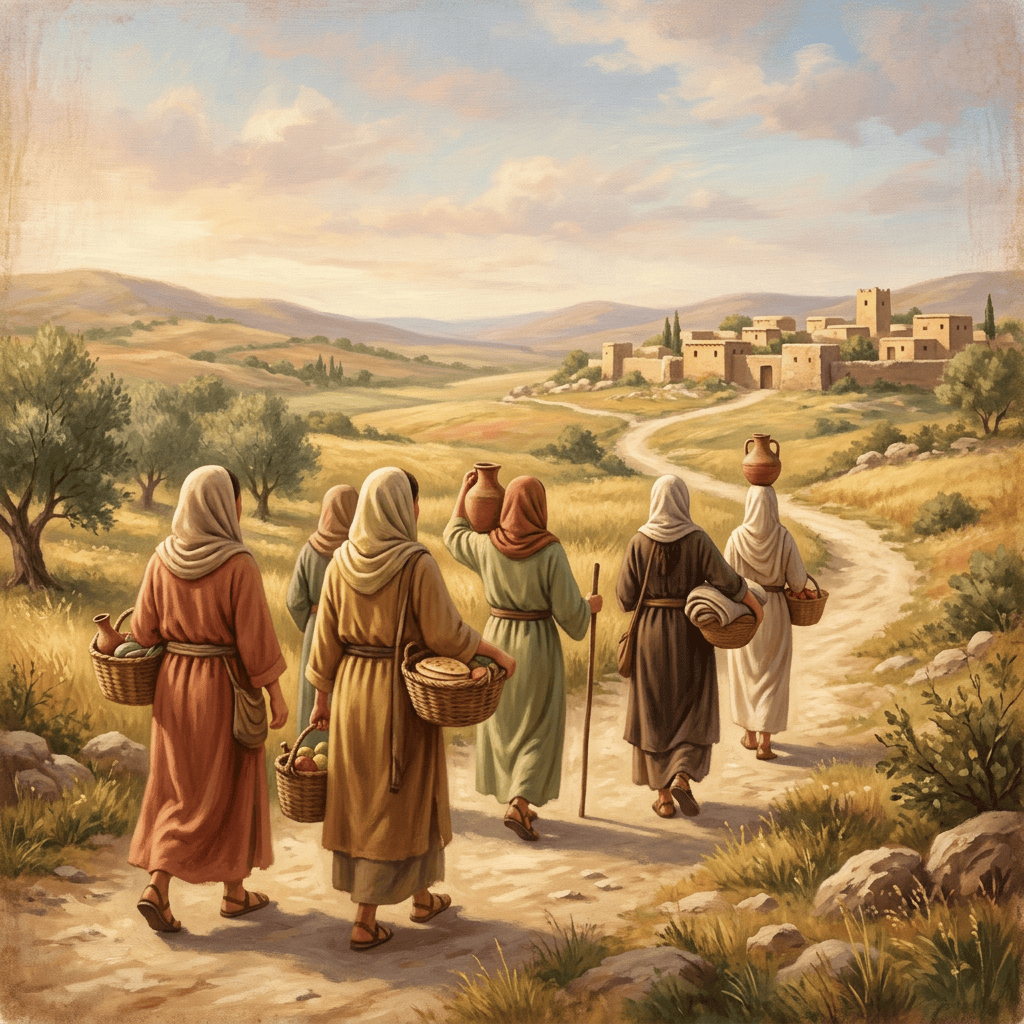
Think of the hemorrhaging woman. Twelve years of suffering. Twelve years of doctors and disappointment. Twelve years of being considered “unclean,” kept at arm’s length from worship and community. If anyone’s heart could have turned into hard-packed path or thorn-choked ground, it’s hers.

But what does she do? She pushes through the crowd, quietly, almost secretly, and reaches out for Jesus, believing that just touching his cloak is enough. That’s good soil right there—not because she feels strong, but because she refuses to let shame, fear, or exhaustion have the last word. She lets faith crack the surface of the soil.

When Jesus turns and calls her “Daughter,” when he says, “Your faith has made you well. Go in peace,” something beautiful shows up above the surface. Love appears in her willingness to step forward and tell her story. Joy begins to replace the long years of humiliation. Peace settles over her future because she’s heard the Lord’s verdict on her life. These are the fruits of the Holy Spirit in real time—signs that Jesus’ word has taken root in the deepest, most wounded places of her heart.


The centurion: generosity, courage, and deep trust

Now look at the centurion. He’s a Roman officer, a man with rank and power. He could have stayed in his own world and handled things his own way. Instead, he crosses religious and cultural lines and comes to Jesus on behalf of a suffering servant. That’s already a hint of generosity: his heart is moved for someone who, in that culture, was easy to overlook.

Then comes that line we know so well from Mass: “Lord, I am not worthy to have you enter under my roof; only say the word and my servant will be healed.” It’s humble, yes, but it’s also brave. He’s basically staking his reputation—and his servant’s life—on the power of Jesus’ word alone. He’s saying, “I know how authority works; I believe your authority is that strong. You don’t even have to come to my house. Just speak.”[en.wikipedia][youtube]

That is rocky ground turning into good soil. Instead of letting fear or pride scorch the seed, he lets faith sink down into how he understands the world. He trusts that Jesus’ word carries more weight than his own rank, more power than distance, more hope than his own ability to control things.

And again, look at the fruit. His servant is healed. But beyond that, his faith becomes a sign for everyone watching—Jesus even says he hasn’t found such faith in Israel. The centurion’s trust, his generosity toward his servant, his courage in approaching Jesus, are all fruits growing from the seed of the Word planted in good, humble soil.[youtube]


What happens when we let God take root

Father Kwame said it clearly: when Jesus’ word finds a home in us, it should produce fruits—love, joy, peace, generosity, courage, and more. These aren’t just nice words on a confirmation banner. They’re the “harvest” that shows what kind of soil we really are.

We see it in these two:

  • In the woman, love looks like drawing near to God instead of hiding, even when she’s afraid. Joy and peace flow from hearing Jesus speak directly into her shame and suffering.
  • In the centurion, generosity looks like using his position to care for someone vulnerable. Courage looks like trusting Jesus’ word more than his own plans or expectations.[catholicsstrivingforholiness][youtube]

If we let Jesus take root in our own hearts—if we stop treating his word as background noise and start giving it space and time—those same fruits begin to grow in us. Not perfectly. Not all at once. But really.

Love might look like choosing patience instead of sarcasm with a family member. Joy might look like a quiet gratitude in the middle of a hard day. Peace might look like a refusal to spiral into anxiety when the news is bad or the bills are high. Generosity might mean giving our time, attention, or talent where it costs us something. Courage might look like admitting our weakness and asking for help—whether from God or from others.[lovedweller]

That’s what happens when we stop guarding the soil and start letting the Gardener work.


Letting someone “taste the pudding”

Father Kwame gave us a great image: “The proof of the pudding is in the eating.” You can’t tell if a pudding is any good by staring at it on the table. You have to taste it. In the same way, people can’t really tell if we have deep faith just by seeing us at Mass once a week. They learn it when they live with us, work with us, bump into us on our worst days and our tired mornings.

As you move into tonight’s examen, try sitting with this simple, honest question:

If someone close to me—my spouse, my kids, a coworker, a friend—were to “taste my pudding” this week, what would they find? Would they taste love, joy, peace, generosity, courage—the fruits that grow when Jesus’ word really has space in my heart? Or would they run into impatience, harsh words, constant worry, resentment, or indifference?[gcdiscipleship]

Don’t answer that to beat yourself up. Answer it to let the Lord show you where the soil is good, and where it needs tilling. Then, like the hemorrhaging woman and the centurion, you can bring that soil to Him and simply say:

“Lord, I am not worthy… but only say the word.”

And trust that His word can take root and grow, right there, in the very real ground of your life.

Fifteenth Sunday Reflections: The Parable of the Sower

Seedling sprouting from soil with seed coat still attached
Fifteenth Sunday in Ordinary Time

First Reading: Isaiah 55:10-11
Responsorial Psalm: Psalm 65:10, 11, 12-13, 14
Second Reading: Romans 8:18-23
Gospel: Matthew 13:1-23
Daily readings: https://bible.usccb.org/bible/readings/071226.cfm

Isaiah opens with one of the most quietly confident images in Scripture. Rain and snow fall from the sky. They do not go back until they have done their work — watered the earth, made it fertile, given seed to the sower and bread to the one who eats. And then: so shall my word be. It goes out from God's mouth. It does not return void. It does what he sent it to do. The word of God is not fragile. It is patient and certain and productive in ways we often do not see or measure.

Paul fills that out in Romans. Creation is groaning, waiting, straining forward like a woman in labor — not in despair, but in hope. The sufferings of this present time are real. But they are not the final word. Creation itself is waiting for the children of God to be revealed. We too groan, even with the firstfruits of the Spirit already in us, waiting for the full redemption of our bodies. It is a strange kind of hope — held in the groaning, not in spite of it.

Then Jesus tells the parable of the sower. The same seed. Four kinds of soil. Path — the word never gets in. Rocky ground — it gets in but has no roots and scorches when heat comes. Thorns — it gets in but worldly anxiety and the lure of riches choke it before it bears fruit. And rich soil — it gets in, takes root, and yields a hundredfold. The question the parable asks is not whether the seed is good. Isaiah already answered that: the word of God does not return void. The question is about the soil. What kind of ground am I?

On a Sunday, walking into Mass, that is a good question to carry in. The word will go out. It will do what God sent it to do. The only variable is whether I am listening, rooted, and uncluttered enough to let it take.


A few questions to sit with today:

1. Which soil do I most recognize in myself right now — the path, the rocky ground, the thorns, or the rich soil? What is making me that kind of ground at this moment in my life?

2. Is there a word God has been speaking to me — in Scripture, in prayer, in the readings at Mass — that worldly anxiety or the pull of other things has been slowly choking? What are the thorns?

3. Paul says creation is groaning in hope. Is there a place in my life where I am groaning — where the waiting is real and hard — and have I brought that groaning honestly before God as a form of hope rather than defeat?

4. "Blessed are your eyes, because they see, and your ears, because they hear." Do I take that seriously — that I have access to something prophets and righteous people longed to see? Does my prayer life reflect that privilege?


One small thing for tomorrow:

Before you open your phone tomorrow morning, read one short passage of Scripture — even just the two verses of today's First Reading (Isaiah 55:10-11). Let the word go in before the noise starts. That is the whole practice. Good soil starts with actually receiving the seed.


Lord Jesus, your word does not return to you void. It goes out, it waters, it makes things grow in ways I cannot always see or measure. Help me to be good soil today. Help me to pull out the thorns — the anxieties, the lures, the noise — that keep your word from taking root and bearing fruit. And where I am groaning, Lord, help me to trust that the groaning itself is part of a movement toward something. Creation is straining forward. I want to strain forward with it, waiting in hope for what you have promised. Thank you for this Sunday, this word, this Mass. May Mary, who kept your word and let it bear fruit in her, teach me the same receptivity. Amen.


If you'd like to share: which soil do you most recognize in yourself right now — and what do you think is making you that kind of ground?

Overcoming Despair: The Gospel of the Sparrows

Person on rooftop looking at Milky Way over city at night

You are smaller than you realize—and more loved than you imagine.[pmc.ncbi.nlm.nih]

Under a Wide, Quiet Sky

Picture yourself on a rooftop at night, maybe on a campus building or your own back porch. The sky looks like a huge sheet of black, with a few faint stars scattered around. It feels quiet, maybe even a little lonely.

Now imagine looking through a telescope and suddenly seeing clouds of stars, glowing nebulae, constellations you’ve only ever seen in pictures. That same sky, which looked like empty darkness, turns out to be crowded with light. You can almost feel your own size shrinking in comparison: just one person, on one rooftop, on one small planet in a universe full of galaxies.

In moments like that, a question often sneaks in: If the universe is this big, does my little life really matter to God at all?

The Sparrows in Today’s Gospel

Today’s gospel reading, from Matthew 10:29–31, goes straight at that question in a surprisingly down-to-earth way. Jesus doesn’t talk about galaxies; He talks about sparrows. “Are not two sparrows sold for a penny?” He asks. “Yet not one of them will fall to the ground apart from your Father… So do not be afraid; you are of more value than many sparrows.”[bible]

In His world, sparrows were about as cheap and ordinary as it gets—sold for pocket change, sometimes thrown in as a bonus bird with a purchase. They were the background noise of daily life. And yet Jesus insists: not one sparrow drops to the ground without God noticing. No small, fluttering life is invisible to Him.[bible.oremus]

Then Jesus pushes the image further: “Even the hairs of your head are all counted.” That’s His way of saying, “God’s attention to you is not vague. It’s specific. It’s detailed. It’s personal.”[theberean]

Feeling Tiny, Living Loved

Maybe you don’t stand on rooftops, but you know the feeling: sitting at the kitchen table with unpaid bills, waiting in a hospital room, scrolling through bad news, wondering how one person can matter in a world where so much is broken.

From the perspective of Catholic Social Teaching, that feeling of insignificance is understandable—but it’s not the final word on you. The Church teaches that every human person has a God-given dignity: a worth that doesn’t come from your job, your health, your bank account, or how “religious” you seem, but from the fact that you are created in the image of God.[pmc.ncbi.nlm.nih]

If you’re not sure what you believe yet, this is one of Christianity’s boldest claims: you are not a random accident of cosmic forces. You are willed. You are known. You are loved—by the same God who keeps track of sparrows and starfields.[pmc.ncbi.nlm.nih]

When Despair Starts Whispering

Despair usually doesn’t show up with a big announcement; it just starts whispering. It says things like, “Nothing is going to change,” “You’re on your own,” or “Don’t expect too much; you’ll only be disappointed.” It’s not just sadness; it’s the belief that God either can’t or won’t act.

The gospel of the sparrows quietly challenges that. It doesn’t promise instant fixes or painless lives, but it does say that God is paying attention—even when you’re waiting, even when nothing seems to be happening. Your prayers are not tossed into a cosmic void; they’re heard by Someone who knows you down to the last detail.[biblehub]

Think of a person who’s praying for financial relief and sees no sudden lottery win or miracle deposit. Instead, they find themselves nudged toward a better job search, a side hustle, and hard decisions about cutting back. That isn’t God ignoring them; it’s God forming them—teaching stewardship, resilience, and trust, while still planning real help in His time.

God’s Providence and Your Part

One of the quiet truths behind this gospel is that God’s providence and our choices usually work together. We pray, we ask, we cry out—but we also act, decide, and take small steps. God doesn’t treat us like puppets; He treats us like partners.[pmc.ncbi.nlm.nih]

Catholic Social Teaching talks about this as co-creation: God invites us to participate in His work, in our families, workplaces, parishes, and communities. You might never feel like the “main character” in the story of the world, but in God’s eyes you are not background. You are part of His cast, with a role that no one else can play in exactly the way you do.[pmc.ncbi.nlm.nih]

A Vital Member of His Vast Cast

So where does that leave you under that wide, quiet sky? You are small, yes—that’s just honest. But you are not insignificant. You are a vital member of God’s vast cast of creation. Your kindness to a stranger, your patience with a child, your courage in suffering, your quiet prayer at the end of a long day—all of these matter.[pmc.ncbi.nlm.nih]

The sparrow gospel is not a sentimental Hallmark moment; it’s a steady, realistic promise:

  • You will feel small sometimes.
  • You will feel overlooked sometimes.
  • But you are never unseen by God.

If even a cheap little sparrow doesn’t fall without His notice, then your tears don’t fall without it either. The invitation today is simple: when you feel like one more face in the crowd, let Jesus’ words interrupt that thought—“You are worth more than many sparrows”—and let that truth sink in until it starts to change how you see yourself.[bible]

Let us pray.

Loving Father,
when we feel small under the weight of the world,
remind us that we are seen and treasured by You.[sacredspace]
You care for the sparrows and number every hair on our heads;
teach us to trust that Your attention and love rest on us, even in the quiet, hidden parts of our lives.[bible]

Lift our eyes from fear to faith,
from despair to hope,
and help us live today as people who know they are deeply loved.[sacredspace]
We ask this through Christ our Lord. Amen.[sacredspace]

Saint Benedict: A Call to Listen and Overcome Fear

Monk in black robe holding staff looking at sunrise over monastery and valley
Memorial of Saint Benedict, Abbot
Patron of Europe, Father of Western Monasticism

First Reading: Isaiah 6:1-8
Responsorial Psalm: Psalm 93:1ab, 1cd-2, 5
Gospel: Matthew 10:24-33
Daily readings: https://bible.usccb.org/bible/readings/071126.cfm

Isaiah sees the LORD seated on a high and lofty throne, the train of his garment filling the temple, the seraphim crying Holy, holy, holy, the doorframe shaking, the house filling with smoke. And Isaiah's first response is not awe in the comfortable sense — it is terror. "Woe is me, I am doomed! For I am a man of unclean lips." He has just seen the one who is entirely holy, and the gap between that holiness and his own life is suddenly visible and overwhelming.

Then a seraph flies to him with a burning coal from the altar and touches his lips. "Your wickedness is removed, your sin purged." Only after that — only after the purification he did not earn and could not provide for himself — does the voice of the LORD come: "Whom shall I send? Who will go for us?" And Isaiah, cleansed, answers from a place he could not have reached five minutes earlier: "Here I am. Send me."

Jesus meets that same fear in the Gospel — but gently. Do not be afraid of those who can only kill the body. Not one sparrow falls without your Father knowing it. Every hair on your head is counted. You are worth more than many sparrows. The God Isaiah saw on that throne is the same God who counts every hair on your head. The holiness and the tenderness belong to the same person.

Saint Benedict, whose memorial we celebrate today, built his entire Rule on one word: "Listen." The first line of the Rule of Saint Benedict reads: "Listen carefully, my child, to the teachings of your master, and attend to them with the ear of your heart." He did not build a monastery on productivity, or achievement, or spiritual performance. He built it on listening — on turning toward the holy, staying in that attention, and trusting that God would do the rest. Benedict knew that the same God who fills the temple with smoke also counts the hairs on your head. You do not have to be afraid. You just have to listen.


A few questions to sit with today:

1. When was the last time I had an Isaiah moment — a genuine sense of the holiness of God, and a real awareness of the distance between that holiness and my own life? What happened in me?

2. Have I been listening today — with the ear of my heart, the way Benedict taught — or has my prayer been mostly talking, asking, rehearsing?

3. Is there something God has been asking me — "Whom shall I send?" — that I have been too afraid or too busy to answer?

4. Do I actually believe I am worth more than many sparrows? Where does that belief feel thin or far away?


One small thing for tomorrow, Sunday:

At some point tomorrow, find two minutes of actual silence — no phone, no background noise — and just sit. Not to achieve anything. Just to listen the way Benedict taught. See what, if anything, arrives. That is the whole practice.


Lord Jesus, you tell me not to be afraid — three times this week you have said it. And yet fear is so often where I live. Help me to be like Isaiah: willing to see the gap honestly, willing to receive the coal I cannot earn, and then willing to say "here I am, send me" from the cleansed place. Teach me Benedict's first word: listen. In the noise of my ordinary Saturday, in the scroll and the busyness and the small anxieties, help me to find the ear of my heart and turn it toward you. I am worth more than many sparrows. Help me to live as though I believe that. May Mary, who kept all things and pondered them in her heart, teach me the same attentive listening. Amen.


If you'd like to share: what is one thing you sense God might be asking you to say "here I am" to — something you have been sitting with but not yet answering?

Returning to the Lord: Healing Through Honest Words

Wooden cross on rocky hill with green translucent fabric blowing around it at sunset
Friday of the Fourteenth Week in Ordinary Time

First Reading: Hosea 14:2-10
Responsorial Psalm: Psalm 51:3-4, 8-9, 12-13, 14, 17
Gospel: Matthew 10:16-23
Daily readings: https://bible.usccb.org/bible/readings/071026.cfm

We have been walking with Hosea all week — through the warnings, the grief, the indictments of a people who kept turning away. And today he closes his book with something breathtaking. "Return, O Israel, to the LORD, your God; you have collapsed through your guilt. Take with you words, and return to the LORD." That is the whole invitation. You do not need to arrive cleaned up. You do not need to have fixed yourself first. Just take whatever honest words you have — even the admission of collapse — and return.

And then God's answer: "I will heal their defection. I will love them freely; for my wrath is turned away from them. I will be like the dew for Israel." Dew. Not thunder. Not a legal decree. Dew — quiet, overnight, arriving while you are asleep, making things green that were dry. "He shall blossom like the lily. He shall strike root like the Lebanon cedar." From collapse to cedar. From defection to blossoming. This is what free love does when it is allowed to work.

Then Jesus prepares his disciples for something harder. Sheep among wolves. Courts. Scourging. Brothers handing over brothers. You will be hated because of my name. It is not a cheerful pep talk. But inside it is a promise that changes everything: when they hand you over, do not worry about what to say — the Spirit of your Father will be speaking through you at that moment. The same God who promised to be dew for Israel promises to be the voice inside the silence when words fail. You will not be alone in the hard moment. He will be there, speaking through what you thought was nothing.


A few questions to sit with today:

1. Is there a place in my life where I have collapsed through guilt — something I have been carrying that I have not yet brought back to the LORD with honest words? What would it sound like to say it plainly and return?

2. Do I trust that God's love is free — not earned by my improvement, not withheld until I am better — or do I secretly believe I need to clean myself up before I can come back?

3. Have I experienced God as dew lately — something quiet that arrived overnight and made something green that was dry? Did I notice it?

4. Is there a hard situation I am facing — at work, at home, in a relationship — where I have been anxious about what to say or how to handle it? Have I invited the Spirit into that moment?


One small thing for tomorrow:

Take with you words, Hosea says. Tomorrow, set aside five minutes to pray very simply and honestly — not polished prayer, just actual words about where you are. "Lord, here is what has happened. Here is where I collapsed. Here is what I am afraid of. I am returning." That is the whole thing. Let those plain words be your offering.


Lord Jesus, Hosea ends his book with dew. Not punishment — dew. Quiet, generous, arriving while I am not looking, making things blossom that I thought were beyond repair. I want to believe that for my own life. I bring you today whatever honest words I have about where I have been — the drifting, the small collapses, the ways I have said 'our god' to things I made with my own hands. Receive this return. Love me freely, the way you promised. And when the hard moments come — when I am handed over to something I did not plan for — remind me that it will not be me speaking alone. Your Spirit will be there. May Mary, who trusted your presence even at the foot of the cross, teach me the same quiet trust. Amen.


If you'd like to share: is there something you have been waiting to bring back to God — some honest words you have been rehearsing but not yet saying? You are welcome to say them here, or just let us know you are returning.

Saint Augustine Zhao Rong: A Martyr’s Journey to Faith

Glowing cross in sky surrounded by clouds over a mountainous landscape with a church
Thursday of the Fourteenth Week in Ordinary Time
Optional Memorial of Saint Augustine Zhao Rong, Priest, and Companions, Martyrs

First Reading: Hosea 11:1-4, 8e-9
Responsorial Psalm: Psalm 80:2ac, 3b, 15-16
Gospel: Matthew 10:7-15
Daily readings: https://bible.usccb.org/bible/readings/070926.cfm

Hosea gives us one of the most tender portraits of God in the entire Old Testament today. Not the thundering judge, not the distant sovereign — a parent teaching a child to walk. "It was I who taught Ephraim to walk, who took them in my arms. I drew them with human cords, with bands of love. I fostered them like one who raises an infant to his cheeks." And still they drifted. Still they turned away. And yet: "My heart is overwhelmed, my pity is stirred. I will not give vent to my blazing anger. For I am God and not man, the Holy One present among you; I will not let the flames consume you."

This is the God who sends the Twelve out in today's Gospel. Not a demanding taskmaster dispatching servants. A parent who has bent down, taken them in arms, taught them to walk — and now sends them out to do the same for others. Without cost you have received; without cost you are to give. Cure the sick. Raise the dead. Cleanse the lepers. Drive out demons. Travel light. Wish peace to every house you enter. The mission flows from the relationship, not the other way around.

Today we also remember Saint Augustine Zhao Rong and his 119 companions, martyrs of China, canonized by Pope John Paul II in the year 2000. Augustine was not a priest when his story began. He was a soldier, assigned to escort a French bishop to his execution in Beijing. During that long march, he watched Bishop Dufresse face suffering and death with a peace that had no human explanation. Augustine began to listen. He asked for baptism. He entered seminary and was ordained — the first native Chinese diocesan priest in history. He was later arrested, tortured, and refused to renounce his faith. He died in prison in 1815. A soldier converted not by an argument, but by watching someone carry the cross without flinching. Without cost you have received; without cost you are to give. Augustine received it watching a man die in peace. He gave it back with his life.


A few questions to sit with today:

1. Do I experience God the way Hosea describes — as one who bent down to teach me to walk, who drew me with bands of love? Or does my image of God feel more distant and demanding?

2. Is there someone in my life right now who is being slowly converted not by my words but by watching how I face difficulty? What are they seeing?

3. "Without cost you have received; without cost you are to give." What have I received freely from God that I have been slow to pass on to others?

4. Where today did I sense the Holy One present among me — in a person, a moment, a quiet grace I almost missed?


One small thing for tomorrow:

Think of one person who shaped your faith — a parent, a teacher, a priest, a friend — whose witness did what Augustine Zhao Rong's bishop did for him: showed you what it looks like to carry the cross in peace. Tomorrow, say a prayer of gratitude for them by name. If they are still living, consider telling them.


Lord Jesus, you taught me to walk. You took me in your arms before I knew your name. And still I drift, still I turn toward other things, still I need you to bend down again and draw me back with bands of love. Thank you for not letting the flames consume me. Help me to live what I have received — to give freely what was given to me freely, to carry the cross the way Augustine Zhao Rong and his bishop carried it: not with performance, but with a peace that only you can give. Through the intercession of Saint Augustine Zhao Rong and all the martyrs of China, who gave everything they had received, make me generous with what I have been given. Amen.


If you'd like to share: who is someone whose witness — the way they carried suffering or lived their faith — quietly changed you? Give them a moment of honor in the comments.

Identifying Idols: Understanding Spiritual Blindness

Winding dirt path through green hills towards a cross on a distant hilltop under partly cloudy sky.
Tuesday of the Fourteenth Week in Ordinary Time

First Reading: Hosea 8:4-7, 11-13
Responsorial Psalm: Psalm 115:3-4, 5-6, 7ab-8, 9-10
Gospel: Matthew 9:32-38
Daily readings: https://bible.usccb.org/bible/readings/070726.cfm

Hosea delivers one of the most memorable lines in all the prophets today: "When they sow the wind, they shall reap the whirlwind." He is talking about Israel's habit of building its own gods — literally casting idols from silver and gold, establishing kings without asking God, making altars to expiate sin that only multiplied sin. The logic of the image is simple and devastating: you cannot plant nothing and harvest something. If what you put into the ground is emptiness — chasing things that have no life in them — what comes back will be a whirlwind. Empty, destructive, out of control.

The Psalm answers it directly: our God is in the heavens. The idols of the nations have mouths but cannot speak, eyes but cannot see, ears but cannot hear, hands but cannot feel. They are made by human hands and they make their worshippers like them — unable to speak truth, unable to see clearly, unable to hear what matters. Whatever we give our attention and devotion to will slowly shape us into its image.

Then Jesus comes into Matthew's Gospel and sees the crowds. Not the crowds abstractly — he sees them specifically, closely. "Troubled and abandoned, like sheep without a shepherd." And his heart is moved with pity. The word in Greek is splanchnizomai — it means a gut-level, visceral compassion, the kind that comes from somewhere deep in the body, not just the mind. Jesus does not see a problem to be managed. He sees people. And then he says the same sentence he said before sending out the seventy-two: the harvest is abundant, the laborers are few — pray for workers. He turns his compassion outward. He invites his disciples into the same seeing.


A few questions to sit with today:

1. What have I been sowing this week — with my time, my attention, my emotional energy? Is it likely to bear fruit, or am I planting wind?

2. Is there an idol in my life right now — something I have been trusting or leaning on that cannot actually speak, see, or hear? A screen, an approval, a comfort that has become a false center?

3. When I look at the people around me — my family, my coworkers, the strangers I pass — do I see them the way Jesus does, as troubled and abandoned and worth his gut-level compassion? Or do I mostly see inconveniences and types?

4. Have I prayed for laborers for the harvest lately — including that I might be one?


One small thing for tomorrow:

The next time you are in a crowd or a waiting room or a meeting, try this: look at one person near you and quietly say inside, "Jesus sees you." Not out loud, not in a strange way — just a private act of extending the way Jesus looks at the crowds to one specific person in front of you. Then notice what shifts in how you treat them.


Lord Jesus, your heart was moved with pity at the sight of troubled and abandoned people. Help me to see the way you see — not abstractly, not impatiently, but with that gut-level compassion that actually stops and looks. I confess that I often plant wind: I give my best attention to things that cannot speak back to me, that cannot feed me, that will only return emptiness. Realign my loves. Show me where I have been trusting idols made by my own hands instead of turning to you. And when I see someone today who is troubled and abandoned, give me enough of your compassion to actually notice them. May Mary, who stood near the crowds watching her Son move through them with such tenderness, teach me to look with the same eyes. Amen.


If you'd like to share: where have you most sensed God's gut-level compassion for you this week — a moment when you felt truly seen rather than managed?

Saint Maria Goretti: Embracing Mercy and Love

Sunset rays breaking through dark clouds above mountains reflected on a tranquil lake

First, here are today’s Roman Catholic Mass details for the United States (Ordinary Form):

  • Day: Monday of the Fourteenth Week in Ordinary Time; Optional Memorial of Saint Maria Goretti, Virgin and Martyr[catholicculture]
  • First Reading (ferial): Hosea 2:16–18, 21–22[ewtn]
  • Responsorial Psalm: Psalm 145:2–9 (or 145:1–2, 8–11, 13–14 in some lectionaries)[ewtn]
  • Gospel: Matthew 9:18–26 (weekday)[ewtn]

The examen is themed around the Memorial of Saint Maria Goretti and today’s overarching scriptural note of covenant love, mercy, and healing.


1. Reflection on today’s theme

Tonight, place yourself before the Lord who says through Hosea, “I will espouse you to me forever… in love and in mercy,” and who, in the Gospel, gently enters houses of grief and illness to raise the dead and heal the suffering. Let that covenant mercy be the backdrop as you remember your day in San Francisco: the commute, the tech-heavy work, the city’s brokenness, its beauty, and your own heart in the middle of it all.[ewtn]

Saint Maria Goretti allowed Christ’s mercy and purity to become stronger than hatred and fear, forgiving her attacker even as she was dying. Ask: Where today did I choose gentleness over irritation, purity of heart over cynicism, and forgiveness over quiet resentment—especially online and in my interior reactions?[facebook]

You might review:

  • Times you noticed God’s tenderness: a kind exchange with family, a moment of beauty on the street, an answered prayer.
  • Moments of “inner violence”: harsh judgments, lust, resentment, or indifference to people’s dignity—especially in digital spaces, headlines, or work frustrations.
  • Places of grief or “death” today—worries about money, Church, family, or the city—where Jesus may have been quietly present, as in the house of the synagogue official’s dead daughter.[ewtn]

Gently name where you cooperated with grace and where you resisted it. Ask for the grace to share Maria Goretti’s courageous mercy and unwavering trust in Christ’s victory over sin and death.


2. Concrete practice for tomorrow (San Francisco)

Choose one small, specific way tomorrow to witness to covenant love, mercy, and purity in ordinary city life, in the spirit of Saint Maria Goretti:

  • Practice of mercy: Intentionally forgive one concrete offense tomorrow—a cutting comment, an annoying email, a driver or commuter who frustrates you. Refuse to replay it, and pray, “Lord, bless this person,” each time it returns.
  • Practice of purity of heart: Set a clear boundary with your screens: for one chosen hour (for example, during a commute or an evening block at home), avoid anything that treats people as objects—whether in entertainment, social media, or news. Offer that hour for young people in the Bay Area struggling with sexual exploitation and violence, asking Saint Maria Goretti’s intercession.[catholicculture]
  • Practice of presence and healing: Seek out one person—at work, on transit, or at home—who seems burdened, rushed, or invisible. Give them your full attention for a few minutes, with a kind word or simple check‑in, as a small echo of Christ entering the sick girl’s house and the hemorrhaging woman’s pain.[ewtn]

At the end of tomorrow, you can revisit which of these you actually lived and how God met you in it.


3. Closing prayer

Lord Jesus, Bridegroom of the Church,
you promise to espouse us to yourself in love and mercy.
Tonight I bring you my whole day in San Francisco—its noise, its beauty, its sin, and its longing for you.[ewtn]

Through the prayers of Saint Maria Goretti,
purify my heart from resentment, impurity, and hardness.[facebook]
Teach me to forgive as she forgave,
to love with a courageous, sacrificial love,
and to trust that your mercy is stronger than any evil.

Heal what is wounded in me,
raise what is dead in my heart,
and tomorrow, let me be a quiet sign of your gentleness
in my family, my work, and my city.[ewtn]
Mother Mary, chaste and faithful,
and Saint Maria Goretti, virgin and martyr,
pray for me.
Amen.

When Effort Leads to Despair: A Biblical Perspective

Flowing river around a moss-covered boulder in a misty evergreen forest

When Pushing Harder Stops Helping

Diminishing Returns, Despair, and Joy in the Lord

A friend of mine recently retired from a long career in logistics.
He spent his life thinking in terms of flow: time, trucks, fuel, labor, all moving toward the right place at the right moment.

In a video he shared, he took that logistics mindset and applied it to the human heart.
He started with a scene from Second Corinthians, where Paul and the early Christians suffer intensely for the Gospel—and yet speak about joy and comfort that seem to grow, not shrink, in the middle of their trials.[esv]

Paul can say things like, “We are pressed on every side by troubles, but we are not crushed. We are perplexed, but not driven to despair,” and, “We rejoice in our sufferings.”[biblehub]
It’s a strange equation: more suffering, more joy.

My friend had a friend call him who was going through a hard time, hoping to cheer him up by reminding him to find joy in the Lord.
From there, my logistics friend did something very practical: he pulled out a concept he knows well—the law of diminishing returns—and tried to connect it to what his friend was living.

The law of diminishing returns in daily life

In logistics and economics, the “law of diminishing returns” says that if you keep adding more of one input (like trucks, workers, or hours) to a fixed situation, each additional unit produces less and less benefit.[dashhouse]
Eventually you reach a point where adding more doesn’t just fail to help; it actively begins to hurt—costs rise, congestion increases, systems break down.

My friend applied that same idea to how we handle time, emotions, and money.
We live in a culture that loves optimization: we want the maximum impact out of every minute, every dollar, every effort.

But there’s a catch: when there is “too much supply,” he said, the demand shrinks and the perceived value diminishes.
Too many texts, too many late‑night calls, too many attempts to “fix” a relationship, too many extra hours at work “just to be sure”—at some point, pushing even harder stops being effective.

His lesson in the video was simple and sobering:
At a certain point, you have to hold back, because the gain decreases with increased effort. If you ignore that point and just keep pushing, you don’t only get less return—you start sliding toward despair.

When more effort leads to despair

Most of us know this by experience.

  • In finances: throwing more money at a problem that has a deeper spiritual or relational root.
  • In relationships: pouring more emotional energy into someone who is stuck, hoping your intensity will save them.
  • In time management: extending your hours, your availability, your responsiveness until you have nothing left.

At first, you see some fruit. Then less. Then none. Then you notice you’re more anxious, more resentful, more hopeless.
What felt like loving effort starts to feel like compulsion.

This is what my friend was naming: if you don’t respect the point of diminishing returns, the “curve” eventually goes negative.
You’re not just failing to make it better—you’re actually making it worse, in your own heart and sometimes in the life of the other person.

And that negative curve, he warned, very often ends in despair.
Not just exhaustion, but that heavy sense that “nothing I do matters; nothing will ever change.”

Scripture’s honest talk about despair

The Bible doesn’t pretend this doesn’t happen.

Paul writes to the Corinthians about being “utterly burdened beyond our strength… so that we despaired of life itself,” and then immediately talks about how God comforted him and used that experience to equip him to comfort others.[enduringword]

He also distinguishes “godly sorrow” from “worldly sorrow”: godly sorrow leads to repentance and life, while worldly sorrow leads to death.[biblehub]
In other words, there is a kind of grief that opens us to God—and another kind that closes us in on ourselves.

Despair belongs to that second category.
It’s the moment when our efforts have failed, our plans are exhausted, and our gaze is stuck on what is seen and breaking, instead of the unseen promises of God.[esv]

Psalm 27 speaks directly into this:
“Trust in the Lord. Have faith, do not despair. Trust in the Lord.”[biblestudytools]

Not despair because the circumstances are easy.
Not despair because our input is always effective.
Not despair because we found the perfect optimization.

“Do not despair” because the Lord is still here, still acting, still loving—even when our curve has bent downward and our efforts have stopped working.

Joy that doesn’t follow the curve

This is where the paradox of Second Corinthians becomes crucial.
Paul’s joy does not ride on the curve of success.

He writes, “We rejoice in our sufferings, knowing that suffering produces endurance, and endurance produces character, and character produces hope, and hope does not put us to shame, because God’s love has been poured into our hearts through the Holy Spirit.”[esv]

Notice what’s happening:

  • The outer situation is getting worse: more suffering, more pressure, more apparent failure.
  • The inner reality is growing: endurance, character, hope, and a deeper experience of God’s love.

For Paul, joy is not the reward at the end of a successful project.
Joy is the fruit of God’s presence in the middle of a project that might look like it’s falling apart.

So we have a tension:

  • On the one hand, practically, there is a point where adding more effort becomes harmful.
  • On the other hand, spiritually, there is a joy that can grow precisely when outward metrics are going down.

Working and loving differently

My friend’s conclusion is wise and very Christian: when you hit diminishing returns, don’t just push harder; work differently, invest differently.
If the pattern you’re in is no longer producing good fruit—either in logistics or in love—it may be time to change the way you are participating.

Scripture supports this kind of discernment.

Romans says that our “light, momentary affliction” is preparing an eternal weight of glory, and that God uses suffering to produce endurance, character, and hope.[esv]
But it never says that the right response to suffering is to keep repeating the same ineffective pattern.

Sometimes love means staying and persevering in the same path.
Sometimes love means stopping, repenting, and receiving a different way of walking.

Godly sorrow leads to repentance—an actual turning.[biblehub]
Worldly sorrow locks us into despair.

A Japanese proverb: when pushing fails

A Japanese proverb a friend once shared with me comes to mind here:

“What you can’t get from pushing, maybe you should try pulling.”

There is a lot of gospel wisdom hidden in that simple line.

Pushing is often about force, control, and urgency.
Pulling suggests invitation, openness, and a different posture.

In a relationship that has hit diminishing returns, “pushing” might look like constant advice, pressure, or rescue attempts.
“Pulling” might look like quiet presence, prayer, listening, or a gentle invitation to take a step rather than a shove.

In a work situation, “pushing” is cramming more hours, emails, and interventions into a system that’s already overloaded.
“Pulling” might be stepping back, asking better questions, or inviting a team into a new design instead of trying to carry it alone.

Filled with the Spirit in a world of limits

As Christians filled with the Spirit, we don’t deny that diminishing returns exist.
We live in the same finite world, with the same limited bodies and overloaded systems, as everyone else.

But we carry a different center.

The Father of mercies is “the God of all comfort, who comforts us in all our affliction, so that we may be able to comfort those who are in any affliction.”[enduringword]
The Spirit pours God’s love into our hearts, anchoring us in a joy and hope that don’t rise or fall exactly with our visible success.[esv]

So when we see the curve bend downward—when more effort leads to less fruit and more pain—we’re invited to:

  • Name honestly what is happening (without shame).
  • Refuse the lie that our worth is equal to our productivity.
  • Ask whether our pattern of “pushing” is still loving, or whether God is inviting us to “pull” instead—to relate differently, work differently, rest differently.
  • Return our gaze to Jesus, who met us not by optimizing our lives, but by entering our suffering and transforming it from the inside.

The law of diminishing returns tells us something true about the limits of our control and our strength.
God’s law of love tells us something deeper about the limitless faithfulness of His heart.

Between those two, we find a humble way to live: willing to work hard and pour ourselves out, but also willing to stop pushing when pushing only produces despair, and to let the Spirit teach us a gentler, more fruitful way of pulling.

If you notice a place in your life today where more effort has started to hurt rather than help, what might it look like to stop pushing—and invite Jesus to show you how to pull instead?