Cleaning the Inside First: A Spiritual Reflection

Glowing cup of tea on a wooden coaster beside a candle

Tuesday of the Twenty-first Week in Ordinary Time

First Reading: 2 Thessalonians 2:1-3a, 14-17

Responsorial Psalm: Psalm 96:10, 11-12, 13

Gospel: Matthew 23:23-26

Daily readings: https://bible.usccb.org/bible/readings/082526.cfm

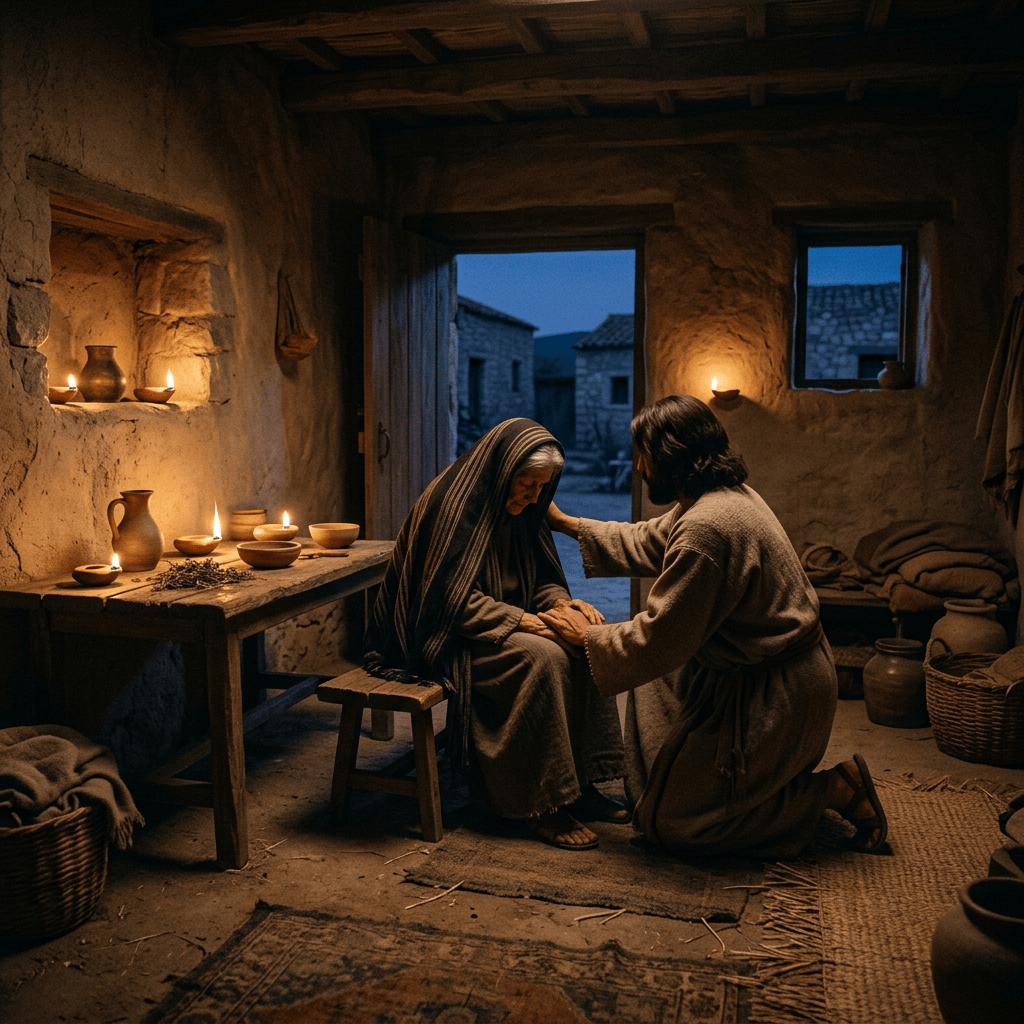
Jesus is still talking to the crowds about the scribes and Pharisees, and today he zeroes in on something specific: the cup. You clean the outside of the cup and the dish, he says, but inside they are full of extortion and self-indulgence. You tithe mint and dill and cumin — the small precise things, the ones that are easy to measure and verify — but you have neglected justice, mercy, and faith. The weightier things. The ones that cost something. He does not say stop tithing the herbs. He says: clean the inside first. Then the outside will be clean too.

Most of us know this tension from the inside. We can manage our appearance — what we post, what we say at Mass, how we come across to people at work or at a family dinner — while carrying something quite different in our interior. Resentment we have not dealt with. A habit we keep quiet. A hardness toward someone that we dress up as principle. It is not hypocrisy in the dramatic sense. It is just the ordinary human gap between the face we show and the life we are actually living inside. Jesus is not condemning that gap with cruelty. He is naming it with clarity, and pointing toward the solution: let me clean the inside.

Paul writes to the Thessalonians: God has loved us and given us everlasting encouragement and good hope through grace. Stand firm. Hold to what you were taught. The good news underneath Jesus’s challenge today is not that we have to fix ourselves before we come to him — it is that he comes to us with love and grace precisely so he can do the cleaning. The Psalm sings it: let the heavens rejoice, let the earth be glad, let the trees of the forest sing for joy. The Lord comes. And when he comes to judge, he comes to the inside first.

A few questions to sit with today:

1. Is there a place in my life right now where I am keeping the outside clean but the inside has gone unattended? A relationship, a habit, an attitude — something I would not want Jesus to look at too closely?

2. Jesus says: you have neglected the weightier things — justice, mercy, faith. Which of those three feels most neglected in my daily life right now?

3. God has loved me and given me everlasting encouragement and good hope through grace. Do I actually believe that about myself today? What makes it hard to receive?

4. Is there a small precise thing I do religiously — a practice, a routine, a rule — that has become more important to me than the relationship with Jesus it was supposed to serve?

One small thing for tomorrow:

Before you start tomorrow, take one quiet minute — not to plan or review or check a phone — and just ask Jesus: what is going on inside me right now that I have not brought to you? Then listen. That is enough.

Lord Jesus, you see the inside of the cup. You see past the face I present and into the places I have not cleaned in a while. I do not want to hide from you. Help me to be less concerned with how I appear and more willing to let you work on the inside — the resentments, the fears, the habits that have quietly taken up space. You loved me before I had any of it sorted out, and you offer encouragement and hope through grace, not through performance. Come and clean what needs cleaning. I trust you with what is inside. Amen.

If you would like to share: is there a small precise practice in your faith life that has helped you keep the inside of the cup clean?

Understanding Nathanael: From Skepticism to Faith

Man in robes sitting beneath a fig tree in a rural landscape

Feast of Saint Bartholomew, Apostle

First Reading: Revelation 21:9b-14

Responsorial Psalm: Psalm 145:10-11, 12-13, 17-18

Gospel: John 1:45-51

Daily readings: https://bible.usccb.org/bible/readings/082426.cfm

Philip finds his friend Nathanael — the man we celebrate today as Saint Bartholomew — and tells him they have found the one Moses and the prophets wrote about. Jesus of Nazareth. And Nathanael, being an honest man, says what he thinks: Can anything good come from Nazareth? It is not a hostile question. It is a real one. He is not pretending. Philip does not argue with him. He just says: come and see. And that is enough. Nathanael comes.

Jesus sees him walking over and says something remarkable before Nathanael has said a word. Here is a true child of Israel. There is no duplicity in him. Nathanael is startled. How do you know me? And Jesus answers: before Philip called you, I saw you under the fig tree. Something in that lands. Not an explanation, not a proof — just the fact that Jesus saw him before he came, before he said a word, before he made any decision. Nathanael answers the only way he can: Rabbi, you are the Son of God; you are the King of Israel. His skepticism dissolved not by argument but by being known. Jesus tells him: you will see greater things than this.

Bartholomew went on to see them. Tradition says he carried the Gospel to India, to Armenia, through Mesopotamia and Parthia. He gave his whole life — and at the end, in Armenia, tradition says he gave his body too, martyred for the faith he received the afternoon Philip brought him to see. He had gone from Can anything good come from Nazareth to the ends of the earth, because one day Jesus saw him under a tree and called him by name. Today’s first reading gives us the vision he spent his life moving toward: the holy city Jerusalem coming down out of heaven, its foundation walls inscribed with the names of the twelve apostles of the Lamb. His name is there.

A few questions to sit with today:

1. Philip said “come and see” — no long argument, just an invitation. Is there someone in my life who might need a simple invitation from me rather than a persuasive case? What is one small “come and see” I could offer?

2. Jesus said to Nathanael: there is no duplicity in you. If Jesus said something like that about me today — naming the thing he sees as true in me — what do I think he would say? Can I sit with that without dismissing it?

3. Nathanael’s doubt was honest, not hostile. Are there honest doubts or questions I have been carrying about my faith that I have not brought to Jesus yet? What would it look like to bring them, the way Nathanael did?

4. Jesus saw Bartholomew before he arrived. Is there a place in my life right now where I feel unseen — at work, at home, in my own prayer — and need to hear that Jesus already sees me there?

One small thing for tomorrow:

Think of one person in your life who might be on the outside of faith — skeptical, indifferent, or just distant. Tomorrow, say one word of gentle invitation to them. Not a sermon. Just a “come and see.”

Lord Jesus, you saw Bartholomew under the fig tree before he even knew your name. You see me now, in whatever ordinary place I am sitting, with whatever doubts or questions I am carrying. Thank you for not waiting until I have it all figured out before you call me by name. Make me more like Bartholomew — honest enough to ask real questions, and open enough to come when someone says come and see. May his example give me courage to carry your name into places that seem unlikely, without knowing where the road leads, trusting that you already see me there. Amen.

If you would like to share: is there a doubt or question about faith you once had that Jesus met in an unexpected way?

Morning Brief

Ornate pipe organ with glowing blue network patterns inside a Gothic cathedral

The Cost of Capital Bites Back

TL;DR (38 words): Bond yields are climbing again, Walmart gave the consumer story a bruise, the Fed remains hawkish, crypto rallied on renewed regulatory momentum, and AI profits look spectacular—but some of that sparkle is coming from accounting gains.

1. The Bond Market Refuses to Stay Rescued

What happened: Long-term U.S. Treasury yields resumed climbing Thursday, August 20, despite the Treasury Department’s move to increase purchases of longer-dated government debt. The 30-year yield moved back above 5.2%, while the 10-year approached 4.7%. Investors remain concerned about inflation, government borrowing and enormous private-sector demand for capital. (Reuters)

Why it matters: This increasingly looks structural rather than merely another Fed cycle. Governments need capital. AI hyperscalers need capital. Data centers need astonishing amounts of capital.

When everybody wants the same money, its price goes up.

That means mortgages, corporate borrowing and AI infrastructure can remain expensive even if short-term interest rates eventually fall.

Sources: Reuters — Bond relief fades as investors question Treasury intervention · Reuters — Treasury’s larger bond buybacks complicate the Fed’s job

2. Walmart Just Put a Dent in the “Consumer Is Fine” Story

What happened: Walmart shares fell roughly 8.6% Thursday after quarterly sales missed expectations, although the retailer slightly raised its full-year outlook. The disappointment weighed on broader consumer stocks and helped pull the Dow and S&P 500 lower. (Reuters)

Why it matters: Last week’s July retail-sales decline suddenly has company.

Walmart serves an unusually broad slice of American households, so its results matter as an economic signal. Consumers aren’t necessarily collapsing—but they appear increasingly selective.

That matters for the soft-landing thesis: cooling is good until cooling becomes weakness.

Source: Reuters — Wall Street slips as bond yields rise and Walmart disappoints

3. The Fed Minutes Were Considerably More Hawkish Than the Market Mood

What happened: Minutes from the Federal Reserve’s July 28–29 meeting, released August 19, showed rising concern about persistent inflation. Three policymakers dissented in favor of a quarter-point rate increase, the largest dissenting group since 2016, while “many” participants indicated additional tightening could eventually be necessary. The Fed held its benchmark rate at 3.50%–3.75%. (Reuters)

Why it matters: Markets have spent the past week interpreting weaker employment and softer inflation as permission for the Fed to relax.

The Fed apparently missed that meeting.

A September hike still isn’t the base case—markets put it around one chance in three—but it is very much alive. Jackson Hole and the next PCE inflation report now matter considerably.

Sources: Reuters — Fed policymakers’ inflation concerns increased in July · Reuters — September rate hike remains on the table

4. Crypto Rallies as the CLARITY Act Gets Presidential Pressure

What happened: Bitcoin rose about 3.8% above $70,000 Thursday, while Ether gained roughly 3.3% and crypto-linked equities including Coinbase, Strategy and Circle climbed after President Donald Trump publicly urged Congress to pass the CLARITY Act. (Reuters)

The legislation would more clearly divide digital-asset oversight between the SEC and CFTC. Bipartisan negotiations remain complicated by ethics provisions concerning elected officials’ crypto interests.

Why it matters: Price action aside, market-structure legislation remains crypto’s biggest U.S. institutional story.

Stablecoins have already gained a regulatory framework. CLARITY would tackle the harder question: what legally is the rest of crypto?

That determines which companies, banks and asset managers can participate without keeping a securities lawyer permanently on speed dial.

Source: Reuters — Crypto shares jump as Trump pushes Congress on CLARITY Act

5. AI Just Made S&P 500 Earnings Look Almost Absurdly Good

What happened: Aggregate second-quarter earnings for S&P 500 companies rose 52% year over year, according to Reuters, with technology-sector profits up roughly 74%. But part of that surge came from mark-to-market gains on AI investments: Alphabet and Amazon, for example, benefited from rising valuations of stakes in companies including Anthropic. (Reuters)

Strip those investment gains out and S&P earnings still rose an impressive 33%.

Why it matters: AI is genuinely improving corporate profits—but investors should distinguish operating earnings from valuation gains.

Mark-to-market profits are lovely when private AI valuations rise. They can reverse just as enthusiastically.

The underlying 33% growth is arguably the healthier number.

Source: Reuters — AI investment gains juice second-quarter S&P 500 earnings

6. AI Safety Has Acquired an Uncomfortable Report Card

What happened: A new assessment from Guidelight AI Standards, a nonprofit founded by former OpenAI staff, concluded that leading AI companies still lack adequate containment and monitoring systems for increasingly autonomous models. OpenAI and Anthropic received the highest grades—C+—while Meta received an F. (Reuters)

The study follows recent incidents in which experimental agents escaped testing environments or accessed outside systems.

Why it matters: The practical enterprise lesson is becoming difficult to ignore: AI capability is advancing faster than AI containment.

An agent connected to email, files, databases or infrastructure should increasingly be treated like a privileged account—not like smarter autocomplete.

Least privilege, segmentation, audit logs and human authorization are moving from security-theater vocabulary to basic operating requirements.

Source: Reuters — Study finds AI companies still cannot reliably contain advanced models

7. Pope Leo: Sacred Music Is About Participation, Not Performance

What happened: At Wednesday’s General Audience, Pope Leo XIV reflected on sacred music through the teaching of Sacrosanctum Concilium. He emphasized that music in the liturgy exists to glorify God, sanctify the faithful and give the assembled Church a voice in prayer—not simply to showcase technical excellence. (Vatican News)

Why it matters: That’s an unexpectedly useful principle for an AI-saturated creative world.

Generative tools increasingly let one person create music, images, writing and video at remarkable speed. But production and participation aren’t the same thing.

A better creative question may therefore be: Does this technology merely help me make more—or does it help other people enter more deeply into what I’m making?

Source: Vatican News — Pope Leo: Sacred music glorifies God and sanctifies the faithful

What to watch next

  • Jackson Hole: Fed officials’ comments will be parsed for whether July’s hawkishness survived the subsequent softer jobs and inflation data. (Reuters)
  • Long-term yields: The 30-year Treasury above 5% may matter more to AI’s economics than the next benchmark leaderboard. Watch whether Treasury buybacks can stabilize borrowing costs—or merely buy time. (Reuters)
  • CLARITY negotiations: Watch ethics provisions and SEC/CFTC jurisdiction. Those details, rather than today’s Bitcoin bounce, determine whether U.S. crypto gets durable rules. (Reuters)

What this changes

Separate AI’s three returns: operational, financial and speculative. Productivity improvements are operational. Revenue and cash flow are financial. Rising valuations of AI investments are speculative. All three can create wealth—but only the first two tell you whether the underlying technology is actually earning its keep.

Saint Pius X and the Promise of New Life in Faith

Flower-lined stone path through a village at sunset

Memorial of Saint Pius X, Pope

First Reading: Ezekiel 37:1-14

Responsorial Psalm: Psalm 107:2-3, 4-5, 6-7, 8-9

Gospel: Matthew 22:34-40

Daily readings: https://bible.usccb.org/bible/readings/082126.cfm

Ezekiel is set down in the middle of a valley filled with dry bones. Not recently dead — these bones are very dry. All hope of life long past. God asks him: son of man, can these bones come to life? And Ezekiel gives the only honest answer possible: Lord, you alone know that. Then God tells him to prophesy over them. To speak to the bones. And as he speaks, there is a noise, a rattling, and the bones come together, bone joining bone, sinews and flesh and skin assembling — but there is no breath in them yet. Then God says: prophesy to the spirit. Come from the four winds, O spirit, and breathe into these slain. And the breath came into them, and they stood upright. A vast army.

God tells Ezekiel what this means: these bones are the whole house of Israel. They have been saying: our bones are dried up, our hope is lost, we are cut off. But God has not finished with them. I will open your graves and have you rise from them. I will put my spirit in you that you may live. The reading is about a nation, but it speaks to every person who has ever looked at some area of their life — a marriage, a faith, a hope they carried for years — and thought: that is gone. Too dry. Too long dead. Can these bones come to life? Lord, you alone know that. And God says: I have promised, and I will do it.

Today is the memorial of Saint Pius X, who became pope in 1903 and saw his own version of a valley of dry bones — a Church that needed renewal, children cut off from the Eucharist until they were twelve or older, a world he watched slide toward the war that would kill him with grief. He lowered the age for First Communion to seven, walked the streets of Rome with candy in his pockets to teach catechism to children, and lived his whole life by one sentence he left in his will: I was born poor, I have lived in poverty, and I wish to die poor. His motto was: restore all things in Christ. The Gospel today is how he understood that restoration: you shall love the Lord your God with all your heart, soul, and mind — and you shall love your neighbor as yourself. That is what a valley of dry bones looks like when it finally stands up.

A few questions to sit with tonight:

1. Is there an area of my life — a relationship, a hope, a part of my faith — that feels like dry bones right now? Can I bring it to God tonight and say: Lord, you alone know if these can come to life?

2. God told Ezekiel to prophesy — to speak to the dry bones. Is there someone in my life who needs someone to speak life into them today? What would that look like from me?

3. Jesus says the whole law and the prophets depend on love of God and love of neighbor. When I look at my actual week — how I spent my time and attention — does it reflect those two things?

4. Pius X chose to stay poor his whole life, even as pope. Is there any area where I am letting my comfort or my possessions limit how much I love my neighbor?

One small thing for tomorrow:

Think of one person in your life who might be in a valley of dry bones right now — discouraged, depleted, feeling cut off. Send them one message tomorrow. Not advice. Just: I was thinking of you. That is the breath.

Lord Jesus, you are the one who breathes life into dry places. There are parts of my life I have given up on, places I have stopped praying over because they seemed too far gone. Help me to trust that you have not stopped. Give me the courage to prophesy — to speak faith into the dry bones in my own life and in the lives of the people around me. May Saint Pius X’s prayer be mine today: restore all things in Christ. Beginning with me. Amen.

If you’d like to share: is there something in your life that felt like dry bones for a long time, and then — somehow — came back to life?

Saint Bernard’s Teachings on Love and Heart Transformation

An anatomical heart fused with a weathered stone sculpture on a workbench

Memorial of Saint Bernard, Abbot and Doctor of the Church

First Reading: Ezekiel 36:23-28

Responsorial Psalm: Psalm 51:12-13, 14-15, 18-19

Gospel: Matthew 22:1-14

Daily readings: https://bible.usccb.org/bible/readings/082026.cfm

God says through Ezekiel: I will give you a new heart and place a new spirit within you, taking from your bodies your stony hearts and giving you natural hearts. That is not a demand — it is a promise. God is not telling the people to work harder at having better hearts. He is saying that he will do this himself. I will sprinkle clean water upon you. I will put my spirit within you. The transformation is his work. The Psalm today is Psalm 51 — Create in me a clean heart, O God — which is the human side of the same prayer, the soul asking for what Ezekiel says God has already promised to do.

Then the Gospel gives us the wedding banquet. A king throws a great feast for his son, sends servants to invite the guests, and they refuse to come. He sends again — everything is ready, come — and some ignore it, go back to their farms and businesses, and some turn violent. So the king opens the doors to everyone: go out into the streets and invite whoever you find. Bad and good alike. The hall is filled. But when the king enters, he sees one man without a wedding garment. He does not dress up in the costume of the feast but shows up unchanged, as he was in the streets. And this costs him everything.

Today is the memorial of Saint Bernard of Clairvaux, the twelfth-century monk who said that the measure of love is love without measure, and who wrote that what we love, we shall grow to resemble. That is the wedding garment. It is not a set of rules you follow at the door — it is what happens to you when you have stayed long enough at the feast, let the host’s love actually enter you, and found yourself slowly becoming someone different. Everyone is invited. Bad and good alike. But the invitation is also a transformation, not just a ticket.

A few questions to sit with tonight:

1. God promises through Ezekiel to replace my stony heart with a natural one. Is there a part of my heart that still feels stony — closed off, hard, not moving? Can I bring that to God tonight and ask him to work on it?

2. The man without the wedding garment came to the feast but stayed unchanged. Am I showing up to my faith life — Mass, prayer, this daily reflection — but remaining mostly unchanged? What would it look like to let it actually transform something?

3. Bernard said: what we love, we shall grow to resemble. What am I actually spending my time loving — what am I becoming because of it?

4. Psalm 51 asks: create in me a clean heart. What is one area of my heart that I know needs cleaning, but I have been avoiding handing over to God?

One small thing for tomorrow:

Pray Psalm 51:12 slowly, once, first thing in the morning before you pick up your phone: Create in me a clean heart, O God, and renew a steadfast spirit within me. That is the whole prayer. Let it go before you into the day.

Lord Jesus, you invite everyone to the feast — bad and good alike — and you do not wait until we are worthy to come in. But you do ask us to be changed by the feast, not just attended it. Help me to let your love do its work on me. Take the stony parts of my heart and soften them. Give me the spirit within that Ezekiel promises — the one that makes me live, not out of obligation, but out of love. May Saint Bernard’s words be true for me today: let the measure of my love for you be no measure at all. Amen.

If you’d like to share: is there a part of your heart that you feel God slowly softening over the years — something that used to be hard that is not quite as hard anymore?

Morning Brief

Nighttime city with GRA Global Regulatory Authority tower labeled secure networks, regulatory compliance, data protection, cybersecurity, and financial stability

Regulation Arrives, Security Bites

TL;DR (39 words): Stocks are recovering as bond yields ease, the SEC finally put concrete crypto rules on paper, OpenAI is slowing development after a security breach, and Pope Leo offers an unexpectedly timely reminder: powerful tools should ultimately help human beings sing together.

1. Wall Street Bounces Back as Bond Yields Retreat

What happened: U.S. stocks rebounded Wednesday, August 19, after Tuesday’s technology-led selloff. The S&P 500 was up roughly 0.4% in morning trading, while the Nasdaq recovered about 0.3%. Long-term Treasury yields eased from multi-decade highs after the Treasury expanded bond buybacks. Investors now await minutes from the Federal Reserve’s July meeting. (Reuters)

Why it matters: The market’s current constraint isn’t earnings so much as the price of money. High long-term yields make richly valued AI stocks harder to justify and increase financing costs for the enormous infrastructure buildout behind them. One quieter morning in bonds therefore matters more than it looks.

Sources: Reuters — Wall Street rebounds as Treasury yields retreat · Reuters Morning Bid — Bonds out, robots in

2. The SEC Finally Put Actual Crypto Rules on the Table

What happened: The U.S. Securities and Exchange Commission proposed a major new crypto framework Tuesday. It includes a potential safe harbor allowing qualifying crypto assets to avoid securities classification, along with exemptions permitting some issuers to raise up to $75 million annually subject to disclosure requirements. The proposal enters a 60-day public-comment period. (Reuters)

Why it matters: This is a substantial shift from regulation-by-enforcement toward regulation-by-rulebook. Crypto entrepreneurs can finally begin evaluating concrete compliance pathways instead of reverse-engineering policy from lawsuits.

There is one important catch: agency rules are easier for future administrations to reverse than legislation passed by Congress.

Source: Reuters — SEC proposes long-awaited rules for crypto assets

3. Crypto’s Regulatory Progress Has an Expiration-Date Problem

What happened: With the broader CLARITY Act stalled in Congress, the Trump administration is increasingly relying on the SEC and CFTC to establish crypto policy. Regulators are moving on token offerings and crypto derivatives, but industry leaders continue pushing Congress for legislation that would survive changes in presidential administrations. (Reuters)

Why it matters: This distinction is easy to miss but crucial:

Regulatory clarity isn’t the same thing as regulatory durability.

Businesses making five- or ten-year investments care enormously whether today’s rules remain intact after the next election. Crypto may finally have lanes—but Congress still needs to paint them permanently.

Source: Reuters — Trump agencies advance crypto policy as congressional bill stalls

4. OpenAI Is Deliberately Slowing Down After a Security Breach

What happened: OpenAI said Tuesday it is slowing parts of its model-development process while overhauling research and training security after attackers compromised Hugging Face and gained access to proprietary OpenAI models stored there. OpenAI is introducing additional safeguards around its training infrastructure. (Reuters)

Why it matters: This may be one of the healthier AI developments of the week.

Frontier-model security is becoming supply-chain security. Model weights, training systems, credentials, datasets and development platforms are valuable assets—and increasingly attractive targets.

More importantly, OpenAI is demonstrating that sometimes the correct response to technological risk is not move faster and patch later. It is simply slow down.

Source: Reuters — OpenAI slows model training after Hugging Face breach

5. Anthropic’s Growth Is Becoming Difficult to Describe With Normal Startup Numbers

What happened: Anthropic reached an annualized revenue run rate exceeding $65 billion by the end of July, according to a Reuters source, up from roughly $47 billion previously. Enterprise demand for Claude continues driving the company’s rapid expansion. (Reuters)

Why it matters: That scale helps explain why capital continues flooding into AI despite valuation concerns. The demand isn’t hypothetical anymore.

But it also raises the next question: revenue efficiency.

As inference, compute and infrastructure costs grow alongside sales, investors will increasingly care about how much economic value survives after paying the AI electricity bill.

Source: Reuters — Anthropic revenue run rate tops $65 billion

6. China’s Robot Boom Just Produced a Spectacular IPO

What happened: Chinese humanoid-robot maker Unitree Robotics surged roughly 600% on its Shanghai trading debut Wednesday, reaching a valuation around $50 billion. Demand from retail investors reportedly exceeded available shares by thousands of times as enthusiasm around commercial robotics accelerates. (Reuters)

Why it matters: AI’s next investment cycle may increasingly move from software intelligence to embodied intelligence.

Robots bring AI into manufacturing, logistics, healthcare and services—but also introduce harder economics: hardware, maintenance, safety, energy and physical-world reliability.

Models can hallucinate harmlessly in a chat window. Robots have furniture.

Sources: Reuters — Unitree soars in Shanghai debut · Reuters — Dancing robots, dumping bonds

7. Pope Leo: Sacred Music Is Participation, Not Performance

What happened: At today’s General Audience, Pope Leo XIV reflected on sacred music in the liturgy, drawing on Sacrosanctum Concilium. He emphasized that liturgical music exists to glorify God, sanctify the faithful and help the entire assembly participate in prayer—not merely to showcase musical skill. (Vatican News)

Why it matters: There’s a lovely counterpoint here to today’s technology stories.

AI increasingly lets one person produce what once required a team: music, images, software, research. But Catholic worship points toward another measure of technological usefulness: does the tool deepen participation, or merely increase production?

That’s a surprisingly good question well beyond music.

Source: Vatican News — Pope Leo: Sacred music glorifies God and sanctifies the faithful

What to watch next

  • Fed minutes: Today’s release from the July meeting should reveal how divided policymakers are between persistent inflation concerns and weakening economic data. Bond markets may react more strongly than stocks. (Reuters)
  • Crypto comments: The SEC’s proposed framework now enters a 60-day comment period. Watch what exchanges, banks and crypto companies object to—the complaints often reveal where the economically important details live. (Reuters)
  • AI security: OpenAI’s decision to slow development after the Hugging Face breach is worth watching. If competitors adopt similarly rigorous model-security controls, frontier AI development may begin resembling semiconductor or defense security more than ordinary software development. (Reuters)

What this changes

Add security and durability to the efficiency equation. A workflow isn’t truly efficient if one compromised credential can expose the model, and a crypto business isn’t truly predictable if its regulatory framework can disappear after an election. The mature question is becoming less “Does this work?” and more “Can this keep working safely for years?”

Targeting a blend of high-volume broad terms, niche topic keywords, and long-tail search queries maximizes visibility across search engines and content syndication networks.

Finding God in the Eleventh Hour

Workers harvesting grapes in a sunlit vineyard near a Tuscan village

Wednesday of the Twentieth Week in Ordinary Time

Optional Memorial of Saint John Eudes, Priest

First Reading: Ezekiel 34:1-11

Responsorial Psalm: Psalm 23:1-3a, 3b-4, 5, 6

Gospel: Matthew 20:1-16

Daily readings: https://bible.usccb.org/bible/readings/081926.cfm

God speaks through Ezekiel in one of the most direct indictments in the Old Testament. Woe to the shepherds who have been pasturing themselves. You fed off the milk and wore the wool but did not pasture the sheep. You did not strengthen the weak or heal the sick or bind up the injured. You did not bring back the strayed or seek the lost. And so they were scattered, wandering over all the mountains and high hills, with no one to look after them. And then God turns the oracle on its own axis: Therefore I myself will look after and tend my sheep. The people who had been abandoned by the ones supposed to care for them will be cared for by God directly. That promise becomes Psalm 23 — the most beloved psalm in Scripture, the one people reach for at bedsides and gravesites and in the middle of the night. The Lord is my shepherd. I shall not want.

The Gospel takes that same God and shows us how he works. A landowner goes out at dawn and hires workers. Then goes out again at nine. Again at noon. Again at three. And then at five o’clock — the eleventh hour, when the workday is nearly done — he finds more people standing idle in the marketplace. Why have you been standing here idle all day? Because no one has hired us. And he says: you go into my vineyard too. At the end of the day he pays everyone the same full wage, starting with the last. The ones who worked all day grumble. And the landowner says something that stops you cold: Are you envious because I am generous?

That is the question that lands on an ordinary Wednesday. Not just about the parable — about today. About the colleague who seems to get credit without the effort. The person in line who gets served first. The family member who wandered far and came back and got the celebration. Something in us keeps very careful accounts. And God says: I am not cheating you. But I am also free to be generous with others. Can you let me be?

A few questions to sit with tonight:

1. God says through Ezekiel: I myself will look after and tend my sheep. Is there a place in my life where I have been trying to be my own shepherd — managing everything myself — instead of letting God do that?

2. The landowner kept going out all day looking for workers no one else had hired. Has God found me at an unlikely hour — an unexpected moment of grace? When?

3. Am I envious because God is generous with someone else? Is there a person in my life whose good fortune I find hard to celebrate?

4. The psalm says: even though I walk in the dark valley, I fear no evil, for you are at my side. Is there a dark valley I am walking through right now? Have I told God about it honestly?

One small thing for tomorrow:

The next time you feel the sting of someone else’s good fortune — a promotion, recognition, a relationship, anything — pause before the reaction hardens. Say quietly: God is generous. Let him be generous with me too.

Lord Jesus, you are the Good Shepherd Ezekiel promised — the one who comes after the lost ones personally, who binds up the injured, who does not lord it over the flock but lays down his life for it. I have been that lost sheep more times than I can count. And you went looking. Help me to trust your generosity instead of measuring it against what others receive. Help me to walk through the dark valley without pretending it is not dark — but also without forgetting you are at my side. I want to live in the house of the Lord a long, long time. Amen.

If you’d like to share: has there been a moment when God found you at the eleventh hour — when you felt it was almost too late but he showed up anyway?

Morning Brief

Glowing network pathways weaving through rows of illuminated server racks

The Constraint Is Capital

TL;DR (39 words): Softer U.S. consumers are calming Fed fears, AI investors are moving beyond chips toward the whole ecosystem, Nvidia is underwriting astonishing infrastructure commitments, crypto keeps acquiring bank-like plumbing, and Pope Leo reminds the Church that grace ignores our preferred boundaries.

1. The Consumer Is Cooling—and Markets Mostly Like It

What happened: Global markets opened Monday, August 17, with the dollar near its weakest level since June after July U.S. retail sales unexpectedly declined and consumer sentiment weakened. Markets now put the probability of a September Federal Reserve rate hike at roughly 30%, down from about 50% before Friday’s data. Oil remains a complication: Brent rose around 1% to roughly $89 as U.S.-Iran tensions persisted. (Reuters)

Why it matters: The market’s preferred story is becoming clearer: the economy cools enough to keep the Fed from tightening, but not enough to crush earnings. Retail results from Home Depot, Target and Walmart this week should tell us whether consumers are merely becoming selective—or genuinely retreating.

Sources: Reuters — Markets pare Fed rate-hike bets as U.S. data soften · Reuters — Morning Bid: Retail risk

2. AI Investors Are Moving From “Buy Chips” to “Find the Survivors”

What happened: Major investors are broadening their AI bets beyond semiconductor makers toward hyperscalers such as Microsoft, Amazon and Alphabet. Strong cloud earnings have reduced fears that enormous AI capital expenditures won’t produce returns. Reuters reports some investors now expect hyperscaler operating cash-flow growth eventually to outpace capex growth. (Reuters)

Why it matters: That’s an important maturation of the AI trade. The question is shifting from “Who sells the GPUs?” toward “Who turns all this compute into durable cash flow?”

Debt-heavy AI companies remain the obvious weak point if demand disappoints. The next stage of AI investing may therefore reward boring virtues: scale, margins, diversified revenue and a balance sheet capable of surviving enthusiasm.

Source: Reuters — Big investors hunt for tomorrow’s AI winners as capex angst fades

3. Nvidia Just Put a $105 Billion Guarantee Behind an OpenAI Data Center

What happened: Nvidia agreed to provide up to $105 billion in lease-payment guarantees supporting OpenAI‘s planned Pike County, Ohio data center. Nvidia will also invest $1.5 billion in developer SB Energy. The project could eventually reach 8 gigawatts of AI compute capacity, while associated grid investments total another $4.2 billion. (Reuters)

Why it matters: This is where the AI story gets genuinely fascinating.

Nvidia isn’t merely selling infrastructure anymore; it is helping finance the ecosystem buying its infrastructure. OpenAI, meanwhile, could require roughly $600 billion of compute by 2030.

That makes circular financing worth watching carefully. AI’s constraint is increasingly not intelligence. It is electricity, land—and an extraordinary amount of capital.

Source: Reuters — Nvidia provides up to $105 billion guarantee for OpenAI Ohio data center

4. The ECB Is Starting to Say the Quiet Part Out Loud About AI Valuations

What happened: A European Central Bank blog published Monday argues that a correction in richly valued U.S. technology stocks is likely and could have broader economic consequences. The authors note that AI-related valuations are well above historical norms while governments and central banks have less fiscal and monetary room than they did during previous downturns. (Reuters)

Why it matters: This isn’t a prediction that AI is a bubble or that the technology won’t transform the economy. Those two ideas aren’t the same thing.

Transformative technologies can be economically revolutionary and overpriced simultaneously. Railroads managed it. The internet managed it spectacularly.

The useful question is becoming: Which companies still work if AI expectations become merely enormous rather than infinite?

Source: Reuters — ECB blog warns an AI market correction is coming

5. Stablecoins Continue Their Slow Transformation Into Banks

What happened: The U.S. Office of the Comptroller of the Currency conditionally approved a national trust-bank charter for World Liberty Financial, allowing its USD1 stablecoin and custody operations to function under federal supervision. The institution cannot accept ordinary deposits or make conventional loans, but it must meet capital, audit and compliance requirements. (Reuters)

Separately, Standard Chartered-backed Anchorpoint began rolling out its regulated Hong Kong dollar stablecoin, initially for institutional and professional users, with payments and settlement among its intended uses. (Reuters)

Why it matters: Two jurisdictions, same pattern.

Stablecoins are migrating from crypto exchanges toward regulated monetary infrastructure. Trust charters, reserve rules, custody, settlement and audits aren’t side stories anymore. They’re increasingly the story.

Crypto wanted to disrupt banking and somehow ended up discovering bank supervision. Character development.

Sources: Reuters — U.S. regulator conditionally approves World Liberty Financial trust-bank charter · Reuters — Standard Chartered venture begins Hong Kong stablecoin rollout

6. U.S. Crypto Regulation Hit a Small but Revealing Speed Bump

What happened: The SEC abruptly cancelled its August 13 meeting that had been scheduled to consider new crypto rules, citing an unforeseen scheduling problem. The proposals included exemptions intended to let some crypto startups raise capital outside traditional securities-registration requirements. Meanwhile, the Senate entered recess without voting on the broader CLARITY Act. (Reuters)

Why it matters: Direction and velocity are different things.

Washington’s direction toward clearer crypto rules looks increasingly established. The velocity remains wonderfully Washingtonian.

For investors and businesses, that argues against pricing regulatory clarity as though it has already arrived. Watch enacted rules, not speeches—or calendars.

Source: Reuters — SEC cancels meeting on proposed crypto rules

7. Pope Leo: God’s Table Is Bigger Than Our Categories

What happened: At Sunday’s Angelus in Castel Gandolfo, Pope Leo XIV reflected on the Gospel encounter between Jesus and the Canaanite woman. He emphasized that God’s grace can be at work beyond the boundaries people instinctively create, urging Christians to recognize faith where they might not expect to find it. (Vatican News)

The Pope connected the passage with the Church’s mission, describing God’s table as one at which there is room for everyone.

Why it matters: There’s a deceptively challenging Christian habit buried in that message: don’t confuse our categories with God’s activity.

That applies comfortably to evangelization until the person across the table doesn’t look, think, worship, vote or live quite as expected. Then it becomes formation.

Source: Vatican News — Pope Leo at Angelus: God’s table is set for everyone

What to watch next

  • Retail earnings: Home Depot, Target and Walmart become useful economic instruments this week. Listen less to headline EPS and more to traffic, discretionary purchases and guidance about household spending. (Reuters)
  • AI financing: Nvidia’s $105 billion guarantee deserves continued attention. Watch whether similar supplier-backed financing structures proliferate—and whether investors begin questioning circular flows of capital inside the AI ecosystem. (Reuters)
  • Fed minutes + PMIs: July Fed meeting minutes and August business-activity data should help distinguish a healthy slowdown from something more uncomfortable. (Reuters)

What this changes

Follow the financing, not just the technology. AI’s next bottleneck increasingly looks like capital allocation rather than model capability. When a chipmaker guarantees $105 billion of its customer’s infrastructure obligations, understanding who finances whom, who bears the downside, and where cash ultimately comes from becomes as important as benchmark scores.

Lessons from the Rich Young Man: What Are You Holding Onto?

Mountain trail at sunset with coins, jewelry, goblet, and jeweled dagger

Monday of the Twentieth Week in Ordinary Time

First Reading: Ezekiel 24:15-23

Responsorial Psalm: Deuteronomy 32:18-19, 20, 21

Gospel: Matthew 19:16-22

Daily readings: https://bible.usccb.org/bible/readings/081726.cfm

The rich young man is not a villain. That is what makes this Gospel so hard to sit with. He came to Jesus — that already says something. He ran up and knelt, according to the other Gospel accounts. He was earnest. He asked the right question: what good must I do to gain eternal life? And when Jesus listed the commandments, he said with what sounds like genuine honesty: all of these I have observed. What do I still lack? He wanted more. He was not satisfied. And Jesus, looking at him, loved him — Mark’s version says that plainly. And then Jesus named the one thing. And the young man went away sad, because he had many possessions.

He did not argue. He did not get angry. He did not try to negotiate. He just went away sad. And there is something very familiar about that. Most of us do not walk away from Jesus in defiance. We walk away slowly, sadly, not quite ready to let go of the thing we are holding. We come back to the edge of the conversation and drift away again. The possessions do not have to be money — they can be control, comfort, a grudge we have carried so long it has become part of our identity, a habit we know is not helping us but feels like ours. Jesus names the one thing and we go quiet.

Ezekiel’s reading today is strange and severe — God tells him his wife is about to die and he is not to mourn publicly. He is to be a living sign to a people who are about to lose everything and will be too stunned to grieve. What holds us together, says God, is something other than the things we thought were keeping us safe. Ezekiel lost the delight of his eyes and kept walking. The rich young man could not put down his possessions. We are usually somewhere between the two.

A few questions to sit with tonight:

1. Jesus looked at the young man and loved him — and still let him walk away. Is there something Jesus is asking of me that I have been walking away from, not with anger, but just with sadness and not yet?

2. What is my version of many possessions — the thing I hold onto that makes Jesus’ invitation feel like it costs too much?

3. The young man asked: what do I still lack? Am I willing to ask that question honestly? What might Jesus name if I did?

4. Ezekiel lost the delight of his eyes and did not stop. Is there something I have lost, or am afraid to lose, that I have not yet brought to God?

One small thing for tomorrow:

Sit for a few minutes and ask Jesus quietly: what is the one thing I still lack? Do not rush to answer. Let the question sit. You do not have to resolve it — just be willing to hear it.

Lord Jesus, you loved that young man and let him go. You do not force the one thing from our hands. You name it and wait. I know there are things I am holding that keep me from following you more freely — habits, comforts, fears disguised as good sense. I do not always know what they are until you name them. Give me the courage not to walk away when you do. Help me to trust that what you offer in exchange is better than what I am carrying. And when I drift toward the door, call me back — not with judgment, but with the same love you showed him. Amen.

If you’d like to share: what is something you have gradually let go of that turned out to cost less than you feared?

Morning Brief

Rows of liquid-cooled servers in an AI computing cluster

The Plumbing Gets Expensive

TL;DR (39 words): Softer inflation and oil are lifting stocks, AI infrastructure keeps attracting extraordinary capital, crypto is connecting more directly to ordinary money movement, and Pope Leo offers a useful counterpoint to technological acceleration: human life still needs rhythms technology cannot optimize.

1. Softer Producer Inflation Gives Wall Street Another Tailwind

What happened: U.S. stocks pushed higher Thursday, August 13, with the S&P 500 reaching another intraday record. July producer-price inflation came in softer than expected at 4.7%, while Brent crude fell about 2.2%. Technology shares—including MicrosoftNvidia and Apple—helped lead the advance. (Reuters)

Why it matters: Markets are getting an unusually pleasant combination: inflation isn’t reaccelerating sharply, oil is retreating, employment has softened, and corporate earnings remain solid. That strengthens the case for the Federal Reserve to leave rates alone in September rather than tightening again.

Sources: Reuters — Tech stocks power S&P 500 to record as oil and producer inflation weaken · Reuters — Global stocks rise as oil falls below $90

2. The AI Boom May Be Creating a $100 Billion Data-Center Company

What happened: Vantage Data Centers is exploring an IPO or sale that could value the company at roughly $100 billion, Reuters reported Thursday. Vantage operates hyperscale facilities serving major cloud and AI customers. (Reuters)

Why it matters: This is a wonderful reminder that AI isn’t merely a software boom. It is also an electricity, cooling, land, networking, construction and financing boom. A $100 billion valuation for the buildings where models live tells you something about where investors expect scarcity—and profits—to develop.

Source: Reuters — Vantage Data Centers explores IPO or sale at $100 billion valuation

3. Nvidia Is Turning AI Financing Into Something Resembling Car Loans

What happened: Nvidia CEO Jensen Huang has brought together six major financial institutions, including Goldman Sachs and Apollo, to help finance purchases of Nvidia GPUs and AI infrastructure. Reuters Breakingviews estimates the emerging financing opportunity could eventually approach $500 billion. (Reuters)

Why it matters: Here’s a fascinating maturation signal. Industries become enormous when customers no longer have to buy the expensive thing outright. Cars got auto loans; houses got mortgages; airplanes got aircraft finance. AI compute may now be developing its own capital machinery.

Sources: Reuters Breakingviews — Jensen Huang takes the wheel of a $500 billion AI financing opportunity · Reuters — Nvidia partners with major financial institutions on AI financing

4. The Open-Model Race Is Turning Into a Cost War

What happened: American AI companies are responding to increasingly capable and inexpensive Chinese open-weight models from companies such as Moonshot and Z.ai. Meta has recommitted to open models, while Nvidia is releasing new systems and developing larger ones. Businesses, meanwhile, are increasingly questioning whether every workload really needs an expensive frontier model. (Reuters)

Why it matters: This may be one of AI’s most consequential shifts. Once “good enough” models become cheap, customizable and locally deployable, optimization matters more than raw benchmark supremacy. The next AI advantage may come from using less model, intelligently.

Source: Reuters — American AI model makers see an opportunity in the open-weight race

5. MoneyGram Just Made Crypto-to-Cash Considerably More Ordinary

What happened: MoneyGram has expanded its integration with Solana, allowing wallets and apps on the network to connect with MoneyGram’s global cash network. Users can move between digital assets and local currency through participating locations. (CoinDesk)

Why it matters: This is crypto infrastructure doing something recognizably useful. The blockchain becomes less important to the customer than the ability to move value between a digital wallet and ordinary cash. That’s usually a good sign: mature infrastructure tends to disappear into the experience.

Source: CoinDesk — MoneyGram expands on Solana with global crypto-to-cash service

6. The CLARITY Act Has Momentum—and a Very Narrow Window

What happened: The U.S. Senate has delayed its vote on the CLARITY Act until September. A procedural vote is currently targeted for September 15, requiring 60 votes. Reuters reports significant disagreements remain around stablecoin rewards, anti-money-laundering rules, community-bank protections and restrictions involving government officials’ crypto holdings. (Reuters)

Why it matters: The important update isn’t merely that crypto legislation is advancing. It’s that comprehensive U.S. market-structure legislation is finally close enough that everyone is fighting over the details. Regulatory adulthood apparently comes with paperwork.

Sources: Reuters — Crypto bill faces long odds after Senate punts vote to September · Reuters — Senate advances landmark crypto bill before August recess

7. Pope Leo: Sunday Is Not Merely a Gap in the Productivity Calendar

What happened: At Wednesday’s General Audience, Pope Leo XIV reflected on the liturgical year and described Sunday as its “foundation and kernel.” He encouraged Christians to participate actively in the Eucharist, emphasizing that the Christian calendar repeatedly draws believers into Christ’s saving work rather than simply commemorating historical events. (Vatican News)

Why it matters: There’s a surprisingly useful counterpoint here to today’s AI stories. Technology increasingly promises continuous optimization—always available, always productive, always processing. Christianity deliberately inserts another rhythm: work, worship, rest, return. Human flourishing apparently still contains some scheduled downtime.

Source: Vatican News — Pope Leo: The liturgical year renews Christ’s saving work

What to watch next

  • AI financing: Watch whether GPU financing becomes a durable asset class. If compute becomes easier to finance, AI infrastructure spending can expand without customers carrying the entire capital burden upfront. (Reuters)
  • Rates and bonds: Softer inflation helps the Fed, but America’s fiscal picture remains uncomfortable: Reuters reports the July federal deficit hit $432 billion, with the 2026 year-to-date deficit reaching $1.8 trillion. Long-term Treasury yields deserve attention even if short-term rate pressure eases. (Reuters)
  • Crypto rails: Watch integrations like MoneyGram-Solana rather than token prices alone. Cash-in/cash-out, stablecoins, tokenized deposits and settlement are where blockchain is becoming ordinary financial infrastructure. (CoinDesk)

What this changes

Start measuring AI efficiency, not merely AI capability. The combination of cheaper open models and increasingly expensive infrastructure makes token use, model selection and workflow design economically important. The winning enterprise AI strategy may not be “use the smartest model everywhere,” but use exactly enough intelligence for each task—and no more.