Understanding Luke’s Beatitudes Through Peter Claver’s Life

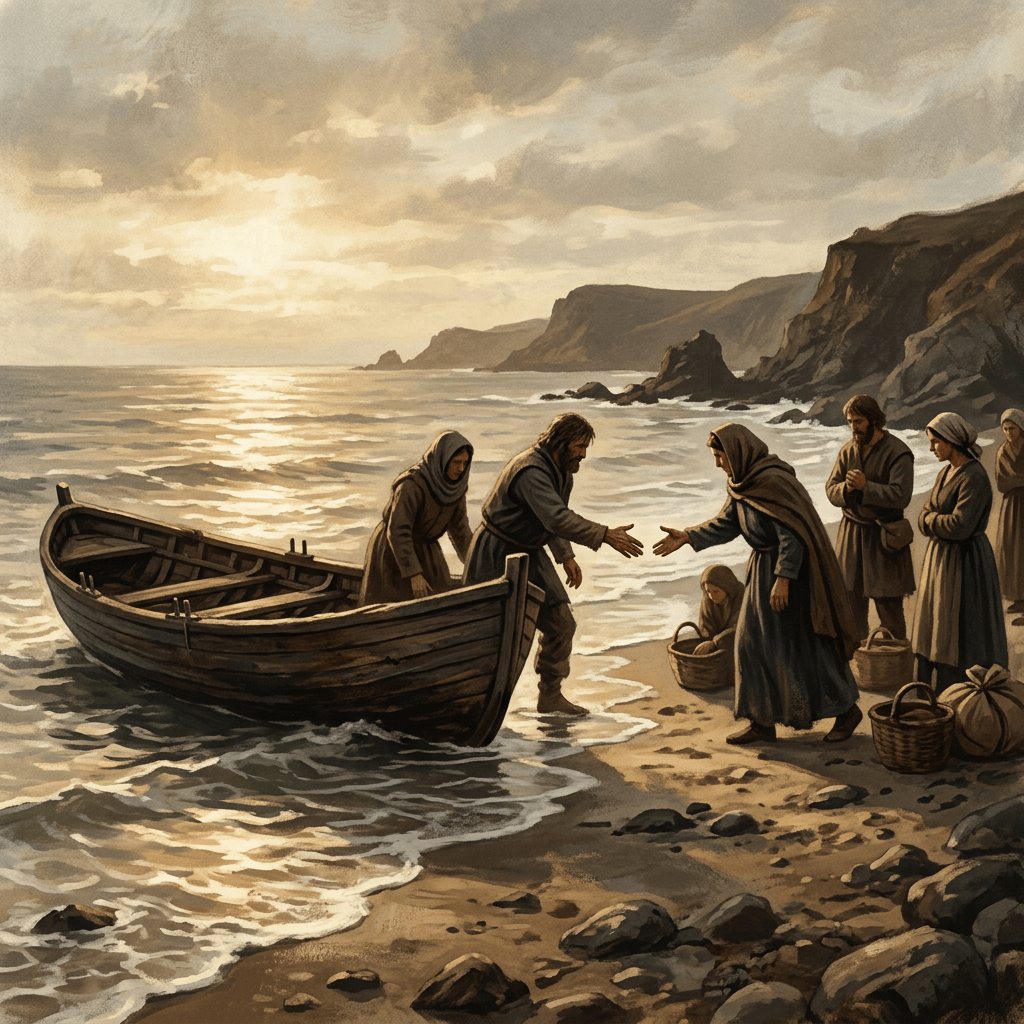
Travelers welcome a man arriving by boat on a rocky shore

Memorial of Saint Peter Claver, Priest

First Reading: 1 Corinthians 7:25-31

Responsorial Psalm: Psalm 45:11-12, 14-15, 16-17

Gospel: Luke 6:20-26

Daily readings: https://bible.usccb.org/bible/readings/090926.cfm

Luke’s Beatitudes are shorter and sharper than Matthew’s. Jesus looks at his disciples and says: blessed are you who are poor — the kingdom of God is yours. Blessed are you who are hungry — you will be satisfied. Blessed are you who weep — you will laugh. Blessed are you when people hate you, exclude you, insult you, and denounce you on account of the Son of Man. Rejoice and leap for joy on that day. Then he turns it over: woe to you who are rich — you have received your consolation already. Woe to you who are filled now. Woe to you when all speak well of you.

That last one is the one worth sitting with. Woe to you when all speak well of you — for their ancestors treated the false prophets in this way. The person who never makes anyone uncomfortable, who has no enemies, who never says anything that costs them — that is not a safe place to be, by Jesus’s measure. The kingdom inverts what looks like security.

Today the Church remembers Peter Claver, a Spanish Jesuit who arrived in Cartagena, Colombia in 1610 and spent forty years boarding slave ships. Cartagena received ten thousand enslaved Africans every year. Claver went into the holds — described by those who saw them as horrifying beyond words — and brought food, medicine, and whatever he could beg. He said: we must speak to them with our hands before we speak to them with our lips. He signed his Jesuit vows: slave of the Africans forever. He baptized an estimated three hundred thousand people. He stayed in the slaves’ quarters rather than the plantation owners’ homes. He lived exactly the Beatitudes he had read: blessed are the poor, blessed are the weeping, blessed are the excluded — and he went to find them.

Paul writes: the world in its present form is passing away. Hold everything lightly. What Cartagena’s society thought was permanent was passing. What Claver was doing was lasting.

A few questions to sit with tonight:

1. Jesus says woe to those when all speak well of them. Is there something true I have held back from saying — at work, at home, in a conversation — because I did not want to lose someone’s good opinion?

2. Peter Claver said: we must speak with our hands before we speak with our lips. Is there someone in my life right now who needs my hands — my presence, my practical help — more than they need my words?

3. The Beatitudes say the poor, the hungry, and the weeping are blessed — not because suffering is good, but because the kingdom belongs to them. Do I actually believe that? How does it show up in how I spend my time and attention?

4. Paul says the world in its present form is passing away — hold lightly what you are holding. What am I gripping too tightly right now that I could loosen my hold on today?

One small thing for tomorrow:

Tomorrow, find one person who is having a hard time — someone weeping, struggling, excluded — and do one thing with your hands. Bring them something. Sit with them. Show up. Let your hands speak first.

Lord Jesus, you said the kingdom belongs to the poor, the hungry, the weeping, the excluded. Peter Claver believed you and spent his life proving it. Help me to believe it too — not just as a doctrine but as something that changes where I go and what I do with my hands. Free me from the need to be spoken well of by everyone. Loosen my grip on what is passing so I can hold more tightly to what lasts. Amen.

If you would like to share: is there someone in your life right now whose burden you could help carry — even in a small way?

Morning Brief

Glowing circuit-patterned olive branch above a sunlit coastal city

CPI Eve, With Oil in the Room

TL;DR (38 words): Stocks slipped as oil complicated tomorrow’s inflation test; AI infrastructure spending keeps getting larger; crypto finally has a concrete SEC rulemaking milestone; and Pope Leo chose “disarming technology” as the Church’s next World Day of Peace theme.

1. Wall Street Backs Away From the Records

What happened: U.S. stocks closed lower Tuesday, August 11: the S&P 500 fell 0.35%, Nasdaq 0.74%, and Dow 0.22%. Fading optimism over reopening the Strait of Hormuz pushed oil higher, while Amazon and Alphabet each dropped more than 2%. (Reuters)

Why it matters: Tomorrow’s CPI was already important. Rising energy prices have now wandered into the room carrying their own inflation spreadsheet.

Sources: Reuters — Wall Street falls as U.S.-Iran optimism fades · Reuters — Oil climbs as global shares retreat

2. Wednesday’s CPI Gets the Big Red Circle

What happened: July U.S. consumer inflation arrives Wednesday, followed by PPI Thursday. Weak July employment data had reduced expectations for further Federal Reserve tightening, but persistent inflation could quickly complicate that story; markets currently see roughly a coin-flip chance of a September hike. (Reuters)

Why it matters: Soft employment plus easing inflation gives the Fed room. Soft employment plus stubborn inflation gives economists new vocabulary words.

Sources: Reuters — Markets await U.S. inflation data · Reuters — Gold and rates ahead of CPI

3. AI’s Next Asset Class: Financing the Machines

What happened: Apollo Global and Blackstone rose after announcing a partnership with Nvidia aimed at mobilizing $500 billion in compute-financing platforms. Separately, Super Micro forecast fiscal-2027 revenue above Wall Street expectations on continued data-center demand. (Reuters)

Why it matters: AI is increasingly a capital-markets story, not merely a software story. Chips require servers; servers require buildings; buildings require power—and somebody has to finance the whole glorious electrical appetite.

Sources: Reuters — Tuesday’s Wall Street report · Reuters — Super Micro raises revenue outlook on data-center demand

4. The SEC Is About to Put Actual Crypto Rules on Paper

What happened: The U.S. Securities and Exchange Commission scheduled an August 19 open meeting to consider proposing “Regulation Crypto,” its first formal rulemaking package intended to create more durable rules for certain digital-asset offerings and transactions. (CoinDesk)

Why it matters: This is more consequential than another enforcement speech. A proposed rule creates text that companies, investors and lawyers can actually examine, criticize and eventually operate under.

Source: CoinDesk — SEC schedules Regulation Crypto proposal

5. Bitcoin Has Found the Snooze Button

What happened: Bitcoin remained near $63,000 Tuesday after weeks of unusually subdued volatility. ETF inflows have helped offset selling pressure, while tomorrow’s CPI is increasingly viewed as the next plausible catalyst. (CoinDesk)

Why it matters: Bitcoin’s direction after CPI is unconfirmed. More interesting is that institutional inflows can now coexist with dull price action—a rather grown-up problem for an asset famous for behaving like a caffeinated squirrel.

Sources: CoinDesk — Bitcoin stuck near $63,000 ahead of CPI · CoinDesk — Crypto markets retreat as inflation approaches

6. Pope Leo Makes Technology a Peace Issue

What happened: The Vatican announced today that the theme for the 60th World Day of Peace, January 1, 2027, will be “Disarming technology for peace.” Pope Leo XIV is extending his concern beyond weapons themselves to technologies that can amplify conflict, manipulation and dehumanization. (Vatican News)

Why it matters: This pushes the Church’s technology teaching somewhere interesting. AI ethics isn’t being treated as a specialist sidebar anymore; it is being connected directly to peace, power and human dignity.

Source: Vatican News — World Day of Peace theme: Disarming technology for peace

7. Christianity’s Quieter Counterweight: Solidarity

What happened: Pope Leo also responded today to the earthquake in Colombia with prayers for victims, injured people and displaced families, calling Christians toward closeness and solidarity with those suffering. (Vatican News)

Why it matters: Beside trillion-dollar compute platforms and geopolitical maneuvering, Christianity offers an intentionally different metric: what happens to the person caught underneath events?

Source: Vatican News — Pope prays for victims of Colombia earthquake

What to watch next (24–48h)

  • Wednesday CPI: This is the main event. Watch Treasury yields and rate futures immediately after the release; they’ll reveal whether markets read inflation as compatible with a soft landing or another reason for Fed restraint. (Reuters)
  • Oil and Hormuz: A durable reopening agreement could remove some inflation pressure. Continued closure—or escalation—would keep energy risk embedded in the macro picture. (Reuters)
  • Bitcoin after CPI: Weeks of compressed volatility make the inflation print an unusually plausible trigger for a larger move. Direction remains unconfirmed. (CoinDesk)

What this changes (if anything)

Practical implication: start treating AI infrastructure as a financing ecosystem, not merely a technology sector.

Today’s $500 billion Nvidia/Apollo/Blackstone announcement is another clue that AI’s economic footprint is spreading outward—from models → chips → servers → data centers → electricity → credit and private capital.

Crypto is undergoing something similar: the interesting story is increasingly rules and rails, not coins going up.

And the Church’s new peace theme offers a useful lens over both: powerful technology doesn’t remain merely technological for long. Eventually it becomes a question about capital, institutions, incentives—and who the system ultimately serves.

Celebrating Mary’s Birthday: A Reflection on Faith

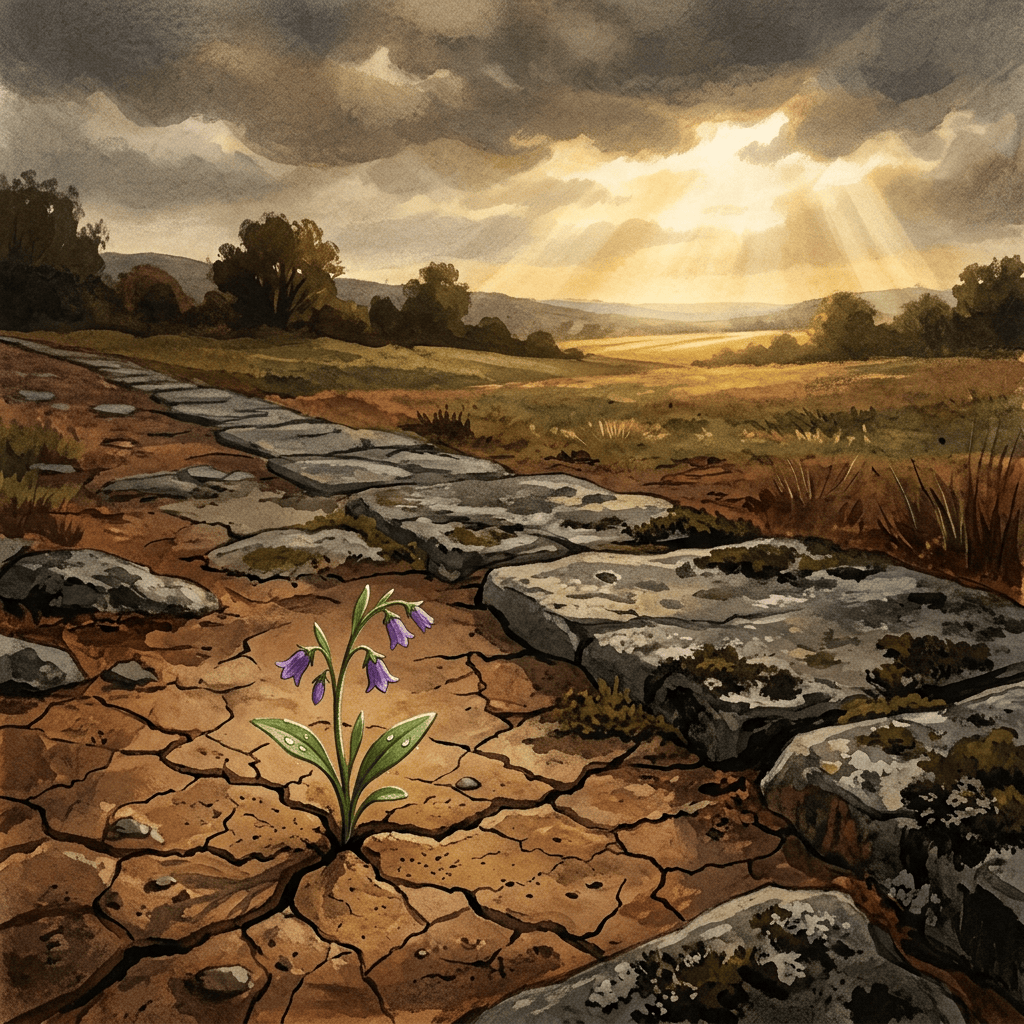
Purple wildflower growing through cracked earth beside a stone path

Feast of the Nativity of the Blessed Virgin Mary

First Reading: Micah 5:1-4a (or Romans 8:28-30)

Responsorial Psalm: Psalm 13:6ab, 6c

Gospel: Matthew 1:1-16, 18-23

Daily readings: https://bible.usccb.org/bible/readings/090826.cfm

Today the Church celebrates Mary’s birthday. Not the Annunciation, not the Assumption — her actual birth, the day a child was born into a family in first-century Palestine who had no idea what her life would hold. The Gospel for her feast is the genealogy — forty-two generations, a long list of names, most of them forgotten. But woven into that list are five women: Tamar, Rahab, Ruth, Bathsheba, and Mary. Tamar widowed and overlooked. Rahab a Canaanite outsider. Ruth a foreigner. Bathsheba named only as “the wife of Uriah.” Each of them unexpected in this lineage. Each of them part of God’s patient, winding work.

Mary comes at the end of all of it. She is the culmination of a long story she did not choose — families and failures and exiles and returns, generation after generation. And when the angel comes, she says yes. Not because she has a clear view of how it will all unfold. Because she trusts the one who asks. Micah says it plainly: from Bethlehem, too small to be among the clans of Judah, shall come the one who is to be ruler in Israel. God works through what looks too small. God works through the unexpected, the overlooked, the ones who were not supposed to be in the story at all.

Paul writes: all things work for good for those who love God. We often read that as comfort in hard times — and it is. But on Mary’s birthday it reads differently: God was working through all of it, through every name in that long list, through the complicated people and the flawed choices and the unexpected inclusions, to bring us to this moment. Mary’s yes was made possible by a thousand hidden yeses before her. And the life of faith we are living now is part of something longer than we can see.

A few questions to sit with today:

1. The genealogy includes people we would not have chosen — outsiders, failures, the complicated. When I look at my own family history, where do I see God’s patient work in people and stories I might have overlooked?

2. Mary said yes without a clear picture of what it would cost. Is there something God has been asking of me that I have been waiting to understand fully before I answer?

3. Micah says God works through what is too small to matter by human measure. What in my life feels too small or too ordinary to be significant? Can I trust that God is working there?

4. Paul says we are predestined to be conformed to the image of his Son. Not to be perfect, but to take the shape of Jesus in our particular life. What would it look like for me to take that shape a little more fully this week?

One small thing for tomorrow:

Tomorrow, say a simple Happy Birthday to Mary — just a brief prayer, a Hail Mary, a word of thanks that she said yes. Then ask her to pray for you to say your own yes to whatever God is asking today.

Lord Jesus, you were born of Mary, who was born into an ordinary family in an ordinary place at an ordinary time. Everything about your coming was unexpected. Thank you for working through the small and the overlooked, through the complicated history of families, through the ones no one expected to be in the story. Help me to trust, as Mary trusted, that you know what you are doing even when I cannot see the end of it. May her yes give me courage for my own. Amen.

If you would like to share: where in your own family history do you see God’s patient, unexpected work?

Navigating Difficult Conversations: Sunday Reflections

Wooden footbridge crossing a stream on a countryside trail at sunset

Twenty-third Sunday in Ordinary Time

First Reading: Ezekiel 33:7-9

Responsorial Psalm: Psalm 95:1-2, 6-7, 8-9

Second Reading: Romans 13:8-10

Gospel: Matthew 18:15-20

Daily readings: https://bible.usccb.org/bible/readings/090626.cfm

Jesus gives his disciples a very specific instruction today, and it is one of the most practically difficult things he ever says. If your brother sins against you, go and tell him his fault between you and him alone. Not to a friend first. Not in a group chat. Not by quietly pulling away. Directly, privately, just the two of you. If he listens, you have won over your brother. That is the goal — not to be right, not to punish, not to feel justified. To win back the relationship.

Most of us do not do it this way. We vent to someone who is not the person. We rehearse the conversation in our heads but never have it. We let the distance grow until the relationship has quietly ended, and we tell ourselves it was not worth saving. Ezekiel gets a harder version of the same call: God appoints him as a watchman, and says if you see something and do not speak, I hold you responsible. To love someone sometimes means saying the hard thing, directly, with care. The watchman who stays silent is not being kind — he is abandoning his post.

Paul wraps it up simply: owe nothing to anyone except to love one another. Love does no evil to the neighbor. The fraternal correction Jesus describes is love in action — the kind that cares too much to let things fester, too much to give up on the person. And then he ends with something that quietly shifts the whole weight of the passage: where two or three are gathered in my name, there am I in the midst of them. The hard conversation, entered in his name, is not something we do alone.

A few questions to sit with today:

1. Is there someone in my life — a family member, a friend, a coworker — with whom I have a real grievance that I have been carrying to everyone except them? What is keeping me from the direct conversation?

2. If I am honest, am I more interested in being right about what happened, or in winning back the relationship? Those are not always the same goal.

3. Ezekiel is told: if you warn them and they do not listen, that is on them. Have I avoided a hard conversation because I am afraid it will not go well? Can I trust God with the outcome and still make the approach?

4. The Psalm says: if today you hear his voice, harden not your hearts. Is my heart hardened toward someone right now — someone I have already written off rather than approached?

One small thing for tomorrow:

Think of one relationship where something has gone unsaid. Tomorrow, do not have the whole conversation — just decide whether you are willing to have it. Ask Jesus to be in the middle of it if you do. That is enough for one day.

Lord Jesus, you said: where two or three are gathered in my name, there am I in the midst of them. I want to believe that includes the conversations I have been avoiding. Give me the courage to go directly to the person rather than around them. Help me to want the relationship more than I want to be right. And when I am the one who has caused the hurt, help me to be the kind of person who can hear a hard word without shutting down. You are the one who makes reconciliation possible. I cannot do it without you. Amen.

If you would like to share: is there a conversation you have been putting off that today’s Gospel is bringing to mind?

Finding Joy in Faith: Balancing Old Habits and New Experiences

Hand pouring red wine from a ceramic pitcher into a glass

Friday of the Twenty-second Week in Ordinary Time

First Reading: 1 Corinthians 4:1-5

Responsorial Psalm: Psalm 37:3-4, 5-6, 27-28, 39-40

Gospel: Luke 5:33-39

Daily readings: https://bible.usccb.org/bible/readings/090426.cfm

The Pharisees come to Jesus with a comparison: John’s disciples fast, our disciples fast — yours eat and drink. They are not wrong about the facts. They are just confused about what they are watching. Jesus answers with an image: you do not fast at a wedding. The bridegroom is right here. This is not the season for mourning. Then he gives two short parables — new cloth on an old cloak ruins both, new wine in old wineskins bursts both. And then a quiet, almost rueful line: no one who has been drinking old wine desires new. He says, the old is good.

That last line is worth sitting with. The old is good. It is not that the old wine is bad. It is that a taste for the old can make us slow to recognize something new being poured. It happens in prayer — a practice that fed us for years goes quiet, and instead of noticing, we keep going through the motions because the form still feels familiar. It happens in how we see people we love — relating to who they were five years ago rather than who they are becoming. It happens in our image of God — we hold an old picture that no longer quite fits, but we say, the old is good, and we do not let it stretch.

Paul writes: I do not even pass judgment on myself. I am not conscious of anything against me, but I do not thereby stand acquitted — the one who judges me is the Lord. He will bring to light what is hidden in darkness and will manifest the motives of our hearts. This is the freedom of a steward: your job is to be trustworthy, not to audit yourself constantly. Stop trying to be both the servant and the judge. Do the work. Trust God with what only he can see.

A few questions to sit with tonight:

1. Is there a spiritual habit or practice in my life that has gone a little flat — that I keep up out of familiarity rather than nourishment? What would it look like to bring that honestly to Jesus instead of just continuing it?

2. Jesus says the wedding guests do not fast while the bridegroom is with them. Do I experience my faith mostly as obligation and discipline, or do I sometimes feel the joy of the feast? When did I last feel that?

3. The old wine feels fine — that is exactly the problem. Is there an area of my life where comfort might be keeping me from something new God wants to do?

4. Paul says: I do not judge myself, and the Lord will bring to light the motives of my heart. Is there a way I am constantly auditing my own worthiness — and could I lay that burden down today?

One small thing for tomorrow:

Tomorrow, if you catch yourself rehearsing an old habit or a familiar worry, pause and ask: is this old wine that has gone flat, or is this something worth keeping? Just notice. You do not have to change anything — just be honest about whether it still holds what it was meant to hold.

Lord Jesus, you said new wine belongs in fresh wineskins. Show me where I am holding on to old containers — old habits, old images of you, old ways of moving through the day — that cannot hold what you are trying to pour. I do not want to miss you because I am comfortable with what I already know. Free me from the need to judge myself and be judged by others. You are the one who sees the hidden motives, and you are also the one who pours out mercy. I trust you with both. Amen.

If you would like to share: is there a spiritual habit or practice that has felt a little flat lately — something you are ready to bring honestly to God?

Healing and Service: Lessons from Simon’s Mother-in-Law

Man kneeling beside and comforting an elderly woman in a candlelit rustic room

Wednesday of the Twenty-second Week in Ordinary Time

First Reading: 1 Corinthians 3:1-9

Responsorial Psalm: Psalm 33:12-13, 14-15, 20-21

Gospel: Luke 4:38-44

Daily readings: https://bible.usccb.org/bible/readings/090226.cfm

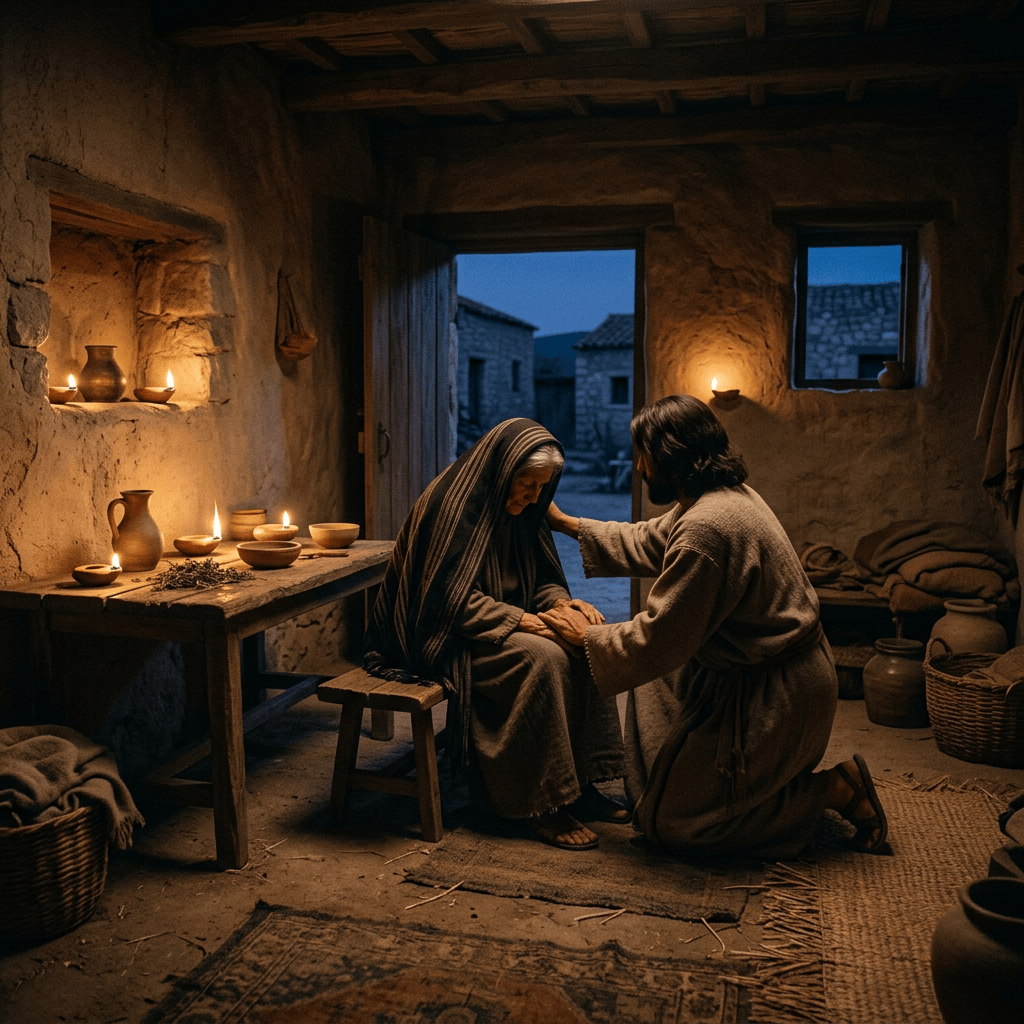
After the synagogue, Jesus goes to Simon’s house. Simon’s mother-in-law is sick with a high fever. They ask Jesus to help her. He stands over her, rebukes the fever, and it leaves. She immediately gets up and serves them. There is something quietly beautiful about that sequence — received healing, then immediately given back in service. No long recovery period, no announcement, no testimony. She just gets up and serves.

That evening the whole city comes. Everyone who is sick is brought to him. He lays his hands on every one of them and heals them. Demons come out crying his name. He silences them. And then — before dawn the next morning — he slips away to a solitary place. When the crowd finds him and tries to keep him, he says: I must preach the good news to other cities also. For this reason I have been sent. He does not belong to Capernaum. He does not belong to the crowd’s need for him to stay. He belongs to the mission, and the mission moves.

Paul writes to the Corinthians about a similar impulse — the human tendency to claim ownership of the thing God is doing. I belong to Paul. I belong to Apollos. Paul says: what is Apollos? What is Paul? Ministers through whom you believed. I planted, Apollos watered, but God caused the growth. Neither the one who plants nor the one who waters is anything — only God, who causes the growth. We are God’s co-workers; you are God’s field. The growth is not ours to control. We do our part — we plant, we water, we get up and serve after we have been healed — and then we let God be the one who makes things grow.

A few questions to sit with tonight:

1. Simon’s mother-in-law received healing and immediately served. Is there a grace I have received — a healing, a gift, a second chance — that I have been holding onto instead of turning outward in service?

2. The crowd tried to hold Jesus in place. Is there a way I have been trying to keep God contained — in one format, one practice, one community — rather than following where he is moving?

3. Paul says jealousy and rivalry are signs of spiritual immaturity, of still being fed milk. Is there a rivalry or comparison — with someone at work, in my community, even in my faith — that is keeping me from growing up?

4. Jesus withdrew to a solitary place before dawn. Is there enough silence in my days for me to hear what he might be saying about where I need to go next?

One small thing for tomorrow:

Tomorrow, after you receive something good — a kind word, a moment of grace, a prayer that lands — let it move you outward. Do something for someone else before the day is over, even something small. That is Simon’s mother-in-law’s way.

Lord Jesus, you healed her and she got up and served. You are always moving — to the next house, the next city, the next person who needs you. Help me not to cling to where you were yesterday but to follow where you are going today. Teach me the difference between the part I am called to do and the part that belongs to you alone — the planting and watering that are mine, and the growing that is yours. Keep me from jealousy and rivalry that would keep me small. Lead me to the solitary place when I need it, and back into service when the time comes. Amen.

If you would like to share: is there a moment when you received something from God and found yourself wanting to give it back to someone else right away?

Lessons from Capernaum: Openness to Jesus’ Word

Golden swirling path winding through a star-filled deep blue cosmos

Tuesday of the Twenty-second Week in Ordinary Time

First Reading: 1 Corinthians 2:10b-16

Responsorial Psalm: Psalm 145:8-9, 10-11, 12-13ab, 13cd-14

Gospel: Luke 4:31-37

Daily readings: https://bible.usccb.org/bible/readings/090126.cfm

Yesterday Jesus went to Nazareth and was nearly thrown off a cliff by the people who knew him best. Today he goes to Capernaum, a town with no history with him, and the reception is entirely different. He teaches on the sabbath and they are astonished because he speaks with authority. Then a man with an unclean spirit cries out: what have you to do with us, Jesus of Nazareth? Have you come to destroy us? I know who you are — the Holy One of God. Jesus says: be quiet, come out of him. The demon leaves without harming the man, and the crowd turns to each other and says: what is there about his word? With authority and power he commands unclean spirits, and they come out. News of him spreads everywhere.

There is something worth sitting with in who recognizes Jesus in this story. The people of Nazareth — who watched him grow up, who knew his family — could not see him. The unclean spirit in Capernaum sees him immediately. It does not take a theology degree or a lifetime of practice. It takes openness. The demon was not open, but it was not blind. The people of Nazareth were not exactly closed, but familiarity had quietly filled the space where wonder might have been. The crowd in Capernaum had none of that history, and so when he spoke, they heard something new — authority unlike anything they had encountered before.

Paul writes that the Spirit scrutinizes everything, even the depths of God. We have received not the spirit of the world but the Spirit of God, so that we may understand the things freely given us. The natural person cannot accept what pertains to the Spirit — not because it is hidden, but because it can only be understood from the inside, spiritually. We have the mind of Christ. That is not a credential to boast about. It is a gift that keeps being given, every time we sit still and let the word land rather than filing it away under what we already know.

A few questions to sit with tonight:

1. The crowd in Capernaum heard something in Jesus’s word that left them astonished. Is there a place in my prayer or scripture reading lately where I have felt that kind of astonishment — or has it been a while? What would it take to be that open again?

2. Paul says we have the mind of Christ — not our own wisdom, but his. Is there a decision or a situation I am facing right now where I have been relying mostly on my own understanding instead of asking for his?

3. Jesus said to the unclean spirit: be quiet, come out. Is there a voice in my interior life — anxiety, resentment, a habit of thought — that needs to hear those same words? What would it look like to let Jesus say that to it?

4. The Lord lifts up all who are falling and raises up all who are bowed down. Where am I bowed down right now — in a relationship, at work, in my faith — and have I brought that place to God?

One small thing for tomorrow:

Before you open anything tomorrow — email, news, social media — spend sixty seconds asking the Spirit to give you fresh eyes for the day. Not a long prayer. Just: come, Holy Spirit, help me see what you see today.

Lord Jesus, you spoke with authority and unclean spirits obeyed you. You speak the same word into my life and sometimes I am not sure I hear it over everything else. Quiet what needs to be quieted in me. Help me to receive your word the way the crowd in Capernaum did — with astonishment, with open hands, without the weight of too much familiarity. Give me what I cannot give myself: the mind of Christ, the eyes of the Spirit, the grace to be raised up when I am bowing under the weight of the week. Amen.

If you would like to share: is there a moment when a word from scripture or prayer landed in a way that surprised you — that felt like it had real authority?

How Familiarity Can Hinder Faith: A Reflection

Open Torah scroll on a wooden reading stand inside a historic synagogue

Monday of the Twenty-second Week in Ordinary Time

First Reading: 1 Corinthians 2:1-5

Responsorial Psalm: Psalm 119:97-102

Gospel: Luke 4:16-30

Daily readings: https://bible.usccb.org/bible/readings/083126.cfm

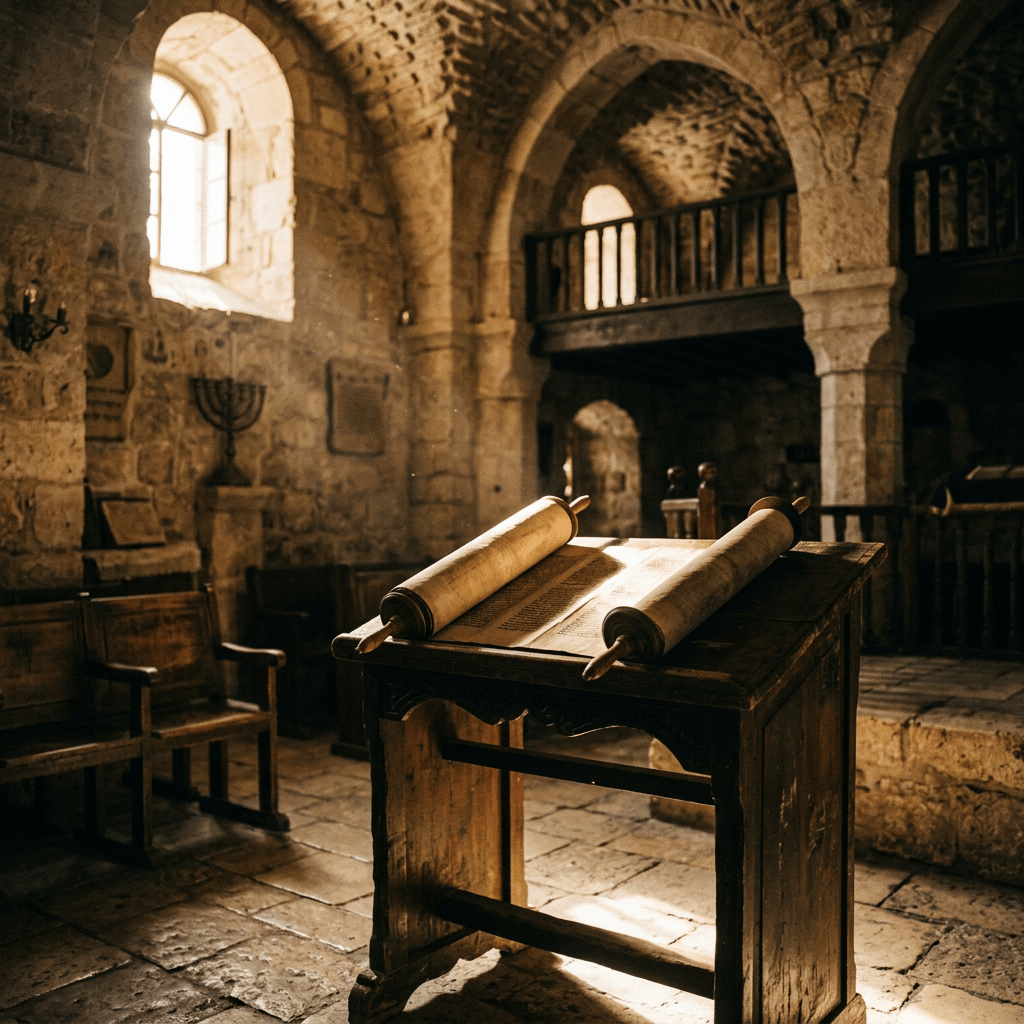
Jesus goes home to Nazareth and reads from Isaiah in the synagogue: the Spirit of the Lord is upon me, because he has anointed me to bring glad tidings to the poor, to proclaim liberty to captives, recovery of sight to the blind, to let the oppressed go free. He rolls up the scroll, sits down, and says: today this scripture passage is fulfilled in your hearing. And at first everyone speaks well of him. They are amazed. And then someone says: is this not Joseph’s son? And that is where it turns. Because they think they know him. They grew up with him. They have a category for him, and the category does not include what he is saying about himself. They go from amazed to furious in a few verses, drive him out of town, and lead him to the edge of a cliff. He passes through their midst and goes away.

There is something quietly painful about this story. The people closest to Jesus physically could not receive him. Familiarity became a wall. They heard the same words as everyone else and their first reaction was to sort him into the box they already had: Joseph’s son, local boy, nothing new here. Jesus names it himself: no prophet is accepted in his native place. And he goes further — he reminds them that Elijah and Elisha were sent not to Israel’s insiders but to a widow in Sidon and a general from Syria. God’s mercy and God’s power move where there is room to receive them.

Paul writes to the Corinthians that when he came to them he resolved to know nothing except Jesus Christ and him crucified. He did not come with impressive words or clever arguments. He came in weakness and fear and much trembling. And he says this was on purpose — so that their faith might rest not on human wisdom but on the power of God. That is the opposite of what blocked Nazareth. They were waiting for something that matched their expectations. Paul offered only the thing that looked weakest.

A few questions to sit with tonight:

1. Is there an area of my faith life where familiarity has made me less open — a prayer I say without really praying it, a scripture I read without really listening to it, a Sunday routine I go through without much interior presence?

2. Jesus passed through the midst of the people trying to harm him and went away. Is there a place in my life right now where I am resisting what God is doing because it does not match the shape I expected?

3. Paul says he came in weakness and fear and much trembling. Is there something God is calling me to that I have been holding back from because I do not feel strong or impressive enough to do it?

4. The people of Nazareth went from amazed to furious very quickly. Is there a person or situation in my life where I moved from open to closed — and do I know why?

One small thing for tomorrow:

Pick one scripture verse you know well — one you have read many times. Tomorrow, read it slowly as if you have never seen it before. Ask God: what are you saying to me in this today? Let yourself be surprised.

Lord Jesus, you went home and they tried to throw you off a cliff. The people who should have known you best could not receive you. Help me not to be like that — closed off by what I think I already know, too comfortable in my categories to be surprised by you. Come to me today not through impressive words or power but in weakness and simplicity, the way Paul came to Corinth, and let my faith rest on you rather than on my own understanding. Open what familiarity has closed in me. I love your commands, Lord — teach me to keep loving them with fresh eyes. Amen.

If you would like to share: is there a scripture passage or prayer that surprised you recently — one you thought you knew but heard differently?

Saint Augustine’s Journey: From Restlessness to Redemption

Open Arabic book and glowing heart-shaped lantern beside a sunset beach

Memorial of Saint Augustine, Bishop and Doctor of the Church

First Reading: 1 Corinthians 1:17-25

Responsorial Psalm: Psalm 33:1-2, 4-5, 10-11

Gospel: Matthew 25:1-13

Daily readings: https://bible.usccb.org/bible/readings/082826.cfm

The parable of the ten virgins is about oil — about whether you have something inside that no one can give you at the last minute. Five of them had it; five did not. They all fell asleep waiting, which is not the problem — the problem was that when the bridegroom finally came at midnight, half of them had nothing left to burn. They ran out to buy oil and came back to a locked door. Lord, Lord, open to us. And the answer: I do not know you. Therefore stay awake, for you know neither the day nor the hour.

Today the Church celebrates Augustine, the man who spent thirty-two years running out of oil. He burned through everything — ambition, pleasure, brilliant ideas, one philosophical system after another — and none of it lasted. He is the most honest writer in the history of Christian faith, and the first line of his Confessions says what all that searching taught him: you have made us for yourself, O Lord, and our heart is restless until it rests in you. He did not find that by being wise. He found it in a garden in Milan, weeping, when a child’s voice seemed to say: take up and read. He opened Paul’s letter at random and the words went straight through him. He stopped running. He let himself be found. Paul writes today: God chose the foolishness of the proclamation to save those who have faith. The cross is foolishness to those perishing, but to those being saved it is the power of God. Augustine — professor of rhetoric, master of human eloquence — was brought home not by argument but by grace.

Most of us know the restlessness Augustine describes. We look for it in the next thing — the next achievement, the next distraction, the next scroll through the phone at 11pm. We are not bad people. We are just people whose hearts are made for something that the world cannot quite give us, no matter how much of it we collect. Augustine’s feast day is an invitation to stop and ask: where am I still running? And is the oil in my lamp the kind that will last?

A few questions to sit with today:

1. Augustine’s heart was restless for decades before he let it rest in God. Is there a restlessness I carry right now — a hunger that I have been trying to fill with things that cannot quite satisfy it?

2. The foolish virgins had lamps but no oil. They had the form but not the interior sustenance. Is there a part of my faith life that is more lamp than oil right now — more form than interior life?

3. Augustine was converted by something small — a voice, a passage of scripture, one moment of grace. Is there a small thing God has been saying to me lately that I have not quite stopped to listen to?

4. He ended his life with the penitential psalms on his wall, praying them in his final days. What would I want at the center of my life at the end — and is it at the center now?

One small thing for tomorrow:

Tomorrow, before sleep, take thirty seconds and say Augustine’s prayer in your own words: Lord, you made me for yourself. My heart is restless. Let it rest in you tonight. That is the whole thing, really.

Lord Jesus, Augustine ran from you for thirty years and you waited. You brought him home through a child’s voice in a garden, through a single passage of Paul, through the tears of a mother who never gave up. I want to stop running from whatever I am running from. Help me to find in you what I have been looking for everywhere else. May my lamp have oil in it — not just the form of faith, but the real interior life that comes from actually being with you. May Saint Augustine’s great restless heart, now finally at rest in you, intercede for all of us who are still searching. Amen.

If you would like to share: what is one thing that has helped you find rest in God when your heart has been restless?

Staying Awake: The Enduring Faith of Saint Monica

Open prayer book, rosary, and candle on a stone table overlooking a village

Memorial of Saint Monica

First Reading: 1 Corinthians 1:1-9

Responsorial Psalm: Psalm 145:2-3, 4-5, 6-7

Gospel: Matthew 24:42-51

Daily readings: https://bible.usccb.org/bible/readings/082726.cfm

Jesus tells his disciples: stay awake. You do not know on which day your Lord will come. The faithful servant is the one found doing his work when the master returns — giving the household their food at the proper time. The unfaithful servant is the one who decides the master is delayed and starts cutting corners, treating people carelessly, living as if no one is watching and nothing matters. The question underneath the parable is simple: what are you doing while you wait?

Today the Church remembers Monica, the mother of Augustine — and no one in the history of Christianity has answered that question more quietly or more completely than she did. Monica waited seventeen years for her son’s conversion. She watched him leave the faith, take a mistress, join a heretical sect, pursue worldly ambition through Carthage and Rome and Milan. And she prayed. She wept. A bishop told her: the child of those tears shall never perish. She held on to those words. She did not stop giving the household their food at the proper time. She was found doing exactly that — faithfully, without seeing the end from the middle — when the Lord finally came.

Paul writes to the Corinthians: you are not lacking in any spiritual gift as you wait for the revelation of our Lord Jesus Christ. He will keep you firm to the end. God is faithful, and by him you were called to fellowship with his Son. Monica believed that. She believed it when Augustine was not living it. She believed it when she could not see the evidence. That is what staying awake looks like in real life — not high drama, but faithful presence, patient prayer, love that does not give up on the people we are waiting with.

A few questions to sit with today:

1. What am I doing while I wait — for an answer to a prayer, for someone I love to come around, for something in my own life to change? Am I staying awake and faithful, or have I quietly started to drift?

2. Monica prayed for seventeen years without seeing the fruit. Is there someone in my family or my life I have been praying for — and am I tempted to give up? What would it look like to keep going?

3. The faithful servant gives the household their food at the proper time. What is my household — family, friends, people in my care — and am I giving them what they need from me right now?

4. God is faithful, and by him you were called to fellowship with his Son. Do I actually trust that God is faithful even in the season I am in right now, even without visible evidence?

One small thing for tomorrow:

Think of one person you have been carrying in prayer for a long time — someone whose situation has not changed yet. Tomorrow, say a brief prayer for them by name, and tell God: I am still here. I am not giving up. That is Monica’s prayer. It is enough.

Lord Jesus, Monica stayed awake for seventeen years, giving her household their food at the proper time, faithful in a season that showed her nothing but closed doors. I want to be that kind of faithful — not because I can see the outcome, but because I trust you are working even when I cannot see it. Help me not to drift when the waiting is long. Help me to keep praying for the people I love who have not come home yet. May Saint Monica’s intercession keep me patient, and may your faithfulness carry me to the end. Amen.

If you would like to share: is there someone you have been praying for through a long wait — someone whose story is still unfinished?