Examen: Wednesday of the Eleventh Week in Ordinary Time

Wooden cross on rocky mountain peak with sun setting behind clouds
Wednesday of the Eleventh Week in Ordinary Time

First Reading: 2 Kings 2:1, 6-14
Responsorial Psalm: Psalm 31:20, 21, 24
Gospel: Matthew 6:1-6, 16-18
Daily readings: https://bible.usccb.org/bible/readings/061726.cfm

There is a moment in today's First Reading that is easy to rush past. Elijah is about to be taken up to heaven, and Elisha refuses to leave his side. Three times he is told to stay behind. Three times he says no. "As the LORD lives, and as you yourself live, I will not leave you." He is not doing this for anyone to see. There are fifty other prophets watching from a distance, but Elisha is not performing for them. He is just staying close to the one he loves, all the way to the end.

That quiet faithfulness — the kind nobody posts about — is the thread connecting both readings today. Jesus in the Gospel turns our attention to the same thing. Give in secret. Pray in your inner room with the door closed. Fast without making a show of it. Your Father who sees in secret will repay you. The point is not the action itself but who you are doing it for. There is a kind of goodness that needs an audience, and there is a kind of goodness that is content to be known only by God. Jesus is asking us to practice the second kind.

That is countercultural in the age of the highlight reel. We live in a world that practically rewards the public performance of virtue — the post, the story, the comment that signals we are one of the good ones. Jesus does not condemn generosity or prayer or fasting. He just asks: who is the audience? When I help someone, give something, or make a sacrifice — am I doing it to be seen, or am I doing it because I love God and I love this person?


A few questions to sit with today:

1. Was there a moment today when I did something good — and noticed I wanted someone to see it or know about it? What was underneath that?

2. Is there a place in my prayer life that has become more about routine or appearance than about actually being with God?

3. Did I stay close to what matters today — to the people I love, to God — or did I drift toward what was easier or more visible?

4. Where did I sense God seeing something in me that nobody else saw today — a small kindness, a quiet struggle, a hidden prayer?


One small thing for tomorrow:

Do one good thing tomorrow that no one will know about. It does not have to be big — leave a kind note somewhere anonymous, let someone go ahead of you without making it a moment, say a prayer for someone without telling them. Let it be between you and God. Notice how that feels.


Lord Jesus, thank you for seeing what is hidden. You see the small acts of love no one notices — the patience held together at the end of a long day, the prayer said quietly before sleep, the kindness given to someone who will never think to thank me. I confess that I do not always do these things just for you. Sometimes I want to be seen, to be known, to be credited. Forgive me for the ways I perform goodness instead of simply living it. Help me to close the door a little more often and meet you in the quiet. Teach me Elisha's faithfulness — staying close to you not for an audience, but because you are my life. Amen.


If you'd like to share: what is one small, hidden way you tried to love someone today — something only God saw?

Examen: Tuesday of the Eleventh Week in Ordinary Time

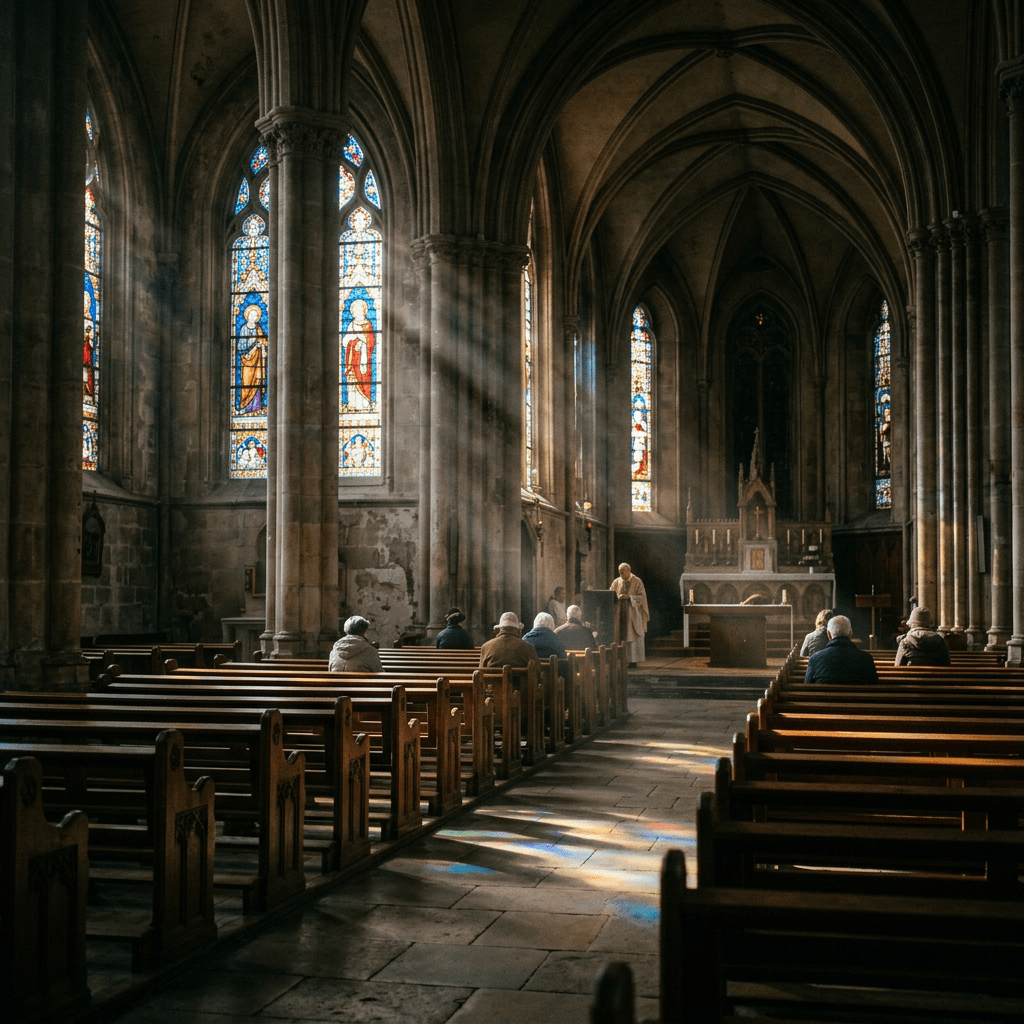
Interior of a gothic church showing stained glass windows and people seated during a religious service
Tuesday of the Eleventh Week in Ordinary Time

First Reading: 1 Kings 21:17-29
Responsorial Psalm: Psalm 51:3-4, 5-6ab, 11 and 16
Gospel: Matthew 5:43-48
Daily readings: https://bible.usccb.org/bible/readings/061626.cfm

Yesterday we watched Ahab pout and scheme his way into an innocent man's vineyard. Today the story continues — and something unexpected happens.

Elijah comes with a word of judgment. God names what Ahab did: he murdered, and he took. There is no softening it. But then Ahab does something surprising. He tears his garments, puts on sackcloth, fasts, and walks humbly. And God sees it. "Have you seen that Ahab has humbled himself before me?" God asks. And because of that small turning, God's response changes.

It is a remarkable thing. Not because Ahab deserved mercy — he didn't — but because God is paying attention to the posture of the heart, even in a man who had done terrible things. Then Jesus arrives in the Gospel and pushes further still. Love your enemies. Pray for those who persecute you. Be perfect as your heavenly Father is perfect. God lets the sun rise on the bad and the good. The rain falls on the just and the unjust alike. We are being invited into a love that does not sort people by what they deserve first.

That is a hard ask for an ordinary Tuesday. At work, there may be someone who got credit you earned. At home, there may be a wound that hasn't fully healed. On the road, there's probably someone who cut you off. Jesus is not asking us to pretend none of it happened. He is asking us whether we are willing to let God's kind of love be bigger than our accounting.


A few questions to sit with today:

1. Is there someone in my life I have quietly filed under "enemy" — someone I've stopped wishing well? How do I feel when I pray for them, even briefly?

2. Was there a moment today when I caught myself keeping score — measuring what I give against what I receive?

3. Is there any area of my life where I need to do what Ahab did — tear something, put something down, walk more humbly before God?

4. Where did I experience God's generosity today — sun on the bad and the good — and did I notice it?


One small thing for tomorrow:

Think of one person who has hurt you or frustrated you — someone you'd rather avoid. Tomorrow, say one quiet prayer for them. Not a big gesture, not a conversation, just a sentence: "Lord, bless them today." That's it. You don't have to feel it fully yet. Just begin.


Lord Jesus, thank you for this Tuesday and for the strange, stubborn mercy you show even to people like Ahab — and like me. I know there are places in my heart where I love only the lovable, where I give only to those who give back. Forgive me for the smallness of my love compared to yours. Today's readings remind me that you watch for even the smallest turning toward you — a torn garment, a bowed head, a moment of honesty. I offer you mine. Help me tomorrow to pray for someone I find hard to love, and to trust that you will do what only you can do in their life and mine. May Mary, who said yes to a love she could not yet fully understand, teach me to open my hands a little wider. Amen.


If you'd like to share: is there someone you've been finding hard to love lately — and what would it look like to pray for them this week?


Examen: Monday of the Eleventh Week in Ordinary Time

Vineyard rows on rolling hills with farmhouse and purple-orange sunset sky

Monday of the Eleventh Week in Ordinary Time
No feast or memorial today

First Reading: 1 Kings 21:1-16
Responsorial Psalm: Psalm 5:2-3ab, 4b-6a, 6b-7
Gospel: Matthew 5:38-42
Daily readings: https://bible.usccb.org/bible/readings/061526.cfm

Today’s readings put two very different pictures of the human heart side by side, and then Jesus comes along and flips the frame entirely.

Naboth had a vineyard. It was his family’s land, handed down through generations, tied to his identity and his inheritance before God. When King Ahab came wanting it — offering a fair price, even — Naboth said no. Not out of stubbornness, but out of integrity. Some things are not for sale. Ahab went home, lay on his bed, turned his face to the wall, and refused to eat. A king. Pouting. And then Jezebel stepped in and schemed. She had Naboth falsely accused and stoned to death, and Ahab got his vineyard.

It is a painfully familiar script, even if our version plays out in kitchens and offices instead of palaces. We feel entitled to something — our evening quiet after a long day, credit for work we did, an apology we think we have earned — and when we do not get it, we either sulk like Ahab or we start maneuvering like Jezebel. We dress it up as justice. We tell ourselves we are simply asking for what is right. And maybe sometimes we are. But Jesus arrives in Matthew 5 and says something almost scandalous: do not resist the one who wrongs you. Turn the other cheek. Walk the second mile. Give the cloak too. He is not asking us to be pushovers. He is asking us to stop letting our wounded ego run the show. There is a surprising freedom in it — acting from love instead of keeping score.

A few questions to sit with tonight:

  1. Was there a moment today when I felt something was owed to me — and how did I respond?
  2. Did I hold my time, my energy, or my plans loosely, or did I grip them tight when someone touched them?
  3. Was there someone today who needed more from me than I wanted to give — and what did I actually do?
  4. Where did I sense God asking me to trust rather than scheme or try to control the outcome?

One small thing for tomorrow:

Pick one moment tomorrow — at the breakfast table, in a meeting, in traffic, at bedtime with the kids — when you feel that familiar pull of “this isn’t fair” or “I deserve better than this.” Before you react, take one breath and ask: what would the genuinely generous response look like here? Not the doormat response. Not the martyred sigh. The free one, chosen on purpose. Just one moment. That is enough to start.

Lord Jesus, here I am at the end of this day. I know there were moments I acted more like Ahab than like you — sulking over small things, gripping what I thought was mine, calculating instead of giving. I bring that to you honestly, without trying to dress it up. Forgive me. Give me open hands, Lord. Give me a heart that holds things loosely because it trusts you completely. Teach me what it means to walk that second mile — not out of weakness or resignation, but out of the deep freedom that only love can give. May Mary’s quiet yes remind me tonight that surrender to you is never loss. Thank you for this ordinary Monday, and for the extraordinary grace hidden inside it. Amen.

I would love to hear from you — share in the comments a moment today when you chose generosity over getting even, or a time when letting go of something turned out to be a gift.