Celebrating God’s Generosity: A Reflection for July 4

Stone church with bell tower in misty rural landscape at sunrise
Saturday of the Thirteenth Week in Ordinary Time

First Reading: Amos 9:11-15
Responsorial Psalm: Psalm 85:9-10, 11-12, 13-14
Gospel: Matthew 9:14-17
Daily readings: https://bible.usccb.org/bible/readings/070426.cfm

All week, Amos has been bringing hard words. Judgment, exile, warning, fire. And today — the very last verses of his book — he pivots completely. "Yes, days are coming, says the LORD, when the plowman shall overtake the reaper." That is an image of such overwhelming abundance that harvest cannot keep pace with planting. The mountains will run with wine. Ruined cities will be rebuilt. People will be planted firmly in their own ground, and never uprooted again. After all the warnings, after all the honest accounting of what had gone wrong, Amos ends with God's intention: restoration. Not because the people earned it, but because God is who he is.

Jesus speaks today about new wine and old wineskins. John's disciples come asking why his followers do not fast — and Jesus's answer is essentially: something new is here. You cannot pour what I am bringing into the old containers. It is not that the old is bad — it is that what I bring is so alive, so expansive, so full of new possibility, that it needs room to breathe. New wineskins. New cloth. A new way of being with God that is less about anxious religious performance and more about being present to the bridegroom who is right here, right now.

Today in the United States, many families are gathering for the Fourth of July — cookouts, fireworks, children running in the yard, the ordinary abundance of a summer holiday. It is a good day to notice that abundance itself is a form of God's speech. Amos's image of mountains running with wine was his way of pointing to the same thing: a God who, when he restores, does not restore stingily. He restores with such generosity that the harvest cannot keep up. Whatever container you have been using for your faith — if it has felt tight, dry, or too small — today's readings invite you to ask for a new one.


A few questions to sit with today:

1. Is there an area of my faith that has started to feel like an old wineskin — brittle, tight, going through motions? What would it look like to ask God for something new and alive there?

2. Where have I experienced God's abundance this week — not just spiritually, but in ordinary life: food, laughter, rest, the people around me?

3. Is there something I have been mourning or grieving that God might be ready to restore? Have I brought that hope honestly to him?

4. Am I present to the bridegroom who is with me right now — or am I mostly anxious about whether I am doing religion correctly?


One small thing for today and tomorrow:

At some point in the holiday today — a meal, a moment of fireworks, a quiet pause — say a simple prayer of gratitude. Not a long one. Just: "Thank you. This is from you." Let the abundance around you be a reminder of Amos's final word: restoration, wine running down the mountains, planted and never uprooted.


Lord Jesus, Amos ends his hard book with your Father's heart laid open: restoration, abundance, a people planted so firmly they will never be uprooted again. I want to believe that for my own life. There are places that feel like ruins — relationships, habits, hopes that collapsed a while back — and I sometimes wonder if they are too far gone. Today's readings say they are not. Help me to be a new wineskin for whatever you are pouring. Loosen what has gone brittle. Give me room to receive you freshly, not just faithfully. On this holiday, surrounded by ordinary abundance, help me to see it all as a word from you. May Mary, who treasured God's abundance in her heart, teach me to receive it the same way. Amen.


If you'd like to share: where have you experienced God's restoration in your life — something ruined that was rebuilt, something lost that came back?

Lessons from Saint Thomas: Embracing Doubt in Faith

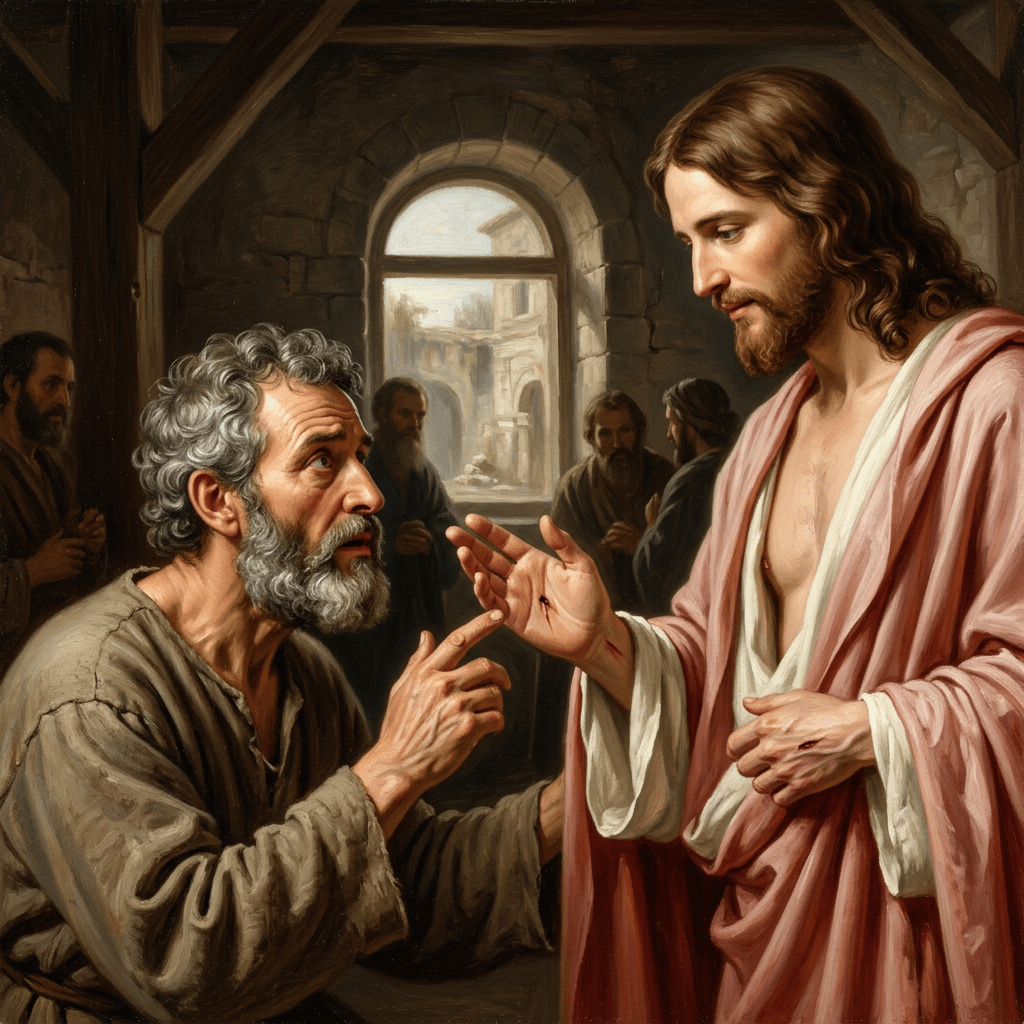
Apostle Thomas touching Jesus' wounds, confirming his resurrection
Feast of Saint Thomas, Apostle

First Reading: Ephesians 2:19-22
Responsorial Psalm: Psalm 117:1bc, 2
Gospel: John 20:24-29
Daily readings: https://bible.usccb.org/bible/readings/070326.cfm

Thomas was not there. We do not know why — the Gospel does not say. But while the other ten were locked in a room together, seeing the risen Lord, Thomas was somewhere else. And when they told him, he said: I will not believe unless I see for myself. It is easy to read that as stubbornness or failure. But there is something honest about it. Thomas did not pretend. He did not nod along to something he had not yet experienced. He said plainly what he needed.

And Jesus came back. A week later, doors locked again, and this time Thomas was there. Jesus did not scold him. He did not announce his disappointment. He walked straight to Thomas and offered exactly what Thomas had asked for: "Put your finger here. See my hands. Bring your hand and put it into my side." He met Thomas in the exact place of his doubt, with the exact evidence Thomas had named. And Thomas, in a breath, went further than any of the others had: "My Lord and my God." Not just teacher. Not just rabbi. My Lord. My God.

Then Jesus says the line that reaches across two thousand years to us: "Blessed are those who have not seen and have believed." That is us. We were not in that room. We have not touched the wounds. We believe on the testimony of Thomas and the others, carried forward through the Church, the Scripture, the Eucharist, the lives of the saints. Paul says it in the First Reading: we are built on the foundation of the apostles and prophets, with Christ as the capstone, growing into a temple, a dwelling place of God in the Spirit. Thomas's honest doubt — and the encounter that answered it — is part of what we are built on.


A few questions to sit with today:

1. Is there a doubt I have been carrying that I have not said out loud — to God, to a trusted friend, in honest prayer? What would it feel like to name it plainly, the way Thomas did?

2. Has Jesus ever met me in the exact place of my doubt — not scolding me, but showing up with exactly what I needed? When was that?

3. Do I experience my faith as something I am building on — a foundation laid by the apostles, alive in the Church — or does it feel more isolated and personal?

4. What would it mean for me, today, to say with Thomas: "My Lord and my God"? Not as a formula, but as something I actually mean?


One small thing for tomorrow:

Tomorrow, at some ordinary moment in the day — driving, washing dishes, between tasks — say Thomas's words out loud, slowly: "My Lord and my God." Say them like you mean them. Let that be your prayer. Just those five words.


Lord Jesus, thank you for going back for Thomas. Thank you for not leaving him in his doubt, for not requiring him to fake certainty he did not have. You met him where he was, showed him exactly what he needed, and received the most complete confession of faith in the Gospels. I want that kind of encounter. I have doubts too — things I have not seen, questions I carry quietly. Come through the locked doors of whatever is keeping me closed. Meet me there. Show me your hands. Help me to move from whatever I am uncertain about to the place Thomas arrived: not just belief, but belonging — my Lord, my God. Through the intercession of Saint Thomas, patron of those who need to see before they believe, draw me deeper into you. Amen.


If you'd like to share: is there a doubt you have been carrying in silence — and has Jesus ever shown up in the middle of it in a way that surprised you?

Embracing Forgiveness in Ordinary Life

Green vine leaves climbing a wooden trellis with sunlight shining through
Thursday of the Thirteenth Week in Ordinary Time

First Reading: Amos 7:10-17
Responsorial Psalm: Psalm 19:8, 9, 10, 11
Gospel: Matthew 9:1-8
Daily readings: https://bible.usccb.org/bible/readings/070226.cfm

Amos is not a professional prophet. He tells us that himself. "I was no prophet, nor did I belong to a company of prophets. I was a herdsman and a dresser of sycamore trees." He is an ordinary man from an ordinary trade, and God pulled him out of it and sent him to speak. Amaziah the priest wants him silenced — tells him to go back to Judah and earn his bread prophesying there, not here. And Amos's response is simple: I did not choose this. God took me and said, go, prophesy. This is not my idea. When an ordinary person is willing to be used, God tends to take them at their word.

Then Jesus comes back to his own town. A paralyzed man is brought to him on a stretcher. And before he does anything else, Jesus says something that causes a small scandal in the room: "Courage, child, your sins are forgiven." Not — you are healed. First: your sins are forgiven. The scribes immediately recognize what this implies. Only God forgives sins. So either Jesus is blaspheming, or he is who he says he is. Jesus reads the room, addresses their thoughts directly, and then heals the man to demonstrate that the authority is real. "But that you may know that the Son of Man has authority on earth to forgive sins..." He gets up and walks home.

The crowd's response is worth sitting with: "They were struck with awe and glorified God who had given such authority to human beings." Not just to this one man — to human beings. The Incarnation means that God, in becoming one of us, has authorized something new. Forgiveness walking the earth in a human body. Healing happening through human hands. Ordinary people like Amos — like us — being taken from their fig trees and sent somewhere. The same authority that raised the paralyzed man is offered to the Church, and through the Church, to each of us in confession, in prayer, in the ordinary moments of a Thursday.


A few questions to sit with tonight:

1. Is there something I am carrying — a guilt, an old wound, a sin I keep circling back to — that I have not yet fully received forgiveness for? What is keeping me from letting it go?

2. Like Amos, has God ever pulled me out of something ordinary and asked me to do something I did not choose? How did I respond?

3. When I encounter Jesus in prayer or at Mass, do I come as someone who needs forgiveness first — or do I mostly come with requests? What would it change to start there?

4. Was there a moment today when I was struck with awe — when something reminded me that God is real and near? Did I stop long enough to notice it?


One small thing for tomorrow:

If you have been away from Confession for a while, let tomorrow be the day you look up your parish's confession times and write them down. You do not have to go tomorrow — just find the time and put it somewhere visible. That small act of intention is already a turning.


Lord Jesus, you said to the paralyzed man what you say to me: courage, your sins are forgiven. I do not always feel the courage or the forgiveness. But I want to receive both. Thank you for crossing into my ordinary life — my ordinary Thursday — with the same authority you brought to that room in Capernaum. Forgive me for the things I carry that I have not laid down. Heal what is paralyzed in me, the places where I have stopped moving because I stopped believing you could reach there. Like Amos, I am nothing special — just someone you took from their ordinary work. Use me anyway. May Mary, who said yes before she understood, help me to say the same. Amen.


If you'd like to share: is there something you have been carrying that you have not yet fully received forgiveness for — and can we pray together that you find the courage to lay it down?

Connecting Worship to Life: A Call for Justice

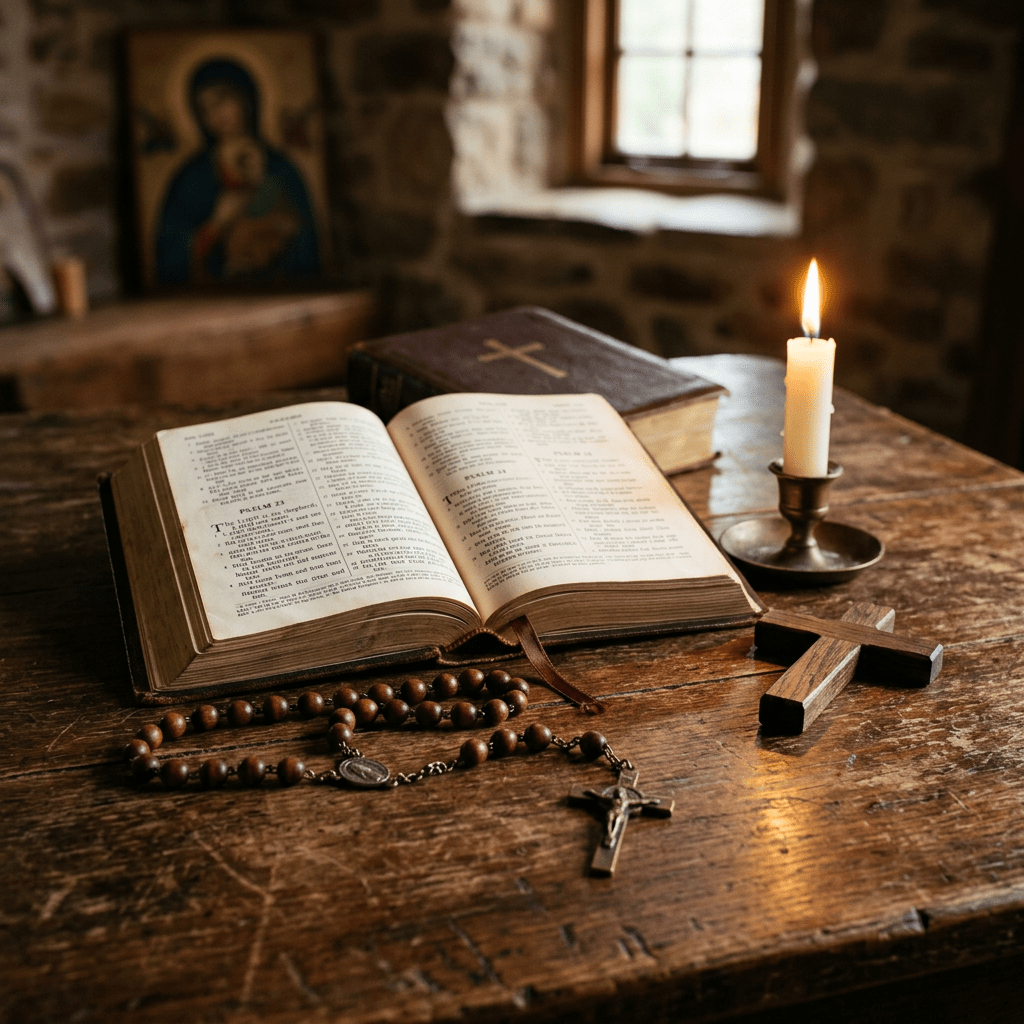
Open Bible with rosary beads, wooden cross, and lit candle on wooden table
Wednesday of the Thirteenth Week in Ordinary Time

First Reading: Amos 5:14-15, 21-24
Responsorial Psalm: Psalm 50:7, 8-9, 10-11, 12-13, 16bc-17
Gospel: Matthew 8:28-34
Daily readings: https://bible.usccb.org/bible/readings/070126.cfm

Amos has been speaking hard words all week, but today he offers something surprising — a way through. "Seek good and not evil, that you may live. Hate evil and love good, and let justice prevail." It is not complicated. There is no elaborate ritual required, no spiritual performance. Just a turning: toward good, away from evil, toward justice for the people around you. God will be with you if you do this, he says. As you have claimed.

Then comes the part that stings: "I hate, I spurn your feasts. I take no pleasure in your assemblies. Away with your noisy songs. I will not listen to the melodies of your harps." God is not dismissing worship — he is dismissing worship that is hollow because it is disconnected from how people treat each other. You can fill a church, sing every hymn, show up every Sunday, and still be far from God if outside those walls you are indifferent to the suffering of the people around you. "Let justice surge like water, and goodness like an unfailing stream." The worship God wants is a life.

Then Jesus arrives in Gadara — territory outside Israel, pagan land, a place of tombs — and two men possessed by demons come out to meet him. They are violent, untouchable, living among the dead. And immediately they recognize him. "What have you to do with us, Son of God?" They know exactly who he is. He casts them out, the pigs rush into the sea, and the town comes to meet him. And then this strange, sad ending: the whole town begs Jesus to leave. He has just freed two men who had been terrorizing the region. And instead of celebrating, they want him gone. Perhaps his power frightened them. Perhaps losing the pigs cost too much. Whatever the reason — when Jesus shows up fully, it sometimes asks more of us than we planned to give.


A few questions to sit with today:

1. Is my worship — my Sunday Mass, my daily prayer, my Catholic identity — connected to how I actually treat people the rest of the week? Where is the gap?

2. Is there something in my life I would rather Jesus not touch — because cleaning it up would cost something I am not ready to lose?

3. Where have I been asked to let justice surge like water, and quietly turned down the volume instead?

4. Was there someone today living among the tombs — isolated, struggling, pushed to the edges — whom I noticed, or whom I passed by?


One small thing for tomorrow:

Think of one person in your life who is overlooked, difficult, or on the outside of your usual circle. Tomorrow, do one thing that acknowledges their dignity — a word, a small act, a moment of real attention. Let justice be, for that one moment, an unfailing stream.


Lord Jesus, you crossed into pagan territory, into the land of tombs, to free two men nobody else would go near. I want to be that kind of follower. Help me to connect my worship to my life — to let what I receive at Mass on Sunday actually change how I treat people on Wednesday. Forgive me for the places where I have sung the songs and said the prayers but kept the door closed on the justice you are asking for. And where you show up in my life asking for something costly — help me not to beg you to leave, but to trust that your presence is worth whatever it rearranges. May Mary, whose whole life was an act of justice and love, pray for me to live the same way. Amen.


If you'd like to share: is there a place in your life where you sense God is asking for more than ritual — more than showing up — and what would it look like to say yes?