Clearing the Thorns: Saturday Reflection Before Sunday Mass

Young green plant growing among tangled branches in a sunlit forest

Saturday of the Twenty-fourth Week in Ordinary Time

First Reading: 1 Corinthians 15:35-37, 42-49

Responsorial Psalm: Psalm 56:10c-12, 13-14

Gospel: Luke 8:4-15

Daily readings: https://bible.usccb.org/bible/readings/091926.cfm

The sower goes out and scatters seed everywhere — on the path, on rocky ground, among thorns, on good soil. The same seed. The same sower. Wildly different outcomes, and Jesus explains exactly why. The path: the word is taken before it can take root. The rocky ground: received with joy, but no depth — it falls away under pressure. The thorns: choked by the anxieties and riches and pleasures of life, and it never matures. The good soil: those who hear the word, embrace it with a generous and good heart, and bear fruit through perseverance. Four kinds of soil, and only one produces anything. The seed does not change. The question is always the condition of the ground.

The thorns are the one that most of us live closest to. Not attacked. Not dramatically fallen. Just slowly choked. The word is real. The faith is genuine. But the anxieties of work pile up, the calendar fills, the screens take the silence, and weeks go by without the word having any room to breathe. It does not fail dramatically — it just never quite matures. Paul’s image from the first reading sits underneath all of this: what you sow is not brought to life unless it dies. The kernel has to go into the ground. There has to be space — quiet, surrender, waiting — for something to grow.

Today is Saturday, the day before Sunday, the day before resurrection. It is a day for preparing the soil. Good soil is not accidental. It is made through the small choices of the week: the prayer that happened even briefly, the Scripture read even a few verses, the moment of quiet before the phone was picked up. None of those feel dramatic. But they are the tilling. And Paul reminds us what is being prepared for: sown weak, raised powerful. Sown dishonorable, raised glorious. We shall bear the image of the heavenly one. That is what the word, given room, is working toward.

A few questions to sit with today:

1. Which of the four soils do I most recognize in my life right now — the path, the rocky ground, the thorns, or the good soil? Is that hard to look at honestly?

2. Jesus names anxieties and riches and pleasures of life as the thorns that choke the word. Which of those is most active in my life right now? What is crowding out the silence?

3. The good soil embraces the word with a generous and good heart and bears fruit through perseverance — not brilliance, not intensity, just perseverance. Where am I being asked to simply keep going?

4. Paul says we shall bear the image of the heavenly one. What would it mean to live today, this Saturday, with that destination in view?

One small thing for tomorrow:

Before Mass or your Sunday prayer, take two minutes to read one short passage from Scripture. Let it be the seed going into prepared ground before the day begins.

Lord Jesus, you scatter the word generously, without counting the soil. You do not wait for perfect conditions. Help me to do the work of the good soil — to clear out some of the thorns, to let the word have a little more room this week. I know which thorns are choking things in my life. I need your help to pull them, not just name them. Prepare me for Sunday. Prepare me for the life that is coming. Amen.

If you would like to share: which thorns have been crowding out the word in your life lately — and what would it look like to clear a little space?
Women at the Tomb and the Friday Space of Faith

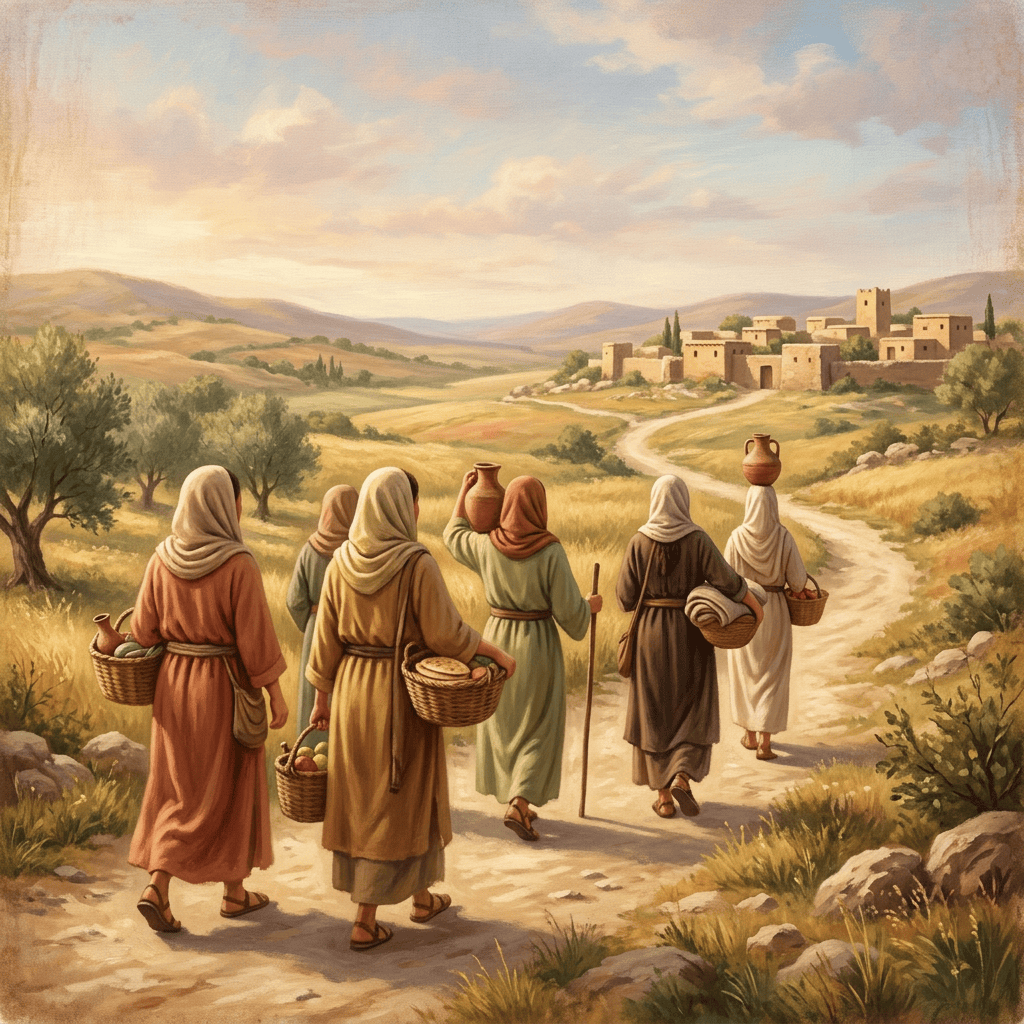
Five robed travelers carrying baskets and pottery walk toward a hilltop village.

Friday of the Twenty-fourth Week in Ordinary Time

First Reading: 1 Corinthians 15:12-20

Responsorial Psalm: Psalm 17:1bcd, 6-7, 8b, 15

Gospel: Luke 8:1-3

Daily readings: https://bible.usccb.org/bible/readings/091826.cfm

Luke’s Gospel today is only three verses, but there is a lot inside them. Jesus is traveling from town to town, proclaiming the Kingdom of God. With him are the Twelve — and also some women: Mary Magdalene, from whom seven demons had gone out; Joanna, wife of Herod’s steward Chuza; Susanna; and many others who provided for them out of their own resources. Luke names them. He does not treat them as background. These are women who had been healed, women who left comfortable or difficult lives to follow Jesus on the road, women who used what they had to support the mission. Luke is not making a point about gender roles — he is recording who was actually there. And he is setting something up: these same women will be the first at the tomb.

Paul is clear about why that matters. If Christ has not been raised, he says, then your faith is vain, our preaching is false, those who have died are simply gone, and we are the most pitiable of all people — people who have organized their lives around something that is not true. He does not soften this. He runs the logic all the way out: everything depends on the resurrection. Either it happened and everything is different, or it did not and nothing holds. But then he turns: But now — Christ has been raised from the dead, the firstfruits of those who have fallen asleep. That “but now” carries the whole weight of the Christian life.

Friday is the right day to sit with that. Today is the day between death and resurrection — in the liturgical imagination, the day the disciples did not know what Sunday would bring. Mary Magdalene, Joanna, Susanna followed Jesus and provided for him out of their resources. They gave what they had while he was alive. They will be the first to bring spices to the tomb. Their faithfulness does not depend on certainty — it depends on love and on memory of what happened to them when they met him.

A few questions to sit with today:

1. Paul says: if for this life only we have hoped in Christ, we are the most pitiable of all. Is my hope genuinely oriented beyond this life — or is my faith mostly about getting through the day? Is that honest, and what would I want it to be?

2. Mary Magdalene was healed of seven demons. Joanna walked away from a comfortable position to follow Jesus on the roads of Galilee. Both gave out of what they had been given. What has Jesus freed me from or given me that I am offering back to him?

3. The women provided for the mission out of their resources. Is there a concrete way I am supporting something larger than myself right now — in my family, my parish, my community?

4. It is Friday. Where am I between death and resurrection in my own life right now — what is still in the tomb, waiting?

One small thing for tomorrow:

Tomorrow — Saturday — is the day before resurrection. Light a candle, or simply sit in quiet for a few minutes, and name one thing you are waiting to see come back to life.

Lord Jesus, you let women travel with you, be changed by you, and give to you out of what they had. You did not ask them to be less than they were. You asked them to follow. Help me to follow in the same way — not because I have everything figured out, but because I remember what happened when I met you. Let my faith rest on the resurrection, not just on comfort. When I am in the Friday space, remind me that Sunday is coming. Amen.

If you would like to share: what is one thing in your life right now that is still in the tomb — that you are waiting to see raised?

Lessons from Our Lady of Sorrows: Standing with Suffering

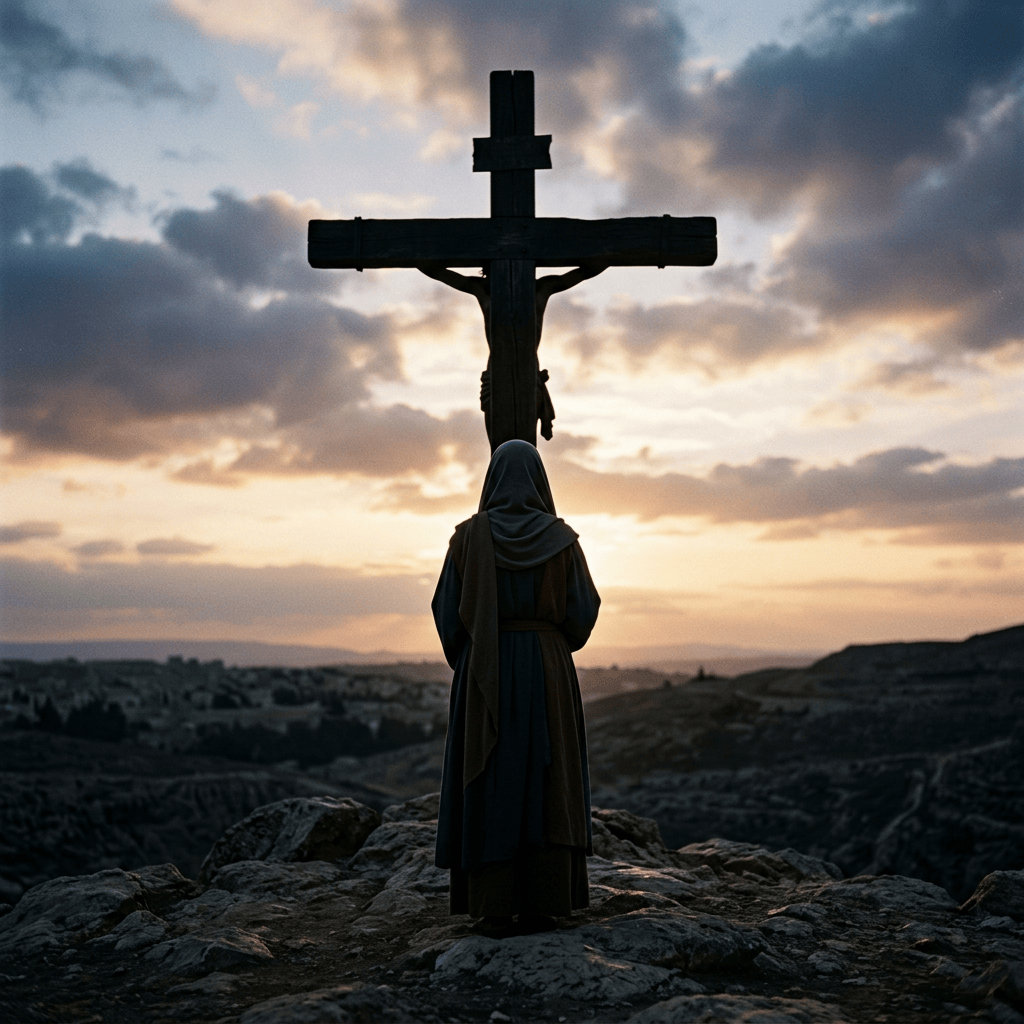
A robed figure standing beneath a wooden cross at sunset

Memorial of Our Lady of Sorrows

First Reading: 1 Corinthians 12:12-14, 27-31a

Responsorial Psalm: Psalm 100:1b-2, 3, 4, 5

Gospel: John 19:25-27

Daily readings: https://bible.usccb.org/bible/readings/091526.cfm

Standing by the cross of Jesus were his mother, his mother’s sister, Mary the wife of Clopas, and Mary Magdalene. That single word — standing — carries everything. Others fled. Others watched from a distance. Others could not bear to be close. Mary stood. She did not look away. She could not fix anything, could not stop what was happening, could not reach her son. She stood and watched and stayed. When Jesus saw her and the beloved disciple beside her, he gave them to each other: Woman, behold your son. Behold your mother. And from that hour the disciple took her into his home.

Simeon had seen this coming. At the Presentation in the Temple, when Jesus was forty days old, he blessed Mary and said: a sword will pierce your own soul. Today is the fulfillment of that sword. The Church calls her Our Lady of Sorrows and has counted seven — from Simeon’s prophecy to the burial of her son. What she carried was not a series of events but one continuous act of faithful presence through suffering she could not prevent and did not fully understand. She did not know, standing at the cross, what Sunday would bring. She stood anyway.

This is the gift she offers the rest of us who are Christ’s body: the witness that it is possible to stay. Most of us know a version of this — someone we love going through something we cannot take from them, a grief we cannot resolve, a situation where showing up is all we have. The temptation is to manage our distance, to stay helpful and in control rather than simply present. Mary’s answer is to stand. To stay in the room. To receive what is given even when what is given is a sword.

A few questions to sit with today:

1. Is there someone in my life who is suffering right now — and have I been showing up for them, or managing my distance? What would it look like to stand closer?

2. Mary could not fix what was happening to her son. Is there something in my life that I am trying to control or resolve instead of simply being present to? Can I name it and bring it to her?

3. The beloved disciple took Mary into his home from that hour. Who has become family to me through shared suffering — someone who walked through something hard with me or I with them?

4. Mary’s faithfulness was not dramatic. It was quiet and costly and unseen. Is there a quiet, costly act of love I am being asked to do right now that no one will notice?

One small thing for tomorrow:

Tomorrow, if you know someone who is carrying something heavy, do not try to fix it. Just reach out — a text, a call, a note. Let them know you are standing nearby. That is Mary’s way.

Lord Jesus, your mother stood at the foot of the cross when everything in her must have wanted to run. Give me something of her courage — the courage to stay present to suffering I cannot fix, to show up even when showing up is all I have to offer. When I am the one who is suffering, may I know that she is standing near me still, and that you placed her there. Hold me in the body you are building, where we carry one another. Amen.

If you would like to share: is there someone you have been wanting to reach out to — someone carrying a cross — that today’s feast is calling you to stand a little closer to?

Understanding the Feast of the Exaltation of the Holy Cross

Weathered wooden cross overlooking desert mountains at sunset

Feast of the Exaltation of the Holy Cross

First Reading: Numbers 21:4b-9

Responsorial Psalm: Psalm 78:1bc-2, 34-35, 36-37, 38

Second Reading: Philippians 2:6-11

Gospel: John 3:13-17

Daily readings: https://bible.usccb.org/bible/readings/091426.cfm

The people in the desert have had enough. They complain: why did you bring us from Egypt to die here? We are disgusted with this wretched food. The wretched food is manna — bread from heaven, a daily miracle. They have been living inside a gift so long they cannot see it. God sends serpents. People die. They repent. And then God’s answer is strange: he does not take the serpents away. He tells Moses to make a bronze serpent and mount it on a pole. Whoever looks at it will live. The very thing that is killing them becomes, when they turn toward it, the source of their healing.

Jesus tells Nicodemus: just as Moses lifted up the serpent in the desert, so must the Son of Man be lifted up — so that everyone who believes in him may have eternal life. The cross is the same logic. The instrument of death, the thing that was supposed to be the end, becomes the source of life for everyone who turns toward it and looks. Paul fills in the shape of it: he emptied himself, took the form of a slave, humbled himself, became obedient to death — even death on a cross. He went all the way down. And because of this, God exalted him above every name. The descent is not the defeat. The cross is not the failure. It is the place where love goes all the way.

And then the verse everyone knows: God so loved the world that he gave his only Son, so that everyone who believes in him might not perish but have eternal life. God did not send his Son to condemn the world, but that the world might be saved through him. The cross is not guilt or punishment. It is what love looks like when it refuses to stop.

A few questions to sit with today:

1. The people in the desert complained about the manna — bread from heaven — because they were worn out by the journey. Is there a gift in my life right now that I have stopped being able to see because I am tired? What would it look like to look at it again?

2. The bronze serpent: God told them to look at the very thing that was hurting them. Is there a wound, a failure, a cross in my own life that I have been avoiding looking at? Can I bring it to Jesus today and ask him to be present in it?

3. He emptied himself and did not grasp. Is there something I am holding too tightly right now — a need for control, for comfort, for being right — that I could open my hands and release?

4. God did not send his Son to condemn the world. Is there a way I have been carrying a sense of condemnation — from God, from others, from myself — that this feast is inviting me to put down?

One small thing for tomorrow:

Sometime tomorrow, make the sign of the cross slowly and intentionally. Let it be a prayer: Lord, you went all the way down. You did not stop. I belong to you — in life and in death and in everything in between.

Lord Jesus, today the Church lifts up the cross. Not as a punishment but as the place where love went furthest. Help me to look at it honestly — at what it cost you, and at what it means for me. Take whatever I am carrying that I have tried to carry alone and let it be placed there with you. You did not come to condemn me. You came to save me. That is the love I want to live inside. Amen.

If you would like to share: is there a cross in your life right now that you are ready to bring to Jesus — to look at together rather than carry alone?

Seventy-Seven Times: Lessons on Mercy

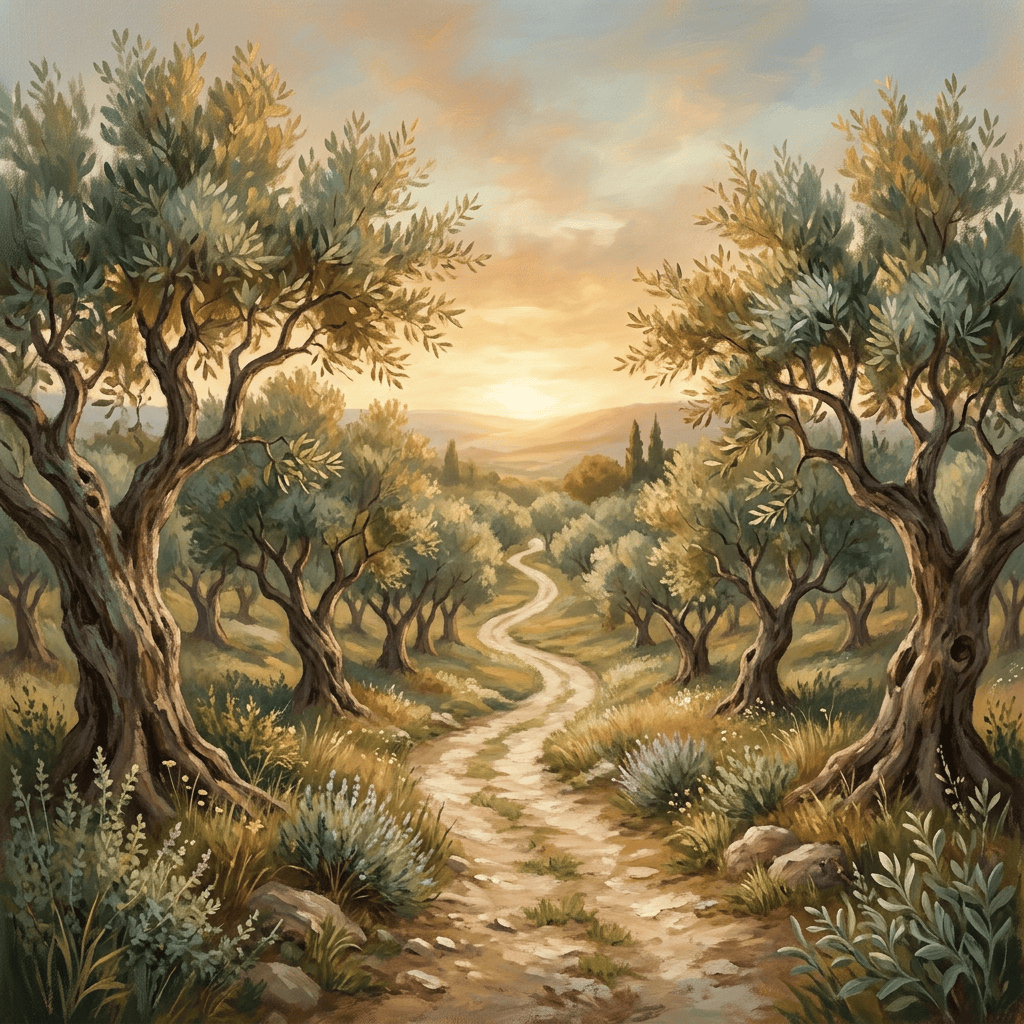
Winding path through an olive grove at sunset

Twenty-fourth Sunday in Ordinary Time

First Reading: Sirach 27:30—28:7

Responsorial Psalm: Psalm 103:1-2, 3-4, 9-10, 11-12

Second Reading: Romans 14:7-9

Gospel: Matthew 18:21-35

Daily readings: https://bible.usccb.org/bible/readings/091326.cfm

Peter thinks he is being generous. How often must I forgive my brother — seven times? Jesus says: not seven times, but seventy-seven times. Then the parable. A king settles accounts and a servant is brought before him who owes a debt so enormous it could never be repaid in a lifetime. The servant falls down and begs for patience. The king, moved with compassion, forgives the entire debt. That same servant immediately finds a fellow servant who owes him a much smaller amount — a real debt, but nothing like what was just forgiven. He seizes him by the throat. When the fellow servant begs for the same patience, he refuses and has him thrown in prison. The other servants are disturbed. The king calls him wicked: I forgave you everything because you begged me to. Should you not have had pity on your fellow servant as I had pity on you?

The parable’s logic is simple and devastating. The first debt is unpayable — it represents everything we owe God, every failure, every wound we have caused, every time we fell short of who we were made to be. It was forgiven. Not because we earned it. Because the king was moved with compassion. The second debt is real, but it is small by comparison. The servant who cannot pass on what was given to him freely has not actually understood what happened to him. He received mercy and walked away still calculating. That is the contradiction Jesus is naming.

Sirach says it plainly: could anyone nourish anger against another and expect healing from the Lord? Wrath and anger are hateful things, yet the sinner hugs them tight. The psalm describes God as slow to anger and rich in compassion — he does not deal with us according to our sins. That is what we have received. And Paul says: none of us lives for oneself. We belong to the Lord, and so does the person we are struggling to forgive. We are not each other’s final judges.

A few questions to sit with today:

1. Is there someone I have been finding it hard to forgive — not just in words, but from the heart, as Jesus puts it? What does the size of their debt look like compared to what God has already forgiven in me?

2. Sirach says the sinner hugs wrath tight. Is there an anger or resentment I have been holding onto that I have told myself I am justified in keeping? What has it cost me?

3. Jesus says: forgive your brother from your heart. What is the difference between saying the words and doing this from the heart? Where am I in that process?

4. Paul writes that we belong to the Lord — in life and in death. Can I hold the person who hurt me in that same belonging, even if I cannot yet feel warmth toward them?

One small thing for tomorrow:

Tomorrow, name the debt — the thing that was done to you that you are still carrying. Then name the debt that was forgiven you. You do not have to feel the forgiveness yet. Just hold both debts in view at the same time. That is the beginning.

Lord Jesus, you told Peter not seven times but seventy-seven times. I am not there yet. There are people and hurts I am still holding at arm’s length, debts I have calculated and not released. Remind me of what I owed and what was forgiven. Help me to receive your mercy fully enough that it can move through me toward someone else. I cannot do this from my own resources. I need you to do it in me. Forgive me as I try, slowly, to forgive. Amen.

If you would like to share: is there a hurt you are carrying that you are ready to begin laying down — not alone, but with Jesus?

Understanding Luke’s Beatitudes Through Peter Claver’s Life

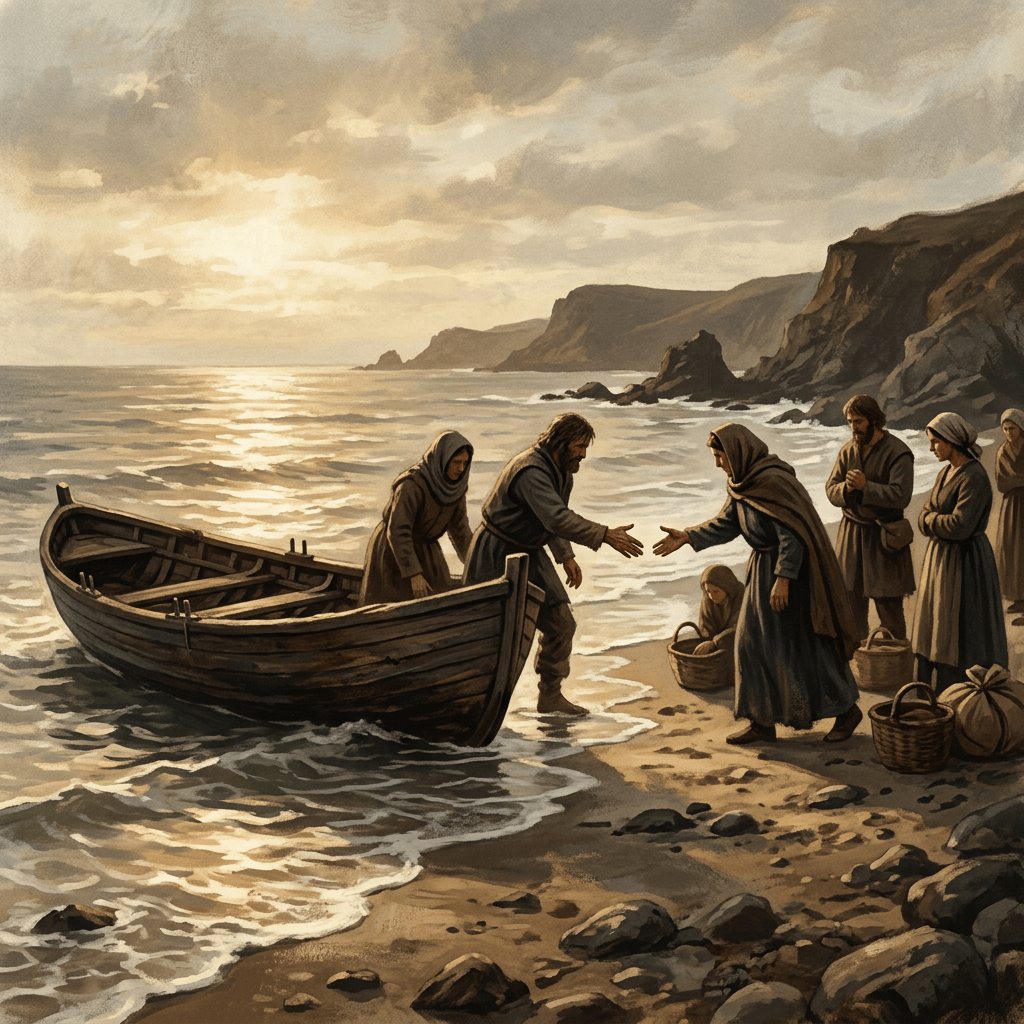
Travelers welcome a man arriving by boat on a rocky shore

Memorial of Saint Peter Claver, Priest

First Reading: 1 Corinthians 7:25-31

Responsorial Psalm: Psalm 45:11-12, 14-15, 16-17

Gospel: Luke 6:20-26

Daily readings: https://bible.usccb.org/bible/readings/090926.cfm

Luke’s Beatitudes are shorter and sharper than Matthew’s. Jesus looks at his disciples and says: blessed are you who are poor — the kingdom of God is yours. Blessed are you who are hungry — you will be satisfied. Blessed are you who weep — you will laugh. Blessed are you when people hate you, exclude you, insult you, and denounce you on account of the Son of Man. Rejoice and leap for joy on that day. Then he turns it over: woe to you who are rich — you have received your consolation already. Woe to you who are filled now. Woe to you when all speak well of you.

That last one is the one worth sitting with. Woe to you when all speak well of you — for their ancestors treated the false prophets in this way. The person who never makes anyone uncomfortable, who has no enemies, who never says anything that costs them — that is not a safe place to be, by Jesus’s measure. The kingdom inverts what looks like security.

Today the Church remembers Peter Claver, a Spanish Jesuit who arrived in Cartagena, Colombia in 1610 and spent forty years boarding slave ships. Cartagena received ten thousand enslaved Africans every year. Claver went into the holds — described by those who saw them as horrifying beyond words — and brought food, medicine, and whatever he could beg. He said: we must speak to them with our hands before we speak to them with our lips. He signed his Jesuit vows: slave of the Africans forever. He baptized an estimated three hundred thousand people. He stayed in the slaves’ quarters rather than the plantation owners’ homes. He lived exactly the Beatitudes he had read: blessed are the poor, blessed are the weeping, blessed are the excluded — and he went to find them.

Paul writes: the world in its present form is passing away. Hold everything lightly. What Cartagena’s society thought was permanent was passing. What Claver was doing was lasting.

A few questions to sit with tonight:

1. Jesus says woe to those when all speak well of them. Is there something true I have held back from saying — at work, at home, in a conversation — because I did not want to lose someone’s good opinion?

2. Peter Claver said: we must speak with our hands before we speak with our lips. Is there someone in my life right now who needs my hands — my presence, my practical help — more than they need my words?

3. The Beatitudes say the poor, the hungry, and the weeping are blessed — not because suffering is good, but because the kingdom belongs to them. Do I actually believe that? How does it show up in how I spend my time and attention?

4. Paul says the world in its present form is passing away — hold lightly what you are holding. What am I gripping too tightly right now that I could loosen my hold on today?

One small thing for tomorrow:

Tomorrow, find one person who is having a hard time — someone weeping, struggling, excluded — and do one thing with your hands. Bring them something. Sit with them. Show up. Let your hands speak first.

Lord Jesus, you said the kingdom belongs to the poor, the hungry, the weeping, the excluded. Peter Claver believed you and spent his life proving it. Help me to believe it too — not just as a doctrine but as something that changes where I go and what I do with my hands. Free me from the need to be spoken well of by everyone. Loosen my grip on what is passing so I can hold more tightly to what lasts. Amen.

If you would like to share: is there someone in your life right now whose burden you could help carry — even in a small way?

Celebrating Mary’s Birthday: A Reflection on Faith

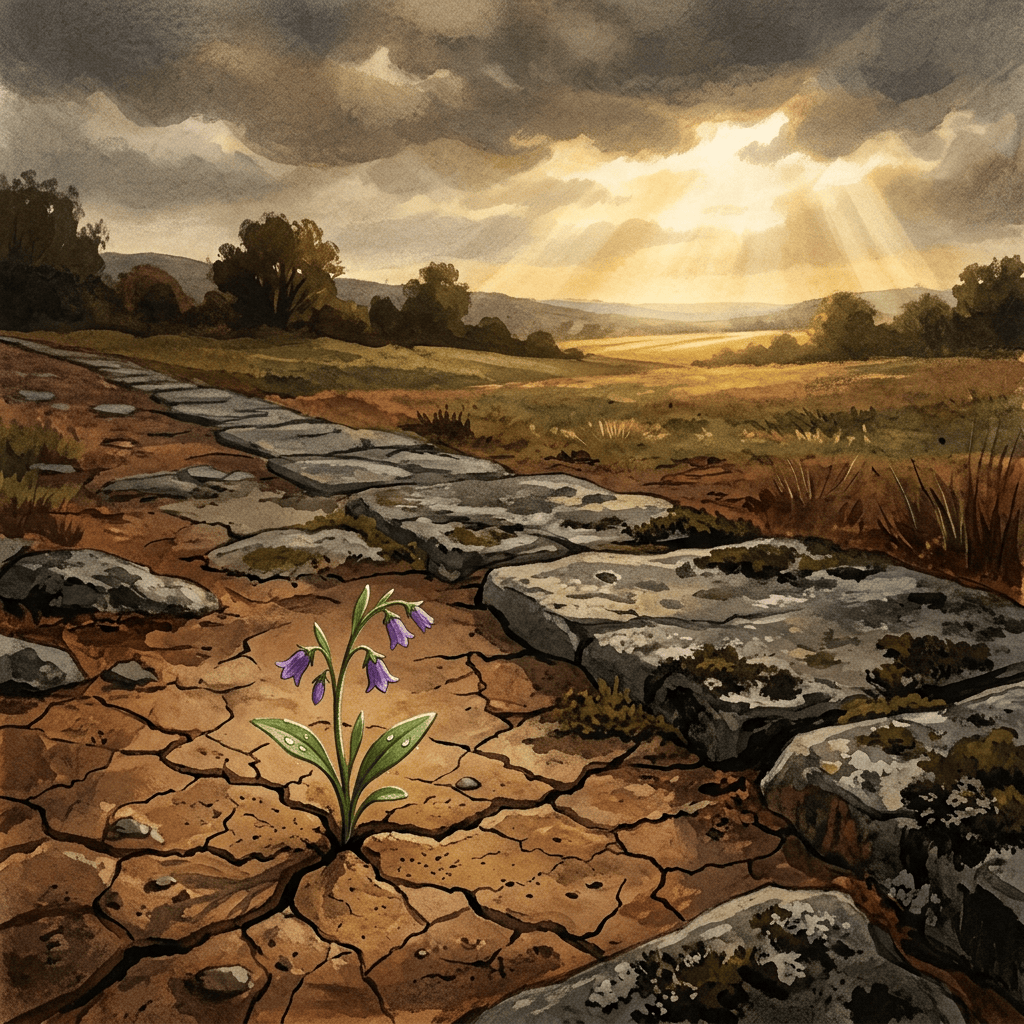
Purple wildflower growing through cracked earth beside a stone path

Feast of the Nativity of the Blessed Virgin Mary

First Reading: Micah 5:1-4a (or Romans 8:28-30)

Responsorial Psalm: Psalm 13:6ab, 6c

Gospel: Matthew 1:1-16, 18-23

Daily readings: https://bible.usccb.org/bible/readings/090826.cfm

Today the Church celebrates Mary’s birthday. Not the Annunciation, not the Assumption — her actual birth, the day a child was born into a family in first-century Palestine who had no idea what her life would hold. The Gospel for her feast is the genealogy — forty-two generations, a long list of names, most of them forgotten. But woven into that list are five women: Tamar, Rahab, Ruth, Bathsheba, and Mary. Tamar widowed and overlooked. Rahab a Canaanite outsider. Ruth a foreigner. Bathsheba named only as “the wife of Uriah.” Each of them unexpected in this lineage. Each of them part of God’s patient, winding work.

Mary comes at the end of all of it. She is the culmination of a long story she did not choose — families and failures and exiles and returns, generation after generation. And when the angel comes, she says yes. Not because she has a clear view of how it will all unfold. Because she trusts the one who asks. Micah says it plainly: from Bethlehem, too small to be among the clans of Judah, shall come the one who is to be ruler in Israel. God works through what looks too small. God works through the unexpected, the overlooked, the ones who were not supposed to be in the story at all.

Paul writes: all things work for good for those who love God. We often read that as comfort in hard times — and it is. But on Mary’s birthday it reads differently: God was working through all of it, through every name in that long list, through the complicated people and the flawed choices and the unexpected inclusions, to bring us to this moment. Mary’s yes was made possible by a thousand hidden yeses before her. And the life of faith we are living now is part of something longer than we can see.

A few questions to sit with today:

1. The genealogy includes people we would not have chosen — outsiders, failures, the complicated. When I look at my own family history, where do I see God’s patient work in people and stories I might have overlooked?

2. Mary said yes without a clear picture of what it would cost. Is there something God has been asking of me that I have been waiting to understand fully before I answer?

3. Micah says God works through what is too small to matter by human measure. What in my life feels too small or too ordinary to be significant? Can I trust that God is working there?

4. Paul says we are predestined to be conformed to the image of his Son. Not to be perfect, but to take the shape of Jesus in our particular life. What would it look like for me to take that shape a little more fully this week?

One small thing for tomorrow:

Tomorrow, say a simple Happy Birthday to Mary — just a brief prayer, a Hail Mary, a word of thanks that she said yes. Then ask her to pray for you to say your own yes to whatever God is asking today.

Lord Jesus, you were born of Mary, who was born into an ordinary family in an ordinary place at an ordinary time. Everything about your coming was unexpected. Thank you for working through the small and the overlooked, through the complicated history of families, through the ones no one expected to be in the story. Help me to trust, as Mary trusted, that you know what you are doing even when I cannot see the end of it. May her yes give me courage for my own. Amen.

If you would like to share: where in your own family history do you see God’s patient, unexpected work?

Navigating Difficult Conversations: Sunday Reflections

Wooden footbridge crossing a stream on a countryside trail at sunset

Twenty-third Sunday in Ordinary Time

First Reading: Ezekiel 33:7-9

Responsorial Psalm: Psalm 95:1-2, 6-7, 8-9

Second Reading: Romans 13:8-10

Gospel: Matthew 18:15-20

Daily readings: https://bible.usccb.org/bible/readings/090626.cfm

Jesus gives his disciples a very specific instruction today, and it is one of the most practically difficult things he ever says. If your brother sins against you, go and tell him his fault between you and him alone. Not to a friend first. Not in a group chat. Not by quietly pulling away. Directly, privately, just the two of you. If he listens, you have won over your brother. That is the goal — not to be right, not to punish, not to feel justified. To win back the relationship.

Most of us do not do it this way. We vent to someone who is not the person. We rehearse the conversation in our heads but never have it. We let the distance grow until the relationship has quietly ended, and we tell ourselves it was not worth saving. Ezekiel gets a harder version of the same call: God appoints him as a watchman, and says if you see something and do not speak, I hold you responsible. To love someone sometimes means saying the hard thing, directly, with care. The watchman who stays silent is not being kind — he is abandoning his post.

Paul wraps it up simply: owe nothing to anyone except to love one another. Love does no evil to the neighbor. The fraternal correction Jesus describes is love in action — the kind that cares too much to let things fester, too much to give up on the person. And then he ends with something that quietly shifts the whole weight of the passage: where two or three are gathered in my name, there am I in the midst of them. The hard conversation, entered in his name, is not something we do alone.

A few questions to sit with today:

1. Is there someone in my life — a family member, a friend, a coworker — with whom I have a real grievance that I have been carrying to everyone except them? What is keeping me from the direct conversation?

2. If I am honest, am I more interested in being right about what happened, or in winning back the relationship? Those are not always the same goal.

3. Ezekiel is told: if you warn them and they do not listen, that is on them. Have I avoided a hard conversation because I am afraid it will not go well? Can I trust God with the outcome and still make the approach?

4. The Psalm says: if today you hear his voice, harden not your hearts. Is my heart hardened toward someone right now — someone I have already written off rather than approached?

One small thing for tomorrow:

Think of one relationship where something has gone unsaid. Tomorrow, do not have the whole conversation — just decide whether you are willing to have it. Ask Jesus to be in the middle of it if you do. That is enough for one day.

Lord Jesus, you said: where two or three are gathered in my name, there am I in the midst of them. I want to believe that includes the conversations I have been avoiding. Give me the courage to go directly to the person rather than around them. Help me to want the relationship more than I want to be right. And when I am the one who has caused the hurt, help me to be the kind of person who can hear a hard word without shutting down. You are the one who makes reconciliation possible. I cannot do it without you. Amen.

If you would like to share: is there a conversation you have been putting off that today’s Gospel is bringing to mind?

Finding Joy in Faith: Balancing Old Habits and New Experiences

Hand pouring red wine from a ceramic pitcher into a glass

Friday of the Twenty-second Week in Ordinary Time

First Reading: 1 Corinthians 4:1-5

Responsorial Psalm: Psalm 37:3-4, 5-6, 27-28, 39-40

Gospel: Luke 5:33-39

Daily readings: https://bible.usccb.org/bible/readings/090426.cfm

The Pharisees come to Jesus with a comparison: John’s disciples fast, our disciples fast — yours eat and drink. They are not wrong about the facts. They are just confused about what they are watching. Jesus answers with an image: you do not fast at a wedding. The bridegroom is right here. This is not the season for mourning. Then he gives two short parables — new cloth on an old cloak ruins both, new wine in old wineskins bursts both. And then a quiet, almost rueful line: no one who has been drinking old wine desires new. He says, the old is good.

That last line is worth sitting with. The old is good. It is not that the old wine is bad. It is that a taste for the old can make us slow to recognize something new being poured. It happens in prayer — a practice that fed us for years goes quiet, and instead of noticing, we keep going through the motions because the form still feels familiar. It happens in how we see people we love — relating to who they were five years ago rather than who they are becoming. It happens in our image of God — we hold an old picture that no longer quite fits, but we say, the old is good, and we do not let it stretch.

Paul writes: I do not even pass judgment on myself. I am not conscious of anything against me, but I do not thereby stand acquitted — the one who judges me is the Lord. He will bring to light what is hidden in darkness and will manifest the motives of our hearts. This is the freedom of a steward: your job is to be trustworthy, not to audit yourself constantly. Stop trying to be both the servant and the judge. Do the work. Trust God with what only he can see.

A few questions to sit with tonight:

1. Is there a spiritual habit or practice in my life that has gone a little flat — that I keep up out of familiarity rather than nourishment? What would it look like to bring that honestly to Jesus instead of just continuing it?

2. Jesus says the wedding guests do not fast while the bridegroom is with them. Do I experience my faith mostly as obligation and discipline, or do I sometimes feel the joy of the feast? When did I last feel that?

3. The old wine feels fine — that is exactly the problem. Is there an area of my life where comfort might be keeping me from something new God wants to do?

4. Paul says: I do not judge myself, and the Lord will bring to light the motives of my heart. Is there a way I am constantly auditing my own worthiness — and could I lay that burden down today?

One small thing for tomorrow:

Tomorrow, if you catch yourself rehearsing an old habit or a familiar worry, pause and ask: is this old wine that has gone flat, or is this something worth keeping? Just notice. You do not have to change anything — just be honest about whether it still holds what it was meant to hold.

Lord Jesus, you said new wine belongs in fresh wineskins. Show me where I am holding on to old containers — old habits, old images of you, old ways of moving through the day — that cannot hold what you are trying to pour. I do not want to miss you because I am comfortable with what I already know. Free me from the need to judge myself and be judged by others. You are the one who sees the hidden motives, and you are also the one who pours out mercy. I trust you with both. Amen.

If you would like to share: is there a spiritual habit or practice that has felt a little flat lately — something you are ready to bring honestly to God?

Healing and Service: Lessons from Simon’s Mother-in-Law

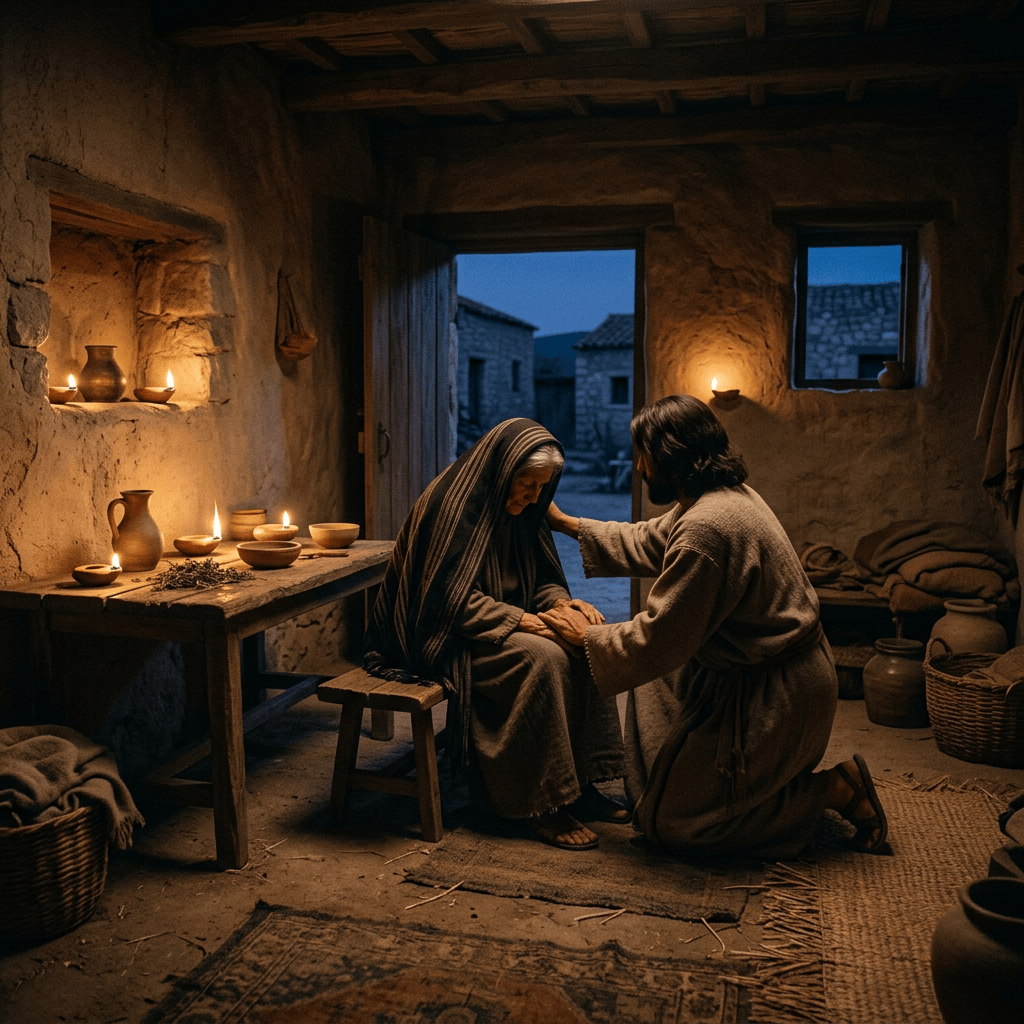
Man kneeling beside and comforting an elderly woman in a candlelit rustic room

Wednesday of the Twenty-second Week in Ordinary Time

First Reading: 1 Corinthians 3:1-9

Responsorial Psalm: Psalm 33:12-13, 14-15, 20-21

Gospel: Luke 4:38-44

Daily readings: https://bible.usccb.org/bible/readings/090226.cfm

After the synagogue, Jesus goes to Simon’s house. Simon’s mother-in-law is sick with a high fever. They ask Jesus to help her. He stands over her, rebukes the fever, and it leaves. She immediately gets up and serves them. There is something quietly beautiful about that sequence — received healing, then immediately given back in service. No long recovery period, no announcement, no testimony. She just gets up and serves.

That evening the whole city comes. Everyone who is sick is brought to him. He lays his hands on every one of them and heals them. Demons come out crying his name. He silences them. And then — before dawn the next morning — he slips away to a solitary place. When the crowd finds him and tries to keep him, he says: I must preach the good news to other cities also. For this reason I have been sent. He does not belong to Capernaum. He does not belong to the crowd’s need for him to stay. He belongs to the mission, and the mission moves.

Paul writes to the Corinthians about a similar impulse — the human tendency to claim ownership of the thing God is doing. I belong to Paul. I belong to Apollos. Paul says: what is Apollos? What is Paul? Ministers through whom you believed. I planted, Apollos watered, but God caused the growth. Neither the one who plants nor the one who waters is anything — only God, who causes the growth. We are God’s co-workers; you are God’s field. The growth is not ours to control. We do our part — we plant, we water, we get up and serve after we have been healed — and then we let God be the one who makes things grow.

A few questions to sit with tonight:

1. Simon’s mother-in-law received healing and immediately served. Is there a grace I have received — a healing, a gift, a second chance — that I have been holding onto instead of turning outward in service?

2. The crowd tried to hold Jesus in place. Is there a way I have been trying to keep God contained — in one format, one practice, one community — rather than following where he is moving?

3. Paul says jealousy and rivalry are signs of spiritual immaturity, of still being fed milk. Is there a rivalry or comparison — with someone at work, in my community, even in my faith — that is keeping me from growing up?

4. Jesus withdrew to a solitary place before dawn. Is there enough silence in my days for me to hear what he might be saying about where I need to go next?

One small thing for tomorrow:

Tomorrow, after you receive something good — a kind word, a moment of grace, a prayer that lands — let it move you outward. Do something for someone else before the day is over, even something small. That is Simon’s mother-in-law’s way.

Lord Jesus, you healed her and she got up and served. You are always moving — to the next house, the next city, the next person who needs you. Help me not to cling to where you were yesterday but to follow where you are going today. Teach me the difference between the part I am called to do and the part that belongs to you alone — the planting and watering that are mine, and the growing that is yours. Keep me from jealousy and rivalry that would keep me small. Lead me to the solitary place when I need it, and back into service when the time comes. Amen.

If you would like to share: is there a moment when you received something from God and found yourself wanting to give it back to someone else right away?