Understanding the Message of Saint James: A Reflection on Fragility

Older man dressed as a pilgrim walking barefoot on a sandy beach at sunrise holding a wooden staff and gourds
Feast of Saint James, Apostle
Son of Zebedee — First Apostle Martyred — Patron of Pilgrims

First Reading: 2 Corinthians 4:7-15
Responsorial Psalm: Psalm 126:1bc-2ab, 2cd-3, 4-5, 6
Gospel: Matthew 20:20-28
Daily readings: https://bible.usccb.org/bible/readings/072526.cfm

Paul says something that deserves to land slowly this Saturday morning: we hold this treasure in earthen vessels, that the surpassing power may be of God and not from us. The treasure is the Gospel, the life of Jesus, the light of the glory of God. The vessel is you and me — cracked, fragile, ordinary clay. And Paul is not apologizing for that. He is pointing to it as the point. If the vessel were impressive, you would look at the vessel. Because the vessel is ordinary and broken and still somehow carrying extraordinary life, you look at what is inside.

He goes on: afflicted in every way, but not constrained. Perplexed, but not driven to despair. Persecuted, but not abandoned. Struck down, but not destroyed. Four blows. Four survivals. Death is at work in us — but life in you. The carrying of the dying of Jesus in a fragile body is not failure. It is the method. The life of Jesus is made visible precisely in the places where human strength runs out.

Then James and his mother come to Jesus with a request: seats at the right and left in the Kingdom. It is a very human moment — ambition dressed up in devotion, the desire to be near Jesus tangled up with the desire to be above everyone else. And Jesus does not shame them. He asks one question: can you drink the chalice I am going to drink? They say yes — confidently, quickly — without knowing what they are agreeing to. Jesus receives it: yes, you will drink my chalice. James was the first apostle to be martyred, beheaded by Herod Agrippa around the year 44. He drank it. The chalice he said yes to without fully understanding became the thing that made him a saint.


A few questions to sit with today:

1. Paul says we are earthen vessels — fragile, cracked, ordinary. Is there a place in my life where I have been ashamed of my weakness or brokenness, rather than trusting that the treasure can shine through it?

2. "Afflicted, but not constrained. Perplexed, but not driven to despair." Which of those pairs most describes something I am living through right now? Can I hold both halves of it today?

3. James said yes to the chalice before he understood what it meant. Is there something God has been asking of me — a direction, a sacrifice, a commitment — where I have been waiting to understand it fully before I say yes?

4. The psalm says those who sow in tears shall reap rejoicing. Is there a place in my life where I am sowing in tears right now? Have I held onto the second half of that promise?


One small thing for tomorrow, Sunday:

At Mass tomorrow, when you receive the Eucharist — the treasure in the earthen vessel — pause for just one moment before you return to your seat and say quietly: this is what I am carrying. This life. This light. In this ordinary body. Let that be enough.


Lord Jesus, you asked James if he could drink your chalice — and he said yes before he understood it. I want that kind of yes, but I confess I usually want to understand first. Help me to trust that you are asking me nothing you have not already carried yourself. You hold the treasure. I am the cracked clay pot. Make me willing to be used that way — not impressive, just willing. And when death is at work in me in the small ways, the quiet ways, the ways that go unseen, let life be at work in someone else because of it. May James, who drank the chalice and is now rejoicing, pray for all of us who are still sowing in tears. Amen.


If you'd like to share: which of Paul's four pairs feels most true for you right now — afflicted but not constrained, perplexed but not despairing, persecuted but not abandoned, struck down but not destroyed?

Saint Sharbel Makhluf: Embracing Silence and Spiritual Depth

Silhouette of person overlooking valley with sunbeams through clouds
Friday of the Sixteenth Week in Ordinary Time
Optional Memorial of Saint Sharbel Makhluf, Priest
Patron Saint of Lebanon — Hermit, Wonder-Worker

First Reading: Jeremiah 3:14-17
Responsorial Psalm: Jeremiah 31:10, 11-12abcd, 13
Gospel: Matthew 13:18-23
Daily readings: https://bible.usccb.org/bible/readings/072426.cfm

God speaks through Jeremiah to scattered, rebellious children: Return. I am your master. I will take you one from a city, two from a clan, and bring you to Zion. I will give you shepherds after my own heart. And in those days — in the fully restored time — they will no longer need the ark of the covenant as a symbol, because Jerusalem itself will be the LORD's throne. All nations will gather. They will walk no longer in the hardness of their hearts.

It is a vision of return and restoration — not for the impressive, not for the already-faithful, but for the rebellious ones who have wandered. One from a city. Two from a clan. Not a crowd. Not the whole institution. A few, gathered in, given shepherds, brought home.

Then Jesus explains the parable of the sower from the inside. The seed that falls on the path — the word enters but the Evil One steals it before it can take root. The rocky ground — joy at first, but no depth; when tribulation comes, it falls away immediately. The thorns — the word gets in, but worldly anxiety and the lure of riches choke it before it bears fruit. And then the rich soil: the one who hears the word and understands it, who bears fruit a hundredfold. The difference between the four soils is not intelligence or talent. It is depth, rootedness, and what is allowed to crowd out the word.

Saint Sharbel Makhluf spent the last twenty-three years of his life in a Lebanese hermitage on a hill above the monastery, in near-total silence. He ate almost nothing. He slept on a rough mat with a wooden log for a pillow. He said: "The things that go on within you are more important than those that take place in your life." And: "A man who prays lives out the mystery of existence. A man who does not pray scarcely exists." He became rich soil by removing everything that could crowd out the word. After his death, his body was found incorrupt, exuding oil and blood. Twelve thousand documented miracles were attributed to him within two years. The seed bore fruit a hundredfold. He is the parable, lived.


A few questions to sit with today:

1. Which soil do I most recognize in myself this week — the path, the rocky ground, the thorns, or the rich soil? Has anything changed since last Sunday when we first heard this parable?

2. What are the thorns in my life right now — the worldly anxieties or lures that are actively crowding out the word? Am I being honest about what they are?

3. Sharbel said: "The things that go on within you are more important than those that take place in your life." Do I believe that? Does my daily schedule reflect it?

4. God says: Return. I will gather you, one from a city, two from a clan. Do I feel gathered in — held, brought home — or do I feel scattered? Have I told him that honestly?


One small thing for tomorrow:

Find five minutes of genuine silence this weekend — no phone, no background noise, no podcast. Just sit. Sharbel spent twenty-three years in silence. You are not asked for twenty-three years. Just five minutes. Let the word have a little more room.


Lord Jesus, you explain the parable clearly and I still recognize myself in the wrong soils more often than I want to. The thorns are real — the anxiety, the noise, the lure of things that crowd out what you are trying to grow in me. Help me to pull something out today. One thorn. Make a little more room. And thank you for Sharbel — for a man who took the parable so seriously that he stripped away everything that was not you, and bore fruit that is still multiplying more than a century after his death. Let his prayer be mine: may the things that go on within me be more important than the things that take place around me. May Mary, who made herself entirely rich soil, pray for all of us who are still being weeded. Amen.


If you'd like to share: what is one thorn — one thing that has been crowding out the word in your life lately — that you sense God is inviting you to let go of?

Finding the Fountain: Lessons from Saint Bridget

Open Bible on green cloth with wooden cross and lit candle on altar
Thursday of the Sixteenth Week in Ordinary Time
Optional Memorial of Saint Bridget of Sweden, Religious
Patron of Europe — Widow, Mystic, Foundress

First Reading: Jeremiah 2:1-3, 7-8, 12-13
Responsorial Psalm: Psalm 36:6-7ab, 8-9, 10-11
Gospel: Matthew 13:10-17
Daily readings: https://bible.usccb.org/bible/readings/072326.cfm

God speaks to his people through Jeremiah like a spouse remembering the beginning of a marriage. I remember the devotion of your youth, how you loved me as a bride, how you followed me in the wilderness, in a land not sown. There was a time when you walked with me through the desert and it was enough. And then — you entered the good land, ate its fruits, and forgot where the water came from. My people have done two evils: they have forsaken me, the fountain of living water, and dug for themselves cracked cisterns that hold no water.

That image is worth sitting with on a Thursday morning. A cracked cistern looks like a solution. You dig it yourself, you fill it yourself, you manage it yourself. But it leaks. And no matter how diligently you maintain it, it cannot hold what only the fountain gives freely. The things we go to instead of God — the busyness, the screens, the approval, the plans we grip too tightly — are not evil in themselves. They are cracked. They cannot hold what we are actually thirsty for.

Then Jesus explains why he speaks in parables. To those who have been given to see, more will be given. To those who have closed themselves off, even what they have will slip away. Gross is the heart of this people — they have shut their eyes, stopped their ears, because if they saw and heard, they would have to turn, and be healed. And then the gift in the middle of that hard word: "But blessed are your eyes, because they see, and your ears, because they hear. Many prophets and righteous people longed to see what you see and did not see it." The seeing is a gift. The open heart is already a grace.

Saint Bridget of Sweden knew both. She was a Swedish princess, wife, mother of eight children — an ordinary layperson by the world's measure. After her husband died, she gave herself entirely to God. She received mystical visions of the Passion so vivid they marked her physically. And she prayed with the simplicity of someone who had found the fountain and drunk from it: "O Lord, say to my soul that nothing happens without You permitting it, and that nothing You permit is without comfort." That is a prayer from someone who has stopped drinking from cracked cisterns.


A few questions to sit with today:

1. What are the cracked cisterns in my life right now — the things I keep going back to that look like they will satisfy but keep leaking? Am I being honest about what they are?

2. "I remember the devotion of your youth." Is there a way I followed God more simply and freely at an earlier point in my life that I have drifted from? What happened?

3. Jesus says blessed are your eyes, because they see. Do I treat the gift of faith — of actually believing, of actually seeing — as the extraordinary privilege it is? Or have I gotten used to it?

4. Bridget prayed: "Nothing You permit is without comfort." Is there something hard in my life right now that I have not yet brought to that kind of trust? What would it take?


One small thing for tomorrow:

Identify one cracked cistern — one thing you keep reaching for that doesn't actually satisfy — and tomorrow, when you reach for it, pause and say: "Lord, you are the fountain. What I am looking for is you." That is the whole practice.


Lord Jesus, Jeremiah says you are the fountain of living water, and I know that is true — and I also know how often I walk past the fountain to dig at something I built myself. Forgive me for the cracked cisterns. Help me to remember the devotion of my youth, the simpler trust, the following you through the wilderness when it was enough just to be near you. And help me to see — to have the open eyes and ears that receive what you are giving, rather than the closed ones that miss it. May Bridget's prayer be mine: nothing happens without you permitting it, and nothing you permit is without comfort. May Mary, who followed you from Nazareth to Calvary without a cracked cistern in sight, pray for me when I forget where the water comes from. Amen.


If you'd like to share: what is one cracked cistern you keep returning to — and what do you think you are actually thirsting for underneath it?

Mary Magdalene: Apostle to the Apostles

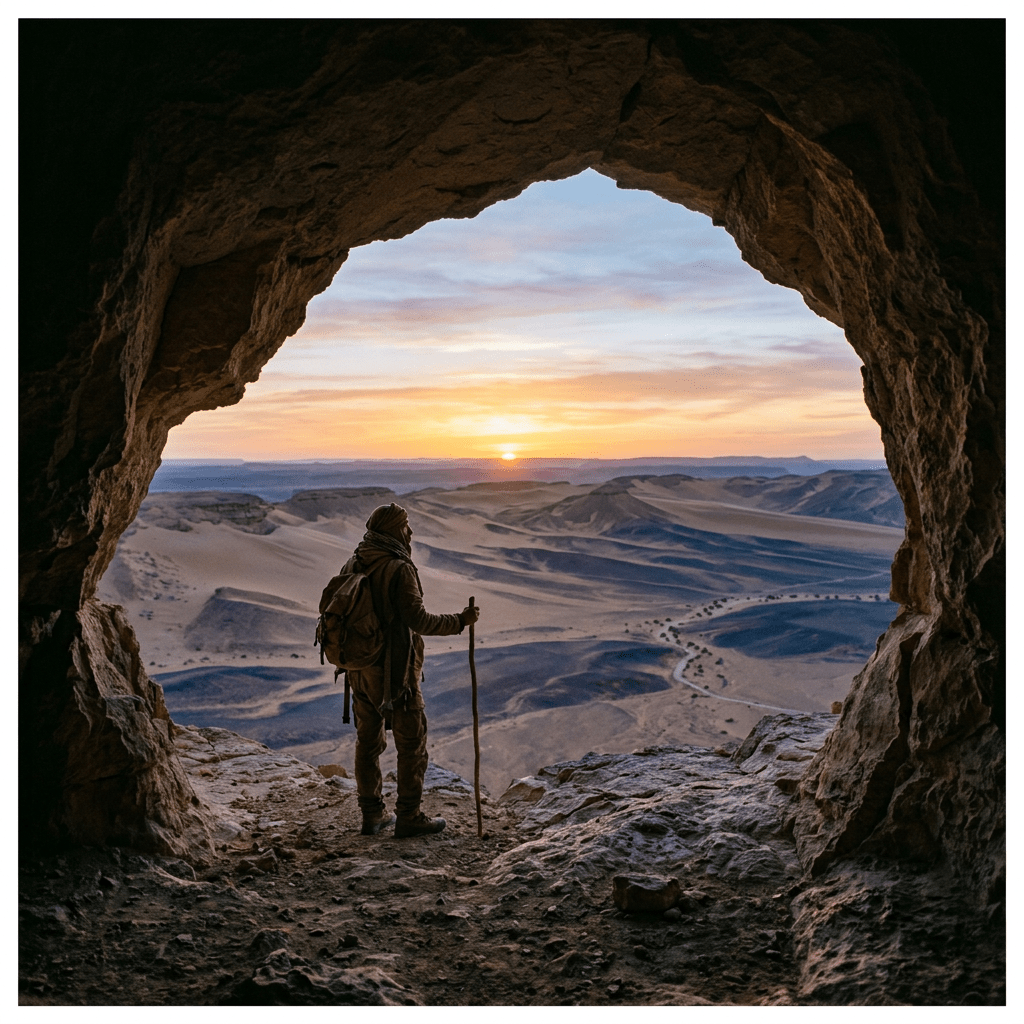
Person wearing a cloak standing in a cave doorway looking at sunset over desert landscape
Feast of Saint Mary Magdalene
Apostle to the Apostles — First Witness of the Resurrection

First Reading: Song of Songs 3:1-4b
Responsorial Psalm: Psalm 63:2, 3-4, 5-6, 8-9
Gospel: John 20:1-2, 11-18
Daily readings: https://bible.usccb.org/bible/readings/072226.cfm

The Song of Songs opens with a woman searching. On my bed at night I sought him whom my heart loves. I sought him, but I did not find him. I will rise and go about the city, in the streets and crossings. I will seek him whom my heart loves. I sought him, but I did not find him. The watchmen found me — have you seen him whom my heart loves? I had hardly left them when I found him whom my heart loves. The whole arc of it — the seeking, the not-finding, the darkness, the questions to strangers, and then suddenly, without drama: I found him — is the arc of Mary Magdalene's morning at the tomb.

She came while it was still dark. She saw the stone moved and ran to tell the others. She came back, stayed outside weeping, bent over into the empty tomb. Angels ask her: woman, why are you weeping? She says the same thing twice, to the angels and to the man she thinks is the gardener: they have taken my Lord, and I do not know where they have put him. She is not looking for proof of the resurrection. She is looking for him. She wants to know where he is so she can go there and be with him.

And then he says one word: Mary. That is all. Just her name. And she knows. She turns and says: Rabbouni. Teacher. Jesus elevated Mary Magdalene to Feast — from the Memorial she had been for centuries — because Pope Francis wanted to honor her as the Apostle to the Apostles, the first to hear the resurrection and be sent to announce it. But what makes her great is not the title. It is what she did in the dark, while the other disciples had gone home: she stayed. She kept looking. She would not leave without him.


A few questions to sit with today:

1. Mary did not know what she was looking for — she just knew she wanted to find him. Is there a place in my prayer life where I am still searching in the dark, not yet finding, but willing to keep looking? Am I still showing up?

2. Jesus says her name and she knows him immediately. When was the last time I felt personally known by God — not as a member of a group, but by name? What was that like?

3. Mary's love was not afraid of the dark tomb, the emptiness, or the not-knowing. Where in my life am I avoiding a dark or empty place instead of staying and searching?

4. She was sent to announce what she had seen. Is there something God has shown me — a consolation, an experience of his presence, a moment of grace — that I have been keeping to myself instead of sharing?


One small thing for tomorrow:

Say your own name quietly in prayer tomorrow and let God say it back. You do not have to feel anything. Just offer him the moment: "Here I am. I am the one looking for you." Then listen. Mary heard one word. You may not hear anything — but you will have stayed.


Lord Jesus, Mary would not leave the tomb empty-handed. She stayed in the dark and kept asking strangers if they had seen you. And you said her name, and that was enough. Say my name today. Help me to recognize you when you speak — in the people around me, in the Scripture, in the quiet moment I almost skipped. Give me Mary Magdalene's courage to stay in the hard, uncertain, dark places and not give up looking for you. And when I find you — help me to announce it, the way she did, without needing it to be impressive or tidy. I have seen the Lord. May Mary Magdalene, apostle to the apostles, pray for all of us who are still searching in the dark. Amen.


If you'd like to share: is there a place in your life right now where you are searching and not yet finding — and are you still willing to keep looking?

Embracing God’s Mercy: Cast Your Sins Into the Sea

Winding dirt path surrounded by trees and grasses at sunrise with soft mist
Tuesday of the Sixteenth Week in Ordinary Time
Optional Memorial of Saint Lawrence of Brindisi, Priest and Doctor of the Church

First Reading: Micah 7:14-15, 18-20
Responsorial Psalm: Psalm 85:2-4, 5-6, 7-8
Gospel: Matthew 12:46-50
Daily readings: https://bible.usccb.org/bible/readings/072126.cfm

Micah ends his book the way Isaiah ended his — not with warning, but with praise. And the praise is for something specific: God's willingness to remove guilt. Who is there like you, the God who removes guilt and pardons sin for the remnant of his inheritance? Who does not persist in anger forever, but delights rather in clemency? You will cast into the depths of the sea all our sins. Not set them aside. Not file them away for later. Cast them into the depths of the sea.

There is a phrase worth sitting with this Tuesday morning: God delights in clemency. Not tolerates it. Not manages it. Delights. Showing mercy is not a reluctant concession — it is the thing that gives him pleasure. And the image of our sins being thrown into the bottom of the ocean is one of the most complete pictures of forgiveness in all of Scripture. Not buried somewhere you might dig back up. Into the sea. Gone.

Then Jesus extends family. His mother and brothers are outside, asking to speak with him. Someone interrupts to tell him. And Jesus stretches out his hand toward the crowd of ordinary people around him — not relatives, not the religiously credentialed, just people who have been listening — and says: here are my mother and my brothers. Whoever does the will of my heavenly Father is my brother, and sister, and mother. The family of God is not defined by bloodline or pedigree. It is defined by orientation — by the direction you are pointed and the one you are trying to follow. And the door into it is open, right now, to whoever will walk through.


A few questions to sit with today:

1. God casts our sins into the depths of the sea. Is there a sin — something old, something I have confessed, something I thought I was past — that I keep pulling back up from the bottom? What would it mean to actually let it stay there?

2. God delights in clemency. Do I extend that same delight to others — am I someone who enjoys showing mercy, or does it feel more like a difficult obligation?

3. Jesus says whoever does the will of the Father is family. Do I actually live with that sense of belonging — that I am a member of something much larger and more permanent than my household or my parish? Or does it remain an idea I believe without feeling?

4. Micah asks God to shepherd his people, to show them wonderful signs as in the days of old. Is there something I have stopped expecting from God — a kind of faith or hope I have quietly set aside as naive — that I might be invited to pick back up?


One small thing for tomorrow:

Sometime tomorrow, bring one specific sin or failure to God — something you have been carrying with some guilt — and say plainly: you promised to cast this into the sea. I am letting go of it now. Then try, for the rest of the day, not to fish it back out.


Lord Jesus, Micah says God delights in clemency. I want to believe that all the way down — not just as a doctrine, but as something I feel when I come to you. You have cast my sins into the sea. Help me to stop wading in after them. And thank you for calling me family — for stretching out your hand toward ordinary, distracted, imperfect people and saying: here are my brothers and sisters. I want to live like I belong to something that large and that permanent. Help me to do the will of the Father today, in the small ways that are in front of me. May Mary, your mother and ours, pray for all of us who are trying to find our way into the family. Amen.


If you'd like to share: is there something you have been pulling back up from the sea — a guilt you keep returning to — and what would it take to let it stay at the bottom?

Reflections on Micah: Walking Humbly with God

Interior of a Gothic church with wooden pews, stone arches, and colorful stained glass windows casting light patterns on the floor.
Monday of the Sixteenth Week in Ordinary Time
Optional Memorial of Saint Apollinaris, Bishop and Martyr

First Reading: Micah 6:1-4, 6-8
Responsorial Psalm: Psalm 50:5-6, 8-9, 16bc-17, 21, 23
Gospel: Matthew 12:38-42
Daily readings: https://bible.usccb.org/bible/readings/072026.cfm

God takes his people to court — and the charge is not that they have stopped performing their religion. The charge is that they have missed the point of it entirely. Micah imagines the mountains and hills as witnesses. O my people, what have I done to you? How have I wearied you? Answer me. It is the voice of a parent, bewildered and grieving, asking the child who has wandered: what went wrong between us?

And then the people's response — which Micah dramatizes as a desperate negotiation. Shall I come with burnt offerings? Thousands of rams? Rivers of oil? My firstborn child? The escalation is almost frantic, as if the answer must be something enormous, something dramatic, something that proves how serious they are. And then God's answer, which is so simple it almost goes past us: you have been told what is good. Only to do right. To love goodness. To walk humbly with your God. Three things. Not a temple program. Not a performance. A direction of life.

Then Jesus speaks to the scribes and Pharisees who are asking for a sign. Give us something to see. Give us proof. And Jesus names what they cannot seem to do: the men of Nineveh repented at the preaching of Jonah — a foreign city, a reluctant prophet, a three-day warning — and they turned. The queen of the south traveled to the ends of the earth to hear Solomon's wisdom. And something greater than Jonah is here. Something greater than Solomon is here. The sign they are demanding is standing in front of them. They are looking past it, looking for a spectacle, looking for something other than the ordinary man speaking ordinary words who is, in fact, everything they are waiting for.


A few questions to sit with today:

1. Micah asks: O my people, what have I done to you, how have I wearied you? If I am honest, is there a way my faith has become burdensome — something I perform or manage rather than a relationship I walk in? What happened?

2. "Only to do the right, to love goodness, and to walk humbly with your God." Of these three, which one am I most neglecting right now? Not the dramatic version — the daily, ordinary version?

3. The Pharisees had Jesus in front of them and kept looking for something else. Is there a way I am doing the same — waiting for a sign, a feeling, a confirmation — while missing what is already present and given?

4. The Ninevites repented at Jonah's preaching. Jonah was not impressive — he was reluctant, resentful, and barely faithful. But they heard the word and turned. Am I hearing what I have been given and actually turning toward it?


One small thing for tomorrow:

Take Micah's three things and apply just one of them to your Tuesday: do one right thing you have been putting off, love goodness in one concrete act, or walk more humbly in one conversation where you usually need to be right. Pick one. Just one. That is enough.


Lord Jesus, you are something greater than Jonah, something greater than Solomon, and I confess that I sometimes pass right by you looking for something more impressive. Forgive me for the times I have turned your friendship into a performance, when you have only ever asked me to do right, love goodness, and walk humbly with you. Help me to hear the word I have already been given and actually turn toward it — simply, today, without waiting for a sign. May Mary, who recognized you in the ordinary and said yes without needing more proof, pray for me when I am tempted to keep looking past what is already here. Amen.


If you'd like to share: of Micah's three — doing right, loving goodness, walking humbly — which one feels most alive in your life right now, and which one feels most distant?

Quiet Growth: Parables of Patience and Faith

Shepherd walking on a path with a dog herding a large flock of sheep in a grassy field
Sixteenth Sunday in Ordinary Time

First Reading: Wisdom 12:13, 16-19
Second Reading: Romans 8:26-27
Responsorial Psalm: Psalm 86:5-6, 9-10, 15-16
Gospel: Matthew 13:24-43
Daily readings: https://bible.usccb.org/bible/readings/071926.cfm

The Book of Wisdom opens today with a portrait of God that is worth sitting with slowly. There is no god besides you who has the care of all. Your might is the source of justice. And then the line that reframes everything: you judge with clemency, and with much lenience you govern us. You taught your people, by these deeds, that those who are just must be kind. God's power and God's patience are not in tension — the patience flows from the power. He can afford to wait. He does not need to rush to judgment. And he teaches us, by the way he treats us, how to treat each other.

Paul continues that thought in Romans. The Spirit comes to the aid of our weakness. We do not know how to pray as we ought — and the Spirit himself intercedes with inexpressible groanings. The one who searches hearts knows what the Spirit intends. This is a remarkable thing to hear on a Sunday morning. You do not have to have your prayer together before you come to God. The Spirit is already inside the silence, already groaning with what you cannot find words for, already bringing it before the Father. You just have to show up.

Then Jesus gives three parables in one Gospel. The wheat and weeds — let them grow together, do not rip out the weeds or you will uproot the wheat alongside them. The mustard seed — the smallest of seeds becomes the largest of plants. The yeast — a woman hides a little in the flour and the whole batch rises. All three say the same thing from different angles: the kingdom works quietly, patiently, from within, over time. God is not in a hurry. He lets the field grow. He trusts the yeast. He knows what a mustard seed can become. And he is patient with the weeds — patient with what is mixed and imperfect and still sorting itself out — because he can see the harvest clearly even when we cannot.


A few questions to sit with today:

1. God judges with clemency and much lenience. Do I extend the same to myself — or do I demand a faster, harsher accounting of my own failures than God does?

2. Is there someone in my life I have been impatient with — wanting to pull up the weeds before the harvest — when God's way is to let things grow together and trust the sorting to him?

3. Paul says the Spirit intercedes when we do not know how to pray as we ought. Have I been staying away from prayer because I do not feel ready or articulate? What would it mean to just show up anyway?

4. Where in my life is God working like yeast — quietly, invisibly, slowly transforming something from the inside? Am I noticing it, or have I given up because I cannot see it yet?


One small thing for tomorrow:

Before you open your phone tomorrow morning, sit for two minutes in silence and simply say: "I do not know how to pray as I ought — but the Spirit does. Come." That is enough. Let the Spirit do the groaning. You just have to be there.


Lord Jesus, you are patient with the field. You see the weeds and the wheat growing together — in the world, in your Church, in me — and you do not pull everything up in frustration. You wait. You trust the harvest. Teach me that patience, especially with myself and the people I love most. And on the mornings when I do not know how to pray, when the words do not come and the silence feels empty, remind me that your Spirit is already there, already interceding, already bringing what I cannot say before the Father. I just have to show up. May Mary, who trusted your slow, hidden work from Nazareth to Calvary, pray for me when the harvest feels far away. Amen.


If you'd like to share: where do you sense God working slowly and quietly in your life right now — something that has not bloomed yet but feels like it might be growing?

Daily Reflections: Healing the Bruised and Smoldering

Swirling streams of green and gold light with sparkling particles
Saturday of the Fifteenth Week in Ordinary Time
Optional Memorial of Saint Camillus de Lellis, Priest
Patron of the Sick, Nurses, and Hospitals

First Reading: Micah 2:1-5
Responsorial Psalm: Psalm 10:1-2, 3-4, 7-8, 14
Gospel: Matthew 12:14-21
Daily readings: https://bible.usccb.org/bible/readings/071826.cfm

Micah opens with a woe against those who lie awake at night planning how to take what belongs to others. They covet fields and seize them. They cheat owners of their houses. When morning comes and the power is theirs, they act. It is not a portrait of violent criminals — it is a portrait of the quiet, calculated accumulation of those who have enough and keep taking more anyway. The psalm continues the thought: do not forget the poor, O Lord. The wicked man boasts that God will not avenge it. He lurks where the unfortunate cannot see him. The poor are caught. The fatherless have no helper.

Then comes the Gospel — and Jesus, who has heard the Pharisees plotting to kill him, quietly withdraws. Not in defeat. He goes on healing. He heals them all, Matthew says. But he warns them not to announce it. No fanfare. No triumph. No street-level performance of power. And then Matthew reaches for the servant song from Isaiah: he will not contend or cry out, no one will hear his voice in the streets. A bruised reed he will not break. A smoldering wick he will not quench.

That phrase is worth sitting with this Saturday morning. A bruised reed — still technically a reed, still shaped right, but damaged, bent, barely functional. Jesus will not break it. A smoldering wick — still technically burning, but just barely, more smoke than flame. He will not put it out. He comes toward the ones who are almost done and does not finish them off. He comes toward the bent and the barely-burning and he heals them.

Saint Camillus de Lellis was both the bruised reed and the one who refused to break others. He was a soldier, a gambler, twice rejected from religious life because of an incurable wound on his leg. He lost everything — his money, his weapons, his shirt — gambling. He found himself destitute and took a laboring job at a Capuchin friary, where a sermon broke him open. His conversion did not make life easy. His leg never healed. He suffered for forty-six years with that wound. But he devoted himself entirely to the sick, and when a cross in his chapel seemed to speak to him — "Why are you afraid? This is not your work but mine" — he understood. He crawled from bed to bed when he could not walk. His last words: "I rejoice in what has been told me. We shall go into the house of the Lord."


A few questions to sit with today:

1. Is there someone in my life who is a bruised reed right now — barely holding together, bent but not broken — and have I been treating them with the gentleness Jesus shows, or with impatience and frustration?

2. Am I the bruised reed? Is there a part of me that is smoldering, barely burning, and have I let Jesus near that part — or have I been hiding it, managing it, pretending it is fine?

3. Micah and the psalm speak about those who scheme against the vulnerable. Is there a way I have been complicit in systems or habits that ignore the poor — not out of malice, but out of inattention?

4. Camillus heard: "This is not your work but mine." Is there something I am carrying — a burden, a mission, a relationship — where I need to hear the same thing and loosen my grip?


One small thing for tomorrow, Sunday:

At Mass tomorrow, look around. Notice if there is someone who seems to be barely holding on — an elderly person, someone sitting alone, someone who looks worn out. Offer one small act of presence: a smile, a word, holding the door. That is the whole thing. A bruised reed you will not break.


Lord Jesus, you withdrew quietly and went on healing. No fanfare, no announcement — just mercy, moving through the crowds. A bruised reed you will not break. I bring you the bent places in me — the parts that are barely holding, the places where the flame has gotten low. Do not quench what is still smoldering. Tend it. And make me, like Camillus, someone who does not break the bruised reeds around me. Give me his gentleness toward the sick, the struggling, the almost-done. May Mary, who stood beneath your cross without flinching, pray for us who find it hard to stay when things are hard. Amen.


If you'd like to share: is there a bruised reed in your life right now — someone barely holding on — and what is one way you could offer them gentleness this weekend?


The Invitation to Come: Jesus’ Promise of Rest

Interior of a historic stone church with wooden pews, stained glass windows, and an altar
Thursday of the Fifteenth Week in Ordinary Time
Optional Memorial of Our Lady of Mount Carmel

First Reading: Isaiah 26:7-9, 12, 16-19
Responsorial Psalm: Psalm 102:13-14ab and 15, 16-18, 19-21
Gospel: Matthew 11:28-30
Daily readings: https://bible.usccb.org/bible/readings/071626.cfm

Isaiah opens with a soul that is awake in the dark. "My soul yearns for you in the night, yes, my spirit within me keeps vigil for you." This is not poetry about pleasant meditation. It is the prayer of someone who has been pressing and straining and working and still comes up empty. The people have conceived and writhed in pain — and given birth to wind. Salvation we have not achieved for the earth. We tried. We failed. We cannot bring it forth on our own.

And yet: "But your dead shall live, their corpses shall rise; awake and sing, you who lie in the dust. For your dew is a dew of light, and the land of shades gives birth." The resurrection promise lands inside exhaustion. God does not wait for us to have it together before he speaks life. He speaks it precisely into the dust, precisely into the failure, precisely into the night where we have been keeping vigil and coming up empty.

Then Jesus speaks three sentences that the whole Church has been returning to for two thousand years. Come to me, all you who labor and are burdened, and I will give you rest. Not: figure it out and come to me. Not: get your act together and come to me. Come. Now. As you are. The yoke he offers is not no yoke — there is still something to carry. But it is his yoke, shaped for you, and the one carrying it with you is meek and humble of heart.

The Carmelite tradition, whose feast of Our Lady of Mount Carmel we honor today, has lived inside that invitation for centuries. Mary is their model — not Mary the warrior or the strategist, but Mary who sat at the foot of the Lord and received. Who kept all things and pondered them in her heart. The Carmelites built a spirituality on that: contemplative rest in God, letting him do what we cannot do ourselves, keeping vigil in love rather than in anxiety. Isaiah's night-vigil, Jesus's rest — Mary shows us what it looks like to hold both at once.


A few questions to sit with today:

1. What am I laboring under right now — what is the burden I am carrying that I have not yet brought to Jesus? Have I actually come to him with it, or am I still trying to manage it alone?

2. Isaiah says "salvation we have not achieved for the earth, we cannot bring it forth." Is there something in my life I am still trying to bring forth by my own effort, when God is waiting for me to let go of it?

3. My soul yearns for God in the night — but do I know what that yearning feels like in my own life? When did I last feel it? What does it point toward?

4. What would it mean today, practically, to take Jesus's yoke instead of the one I have been carrying — to do the same things but with him, in his way, at his pace?


One small thing for tomorrow:

At some point tomorrow, stop whatever you are doing for two minutes and say these words slowly: "Come to me, all you who labor and are burdened, and I will give you rest." Say them as if Jesus is saying them to you, right now, about the exact thing you are carrying. Then just sit for a moment. You do not have to do anything with it. Just receive it.


Lord Jesus, I am tired in ways I do not always name. The labor is real, and the burden is heavy, and there are nights when my soul keeps vigil and comes up empty. But you say come — not after I have figured it out, not after I am rested enough to pray well, but now. I come. Take this yoke I have been carrying alone and replace it with yours. Teach me to be meek and humble of heart the way you are. And let Mary, who knew how to rest in you, pray for me tonight when the vigil is long and the dew has not yet come. Your dew is a dew of light. I trust that. Amen.


If you'd like to share: what burden have you been carrying that you haven't yet handed to Jesus — and what would it feel like to finally set it down?

The Wisdom of Being Childlike: Reflections on Today’s Readings

Open ancient religious manuscript on wooden desk with candle, bishop's crozier, rope, ink, and quill
Memorial of Saint Bonaventure, Bishop and Doctor of the Church

First Reading: Isaiah 10:5-7, 13b-16
Responsorial Psalm: Psalm 94:5-6, 7-8, 9-10, 14-15
Gospel: Matthew 11:25-27
Daily readings: https://bible.usccb.org/bible/readings/071526.cfm

Isaiah gives us a portrait of a man at the height of his power. Assyria has conquered nations, seized treasures, moved the boundaries of peoples. And the king's explanation is simple: by my own power I have done it. By my wisdom, for I am shrewd. Nobody fluttered a wing, nobody opened a mouth. I took all the earth. It reads like a performance review where everything is five stars and the only name in the document is your own.

Then Isaiah asks the question that punctures the whole thing: will the axe boast against him who hews with it? Will the saw exalt itself above him who wields it? The Assyrian king is an instrument — powerful, yes, but an instrument. The glory he is claiming belongs to someone else. And the cost of missing that is not just theological. It is the kindling of fire where his glory used to be.

Then Jesus prays — and what he praises God for is remarkable. Not for revealing these things to the powerful, the successful, the wise and learned. For hiding them from the wise and revealing them to the childlike. The word is nepioi — infants, little ones, those with no credentials. The things of God are not unlocked by intelligence or achievement or the right kind of resume. They are received. Given. The childlike do not grab them — they are handed to them, because their hands are open.

Saint Bonaventure was one of the greatest minds of the medieval Church — theologian, philosopher, Minister General of the Franciscans, Cardinal. He could have worn his learning like armor. Instead, he wrote: "The beginning of wisdom is to know yourself as you truly are before God." When the pope sent messengers to tell him he had been made a cardinal, they found him washing dishes at the friary. He asked them to hang the cardinal's hat on a nearby tree and come back when he was finished. The greatest scholar of his age met the Gospel of the childlike and took it seriously.


A few questions to sit with today:

1. Where in my life am I most tempted to say, even quietly, "by my own power I have done it"? Is there a success, a skill, a way I present myself that I have stopped referring back to God?

2. Am I approaching God with open hands — ready to receive — or with my credentials and achievements already listed, trying to earn my way into the conversation?

3. What would it look like for me to be more childlike in my prayer today — less polished, less managed, more simply present and open?

4. Is there someone in my life I have underestimated spiritually because they are not educated or accomplished? Have I missed something God was revealing through them?


One small thing for tomorrow:

When you sit down to pray tomorrow, resist the urge to make it impressive — no long petitions, no careful vocabulary. Just say something simple and true, the way a child would. "I don't know what I'm doing. I need you." Three sentences is enough. Let your hands be open.


Lord Jesus, you praised your Father for hiding these things from the wise and learned and revealing them to the childlike. I want to be among the childlike — but I know how often I approach you with my hands full of my own competence, my own plans, my own explanations. Empty my hands today. Let me come to you the way Bonaventure came back to his dishes — not impressed with himself, just faithful to the small thing in front of him. You have been handed all things by the Father. I do not need to hold anything back from you. Receive what I bring, and give me what I cannot earn. May Mary, the most childlike of all the disciples, teach me how to say yes with open hands. Amen.


If you'd like to share: where do you find it hardest to come to God with open hands — and what are you usually holding onto instead?